1. Game Background
1.1 World Setting
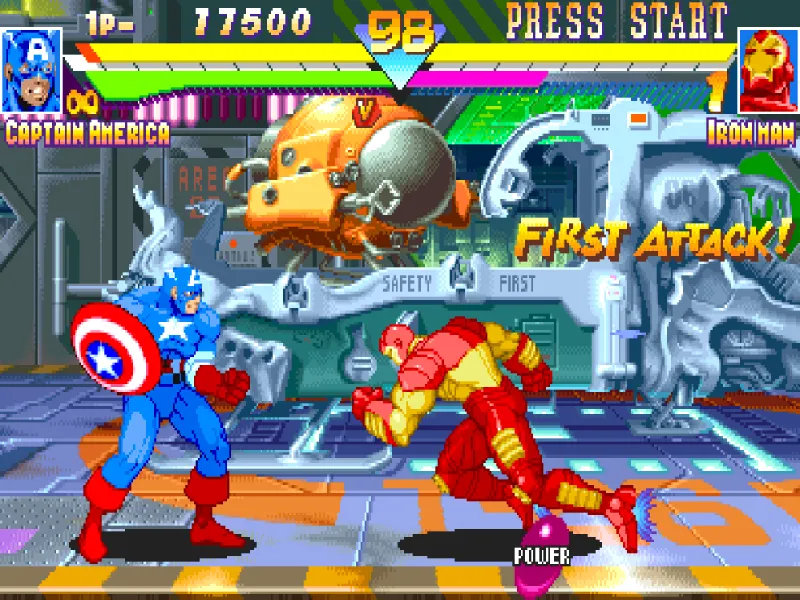
The title Marvel vs. Capcom: Clash of Super Heroes says it all—this game pits Marvel Comics' greatest heroes against Capcom's legendary roster in a single arena. The story is simple: a powerful entity known as "Onslaught" threatens the balance of both universes, forcing the Marvel and Capcom camps to unite. In practice, the plot is just a backdrop—the real draw is the chaotic spectacle of Ryu hitting Spider-Man with a Hadouken or Mega Man blasting Iron Man with his cannon.
In the history of "crossover" fighting games, this title was the first to truly place two complete IP rosters on equal footing. Unlike its predecessors, X-Men vs. Street Fighter and Marvel Super Heroes vs. Street Fighter, which were limited to Street Fighter and X-Men/Marvel characters, this game expanded the scope to include Capcom's entire library—including Mega Man, Darkstalkers, and Strider. Each character features meticulously designed cross-dimensional dialogue and interactions, a level of "clash of the titans" charm that remains unmatched to this day.
1.2 Development History
MvC was released by Capcom in 1998 on the CPS2 arcade board. It built upon the technical foundation of Capcom's previous Marvel-licensed fighters—from X-Men: Children of the Atom to Marvel Super Heroes, and the subsequent Vs. titles. Each game refined the mechanics, culminating in the massive crossover scale seen here. The game features 15 base playable characters (7 Marvel + 8 Capcom) and a unique "Special Partner" system.
This revolutionary "Special Partner" system allows players to select an additional non-playable support character to call into battle for exclusive skills. The partner roster includes about 20 characters, such as Marvel's Jubilee, Thor, Colossus, and Psylocke, and Capcom's Arthur (Ghosts 'n Goblins) and Unknown Soldier. The Hyper Combo system allows for multiple super moves to be unleashed simultaneously, creating a visual revolution of lasers, fire, and explosions that defined the 1998 arcade scene.
2. Character Roster
2.1 Marvel Characters
| Character | Origin | Fighting Style |
|---|---|---|
| Wolverine | X-Men | Speed-based melee; extremely fast claw combos. Strong pressure with Berserker Barrage. High-damage Fatal Claw. |
| Captain America | Avengers | Balanced; shield projectiles provide zoning. Long-range dash with Charging Star. Multi-hit Final Justice. |
| Spider-Man | Amazing Spider-Man | Speed-based; excellent aerial mobility. Web Ball for zoning, high-damage Maximum Spider. |
| Hulk | Incredible Hulk | Power-based; terrifying damage but slowest speed. Gamma Crush has the highest full-screen damage. |
| Venom | Spider-Man | Mid-range zoner; Venom Web projectiles have multiple angles. Versatile Venom Fang combos. |
| War Machine | Iron Man | Ranged pressure; shoulder cannons and missiles provide multi-directional zoning. Proton Cannon is a straight-line full-screen attack. The best ranged character. |
| Storm | X-Men | Aerial specialist; capable of multi-hit attacks in the air. High-damage full-screen Lightning Storm. Hidden character. |
2.2 Capcom Characters
| Character | Origin | Fighting Style |
|---|---|---|
| Ryu | Street Fighter | All-rounder. Complete Hadouken + Shoryuken system. Shin Shoryuken deals massive damage, perfect for combo finishers. |
| Chun-Li | Street Fighter II | Speed-based; many combo starters with Lightning Legs. Kikosho has a massive hit range. |
| Morrigan | Darkstalkers | Strong aerial combat; Soul Fist provides multi-angle zoning. Flashy Darkness Illusion combos. |
| Strider Hiryu | Strider | High-speed; aerial dash and wall-climbing abilities. Ouroboros is unstoppable once activated. |
| Mega Man | Mega Man | Ranged; Mega Buster can be fired while moving. Hyper Mega Man covers the screen with multi-hit projectiles. |
| Zangief | Street Fighter II | Grappler; terrifying damage from Spinning Piledriver. Siberian Blizzard has full-screen hit detection. |
| Captain Commando | Captain Commando | Mid-to-close range; Captain Storm has a massive range. Hidden character. |
| Cammy | Street Fighter | Speed-based melee; Cannon Spike has strong anti-air priority. Hidden character. |
3. Controls
3.1 Basic Controls
| Button | Action |
|---|---|
| Joystick | Move, Block (hold back) |
| Light Punch | Light Attack |
| Medium Punch | Medium Attack |
| Heavy Punch | Heavy Attack |
| Light Kick | Light Kick |
| Medium Kick | Medium Kick |
| Heavy Kick | Heavy Kick |
| LP + MP | Call Special Partner (consumes partner gauge) |
| Two Punches | Hyper Combo (Super Move) |
| Down + Up | Super Jump |
3.2 Core Systems
| System | Description |
|---|---|
| Special Partner | Select a non-playable support character. Call them during battle to perform a unique skill; consumes one partner gauge. Partners are categorized as Attack (Psylocke, Jubilee), Defense (Colossus, Juggernaut), or Support (Arthur, Unknown Soldier). |
| Hyper Combo | Each character has multiple super moves (consumes 1-3 bars). Different supers can be chained in combos. Features "Hyper Combo Cancel"—cancel one super into another before the first ends. |
| Variable Combination | When both partner and super gauges are full, you can unleash both simultaneously for a spectacular visual display. |
| Duo Team Attack | The ultimate dual-attack move. Consumes all resources for massive damage. Best used to secure a kill. |
| Air Combo | Launch the opponent and follow them into the air for pursuit. This system set the standard for the entire MvC series. |
4. Game Modes & Strategies
4.1 Single-Player Guide
| Stage | Opponent | Strategy |
|---|---|---|
| Battles 1-5 | Random | Warm-up phase; AI is conservative. Practice basic air combo routes and partner timing. |
| Battle 6 | Mid-Boss | Usually powerful characters like Bison or Juggernaut. AI is more aggressive and uses Hyper Combos frequently. |
| Final Battle | Onslaught | Two forms. Phase 1: Giant Onslaught (upper body only). Fast projectiles, massive melee range. Phase 2: Energy Sphere. Nearly impossible to block. Use ranged zoning throughout. |
4.2 Competitive Guide
| Strategy | Description |
|---|---|
| Partner Strategy | Attack partners supplement combo damage; Defense partners save you when pressured; Support partners provide unique utility. Beginners: Colossus. Pros: Psylocke. |
| Aerial Dominance | If you aren't following up launches with air combos, you're only using 50% of your potential. Standard route: Ground Heavy > Special > Super Jump > Air Combo > Finisher. |
| Resource Management | Super and Partner gauges are independent. Don't exhaust both at once—keep one in reserve for defensive options. |
| Matchups | Speed types (Spider-Man, Strider, Wolverine) counter Ranged types; Power types (Hulk) counter Speed but are susceptible to zoning. War Machine is the best zoner but weak in close quarters. |
5. Tips & Advanced Tactics
5.1 Survival Tips
- Call Your Partner: Many beginners forget this. Call a defensive partner (like Colossus) when pressured to break the opponent's rhythm.
- Master Air Combos: Start with Wolverine—his aerial hitboxes are generous. Once comfortable, move on to Spider-Man or Strider.
- Confirm Your Hyper Combos: Don't throw them out blindly. Confirm a hit in a combo first; whiffing a super leaves you wide open.
- Venom Web Zoning: Venom's projectiles can be fired at various angles, making them excellent for mid-range control.
- War Machine Pressure: Use shoulder cannons and missiles to lock down the opponent's movement. Keep your distance and force them into your projectiles.
- Strider's Ouroboros: Once activated, this move provides relentless pressure. Use it only when you are certain the opponent cannot escape, as it costs 3 bars.
- Onslaught Tactics: Don't try to show off combos when low on health. Use War Machine or Mega Man to zone him out. Learn the rhythm of his projectiles to dodge effectively.
6. Trivia & Arcade Legends
6.1 A Misunderstood Title
In China, the Marvel vs. Capcom series was collectively known as "Marvel vs. Capcom," but the subtitle "Clash of Super Heroes" was one of the few explicitly displayed on arcade boards. Many players still struggle to distinguish between MvC1, MvSF, and X-Men vs. SF, often referring to it simply as "that game where Marvel fights Street Fighter."
6.2 The Spider-Man Licensing Dilemma
Due to fragmented licensing, this game never received a modern platform port. With film rights split between Fox and Sony at the time, Capcom couldn't easily re-release it. After Marvel Games consolidated rights in 2024, fans finally began hoping for a return of the classic MvC series.
6.3 The Beauty of 15 Characters
Compared to the 56-character roster of Marvel vs. Capcom 2, the 15-character count here feels restrained. However, this allowed the team to hand-draw incredibly rich animation frames—Ryu's Shoryuken has the most frames in the series, and Morrigan's special move animations are still used as GIF assets today.
6.4 The Arcade Culture
While less popular than The King of Fighters in China, this game had a fiercely loyal cult following in major cities. In Guangzhou, some players could clear the game using all 15 characters in a row—a "full roster challenge" considered the ultimate badge of honor.