I. Game Background
1.1 World Setting
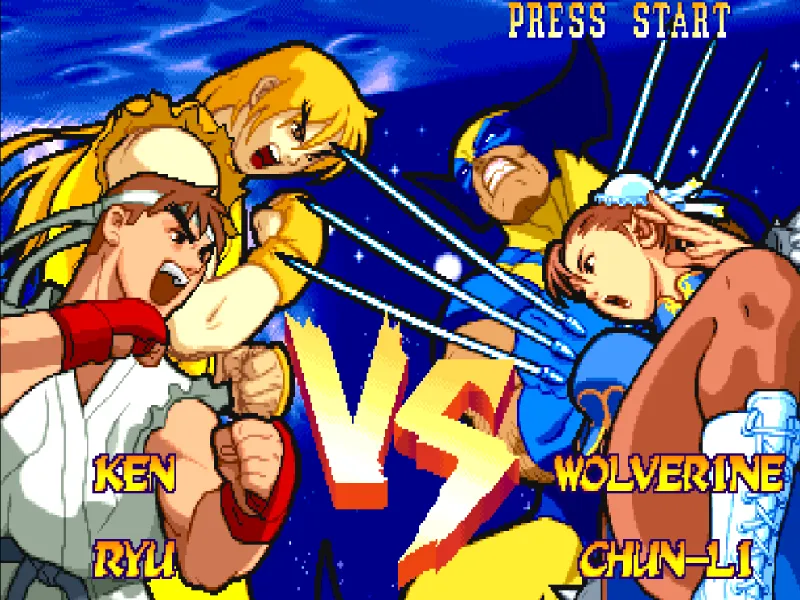
Marvel Super Heroes vs. Street Fighter is a crossover fighting game released by Capcom in 1997 on the CPS2 arcade system, serving as the second installment in the Marvel vs. Capcom series. The story follows the events of X-Men vs. Street Fighter, where the Marvel supervillain "Apocalypse" initiates a new conspiracy. He summons warriors from various eras to battle, seeking the strongest fighters to serve him. Fighters from the Street Fighter universe and superheroes from the Marvel Universe are once again drawn into this interdimensional chaos.
Unlike its predecessor, the Marvel roster is no longer limited to the X-Men series, expanding to include a wider range of heroes—Captain America, Hulk, Blackheart, Juggernaut, and more. Meanwhile, a mysterious black version of Ryu, "Cyber Akuma," appears as a hidden boss. As the ultimate weapon created by Apocalypse through the mechanical modification of Akuma, he is covered in metal armor and replaces his Hadoken with mechanical energy blasts, becoming the game's most iconic original character.
1.2 Development History
Released by Capcom in 1997 on the CPS2 board, Marvel Super Heroes vs. Street Fighter was a pivotal step in Capcom's "VS. Series" of crossover fighters. Building on the revolutionary tag-team system, air combos, and super jumps introduced in X-Men vs. Street Fighter (1996), this title further refined the mechanics. The most significant innovation was the introduction of the "Variable Assist" concept, allowing players to summon teammates for assist attacks during battle—a system that later became the standard for the entire Marvel vs. Capcom series.
In the MvC timeline, this game is often referred to as "MvC 0.5." It sits in the transitional space between X-Men vs. SF and Marvel vs. Capcom, as the Capcom side still consisted only of Street Fighter characters rather than the full Capcom IP roster that followed. However, the refinement of the systems in this title paved the way for the massive success of 1998's Marvel vs. Capcom: Clash of Super Heroes. The game saw great success in arcades across both North America and Japan.
II. Character Roster
2.1 Street Fighter Characters
| Character | Origin | Fighting Style |
|---|---|---|
| Ryu | Street Fighter | All-rounder. Complete Hadoken + Shoryuken system. Shinkuu Hadoken covers the full screen. |
| Ken | Street Fighter | Aggressive. Multi-hit Shoryuken. Shinryuken deals massive damage, perfect for finishing air combos. |
| Chun-Li | Street Fighter II | Speed-based. Many multi-hit combos starting with Hyakuretsukyaku. Kikosho has a massive hit range. |
| Cammy | Super Street Fighter II | Fast melee. Cannon Spike has strong anti-air priority. Spin Drive Smasher is highly efficient for combos. |
| Akuma | Super Street Fighter II Turbo | Boss-tier. Can follow up air combos after a Shun Goku Satsu grab. Strong zoning with air fireballs. |
| Dan | Street Fighter Alpha | Joke character with surprisingly rich combos. Taunts build super meter quickly, offering unique tactical choices. |
| Dhalsim | Street Fighter II | Long-range zoner. Yoga Fire + Yoga Teleport. Has the longest reach in the game. |
| Zangief | Street Fighter II | Grappler. Spinning Piledriver deals terrifying damage. Siberian Blizzard covers the full screen. |
| M. Bison | Street Fighter II | Boss-type. Psycho Power projectiles + throws. Psycho Crusher has long dash distance. |
| Sakura | Street Fighter Alpha 2 | High school fighter. Short-range fireballs but rich combo potential. Extremely popular. |
2.2 Marvel Characters
| Character | Origin | Fighting Style |
|---|---|---|
| Captain America | Avengers | Balanced. Shield projectiles provide zoning. Final Justice is a great multi-hit combo. |
| Spider-Man | Amazing Spider-Man | Speed-based with excellent air mobility. Maximum Spider deals extremely high damage. |
| Wolverine | X-Men | Fast melee. Berserker Barrage provides strong pressure. Fatal Claw deals terrifying damage. |
| Hulk | Incredible Hulk | Power-based. Gamma Crush deals the highest damage in the game, but has the slowest movement speed. |
| Blackheart | Ghost Rider | Mid-range zoner. Multiple dark energy projectile trajectories. Judgment Day is a full-screen super. |
| Storm | X-Men | Air-specialist. Capable of multi-hit air attacks. Lightning Storm deals full-screen damage. |
| Magneto | X-Men | Mid-range zoner. Magnetic projectiles with variable trajectories. Magnetic Tempest covers the screen. |
| Juggernaut | X-Men | Power-based with extreme super armor. Head Crush throw deals massive damage. |
| Rogue | X-Men | Unique. Can absorb opponent's special moves. Kiss of Death deals massive damage. |
III. Controls
3.1 Basic Controls
| Button | Action |
|---|---|
| Joystick | Move, Block (Back) |
| Light Punch | Light Attack |
| Medium Punch | Medium Attack |
| Heavy Punch | Heavy Attack |
| Light Kick | Light Kick |
| Medium Kick | Medium Kick |
| Heavy Kick | Heavy Kick |
| HP + HK | Variable Assist (Call teammate) |
| 2 Punches | Hyper Combo |
| Down + Up | Super Jump |
3.2 Core Systems
| System | Description |
|---|---|
| Variable Assist | The core innovation. Press HP + HK to summon a teammate for an assist attack. Assists vary by character—ground, air, counter, etc. |
| Hyper Combo Gauge | Accumulate meter during battle, up to 3 levels. Spend 1-3 levels to unleash different tiers of Hyper Combos. Can be canceled into from combos. |
| Variable Combination | Ultimate move where both teammates unleash their Hyper Combos simultaneously. Costs double meter but deals massive damage. Covers the entire screen. |
| Air Combo | Launch the opponent and follow up in the air. The air combo system here is more mature than the predecessor—Ground Launch -> Wall Bounce -> Air Pursuit -> Finisher is the standard route. |
| Cross-over Counter | Call a teammate to counter while blocking. Costs one level of super meter. Instantly breaks the opponent's pressure. |
IV. Game Modes and Strategies
4.1 Single-Player Guide
| Stage | Opponent | Strategy |
|---|---|---|
| Rounds 1-4 | Random | Warm-up. AI is conservative; practice air combos and Variable Assist timing. |
| Rounds 5-6 | Mid-Boss | AI becomes aggressive and uses Variable Assist frequently. Focus on blocking and teching throws. |
| Final Boss | Apocalypse | Phase 1 is giant Apocalypse with multi-directional projectiles. Use Super Jumps to evade. |
| True Final Boss | Cyber Akuma | Appears under specific conditions. Mechanically enhanced speed and damage. Shun Goku Satsu range is expanded; air fireball + Shoryuken combo is lethal. |
4.2 Competitive Guide
| Strategy | Description |
|---|---|
| Assist Timing | Don't use assists the moment they cool down. Call them during the opponent's recovery frames to apply "wake-up" pressure. Choose teammates based on synergy. |
| Air Dominance | Players who master air combos have an overwhelming advantage. Ground Heavy > Special > Super Jump > Air Light/Medium/Heavy > Air Special > Finisher is the standard high-damage template. |
| Team Synergy | Classic: Grappler (Zangief/Hulk) + Speedster (Cammy/Spider-Man). Assists cover the grappler's approach weakness. Magneto + Ryu is the most common high-level pairing. |
| Magneto's Pressure | Magneto's projectiles are fast and unpredictable, making him the best mid-range zoner. Combined with assists, he can keep opponents at bay. Widely considered a T0 character. |
V. Tips and Advanced Tactics
5.1 Survival Tips
- Variable Assist is your best friend: Call teammates for rescue when pressured, or to finish combos. It is the deciding factor for survival.
- Super Jump is a strategic escape: Use it to instantly leave dangerous ground zones. You can block or attack in the air to turn the tide.
- Rogue's Move Stealing: Copying the right move is key. Stealing Akuma's air fireball doubles Rogue's zoning power.
- Dan's Taunt Tactic: While a joke character, his taunt builds super meter fast. Use it to bait opponents into attacking, then counter with an air combo.
- Air Combo Basics: Ground Heavy > Special > Cancel into Super Jump > Air Light > Air Medium > Air Heavy > Air Special > Finisher. Practice the cancel timing on the ground first.
- Countering Blackheart's Judgment Day: It deals massive damage but has a long startup. Super Jump or air block the moment the screen darkens—you have about 0.3 seconds.
- Countering Cyber Akuma: He is a melee nightmare. Keep mid-range and use projectiles. Never engage him in close-quarters combat.
VI. Trivia and Arcade Legends
6.1 Cyber Akuma—Capcom's Most Successful "Original Variant Boss"
Cyber Akuma was Capcom's first attempt at "mechanically modifying" an existing character. It was so successful that it was later applied to characters like War Machine in Marvel vs. Capcom. Though not canon, his popularity led to cameos in many future MvC titles.
6.2 "Not MvC, but My VS"
In the MvC timeline, this game is often called "MvC 0.5." It bridges the gap between X-Men vs. SF and Marvel vs. Capcom. Since the Capcom side only featured Street Fighter characters, it felt more like "Marvel vs. SF" than a true "Marvel vs. Capcom," allowing the team to focus on perfecting the core fighting system.
6.3 The Philosophy of "Variable"
Capcom unified these games as the "VS. Series," but the Japanese team used "Variable" as the keyword—Variable Assist, Variable Combination, Variable Cross. This reflects the design philosophy: combat should be a dynamic game that changes at any moment.
6.4 The MvSF Arcade Ecosystem
While not as ubiquitous as King of Fighters, this game had a dedicated following in major cities. Often called "Marvel Street Fighter," it attracted players who were both Street Fighter purists and Marvel fans, usually found in the corners of arcades.