1. Game Background
1.1 World Setting
X-Men: Children of the Atom is a 1994 arcade fighting game developed by Capcom, based on the popular Marvel Comics X-Men series. The game is set during the height of the mutant civil war: Magneto has once again gathered his forces, attempting to prove his philosophy through a mutant fighting tournament—that only the strong should lead the future of mutantkind. Participants include both the heroic X-Men and the villainous warriors under Magneto's command.
The game unfolds in a tournament format. Players choose a mutant character and face off against other contestants one by one. Each character has a unique backstory and motivation for entering. Cyclops fights to rescue his kidnapped X-Men teammates, Storm fights to uphold the dignity of mutants, while villains like Silver Samurai and Spiral have their own ulterior motives. Ultimately, players must face the mastermind himself—Magneto—and prove that the X-Men's ideals are worth defending.
1.2 Development History
X-Men: Children of the Atom holds a landmark position in gaming history—it was the first Marvel fighting game produced by Capcom and the direct ancestor of the world-famous "Marvel vs. Capcom" series. Led by legendary producer Noritaka Funamizu, the development team utilized Capcom's then-state-of-the-art CPS2 arcade hardware—the same platform as Super Street Fighter II Turbo—ensuring top-tier graphics, frame rates, and sound effects.
This title not only shared the hardware foundation of the Street Fighter series but also took a revolutionary step in fighting game design. The team introduced then-cutting-edge mechanics: super jumps, air combos, ground-to-air chain attacks, and a super combo gauge system. These systems later became the standard for almost all anime/Marvel fighting games. The character sprites featured Capcom's signature detailed pixel animation, with each mutant boasting smooth frame counts and flashy special move effects. It is no exaggeration to say that without Children of the Atom, there would be no Marvel Super Heroes, X-Men vs. Street Fighter, or the entire Marvel vs. Capcom series.
2. Character Roster
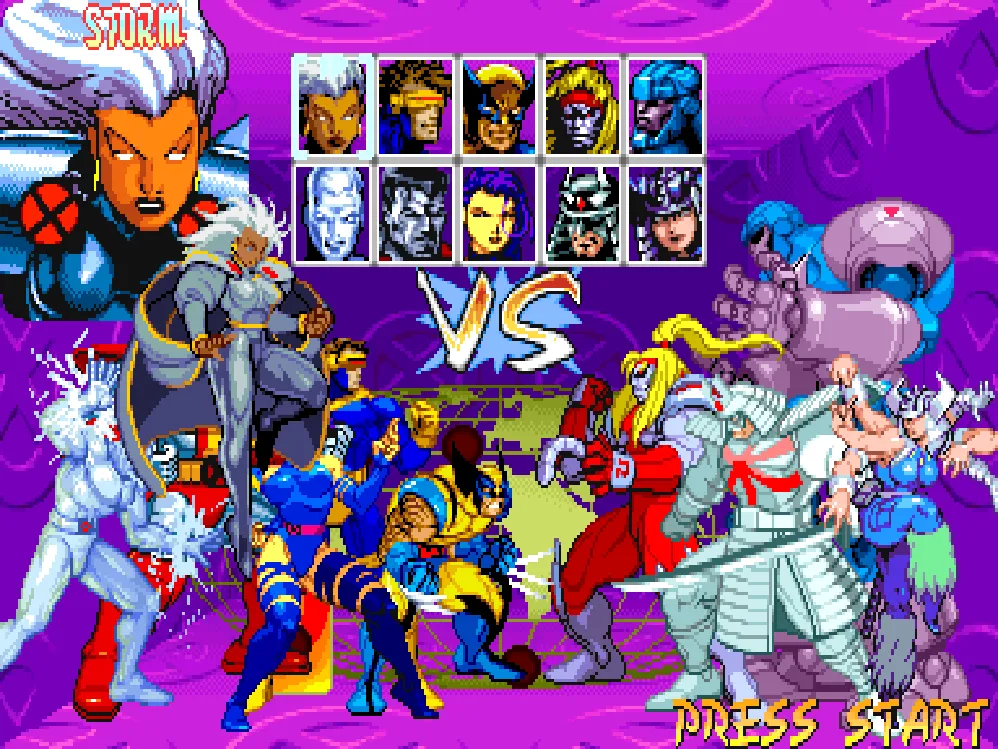
The game features ten base characters and two hidden characters:
| Character | Allegiance | Fighting Style | Key Features |
|---|---|---|---|
| Cyclops | X-Men | Ranged Pressure | Optic blasts control mid-to-long range; simple, effective combos |
| Wolverine | X-Men | Melee Rushdown | Fast claw combos and powerful lunging attacks |
| Storm | X-Men | Full-Screen Control | Wind and lightning skills with wide coverage and high mobility |
| Psylocke | X-Men | High-Speed Assault | Psychic weapons are extremely fast; great for pressure play |
| Colossus | X-Men | Powerhouse | High attack and defense, but slower movement |
| Iceman | X-Men | Mid-Range Control | Ice skills can freeze enemies; a ground-control specialist |
| Silver Samurai | Villain | Weapon Combat | Long reach with his katana and strong lunging attacks |
| Sentinel | Villain | Heavy Pressure | Massive size, incredible attack power, but slow mobility |
| Spiral | Villain | Multi-Hit Combos | Six arms allow for unique, complex combo patterns |
| Omega Red | Villain | Grappler | Carbonadium coils allow for long-range grabs and life-drain |
Hidden Characters:
- Akuma: A crossover character from the Street Fighter series. This was Capcom's first time placing a Street Fighter character into a Marvel game, foreshadowing future crossovers.
- Juggernaut: The game's boss character, unlockable after clearing the game.
3. Controls
3.1 Basic Controls
| Button | Function |
|---|---|
| Joystick (8-way) | Move, Crouch, Jump (Up for normal jump, Down-Up for super jump) |
| Light Punch | Fast light attack, can start combos |
| Medium Punch | Moderate damage, core for some combos |
| Heavy Punch | High damage, required for certain special moves |
| Light Kick | Low light attack |
| Medium Kick | Moderate kick |
| Heavy Kick | High damage kick |
3.2 Revolutionary Combat System
The combat system in Children of the Atom was highly forward-thinking. The Super Jump allows players to quickly launch into the air to attack or evade ground-based skills. Air Combos are a core feature—after launching an opponent into the air, players can follow up to complete a full combo, a very novel design for 1994. Ground-to-air chain attacks allow every character to perform flashy combos. The Super Combo gauge system requires players to build energy to unleash powerful special moves at critical moments. These mechanics were later perfected in the X-Men vs. Street Fighter and Marvel vs. Capcom series.
4. Arcade Mode & Boss Strategy
The game's arcade mode follows a standard tournament format:
| Stage | Opponent | Strategy Tips |
|---|---|---|
| 1st Match | Random | Test the AI's behavior; play conservatively |
| 2nd Match | Random | Start utilizing your character's core combos |
| 3rd Match | Random | Build your super gauge for tougher opponents ahead |
| 4th Match | Random | Watch for increased AI difficulty |
| 5th Match | Villain | Villains have higher attack power; do not underestimate them |
| 6th Match | Random Villain | Prioritize using super combos to chip away health |
| Boss | Juggernaut | Never block his charge head-on; you must jump to evade |
| Final Boss | Magneto | Use ranged skills to chip away; getting too close risks his magnetic shield counter |
5. Tips and Advanced Strategy
5.1 Survival Tips
- Master the Super Jump: Press Down then immediately Up (not a normal jump). This is essential for launching air combos and evading ground attacks.
- Air Combos are Key: Launching an opponent and following up in the air is your primary source of damage. Practice your main character's air combos first.
- Manage Your Super Gauge: Don't waste your super move as soon as the bar fills. Use it during a confirmed combo to ensure it lands.
- Approaching Magneto: Magneto's ground shield is powerful. Use super jumps to approach from the air and land air combos.
- Unlocking Akuma: Use specific inputs on the character select screen. His Raging Demon exists here too—powerful but complex to execute.
- Defensive Play: The CPS2 AI reads inputs; mindless aggression will be countered. Defend, observe patterns, and strike when there's an opening.
6. Trivia and Arcade Legends
6.1 The Birth of the Capcom-Marvel Empire
When X-Men: Children of the Atom debuted in 1994, no one expected it to launch a massive fighting game franchise. Capcom originally only had the license for the X-Men, but the game's success showed Marvel the potential for game adaptations, leading to expanded collaboration. This directly birthed Marvel Super Heroes (1995), X-Men vs. Street Fighter (1996), and Marvel vs. Capcom (1998). The entire Marvel fighting game industry started with this single "Atom."
6.2 Akuma's Crossover Debut
Akuma's appearance as a hidden character was one of the earliest crossovers in fighting game history. At the time, the Street Fighter II series was at its peak, and Akuma had just debuted as a hidden boss in Super Street Fighter II Turbo. Including him in an X-Men game was both an internal nod and a hint at future collaborations. Two years later, X-Men vs. Street Fighter turned that hint into reality.
6.3 The CPS2 Encryption Battle
Children of the Atom ran on Capcom's CPS2 hardware, which featured complex encryption. It used a battery-backed key system to prevent piracy. If the battery died, the board would stop working. This meant piracy was nearly impossible, but today, many boards have become "zombie boards" due to dead batteries. Capcom's 2019 re-release finally allowed these classics to be reborn on modern platforms.
6.4 A Peak in Pixel Art
The character sprites are considered some of the finest pixel art on the CPS2. Each character features hundreds of frames of animation—Wolverine's claws, Storm's floating stance, the Sentinel's massive size—all hand-drawn. Psylocke's psychic blade, with its translucent energy effects, was particularly impressive for the mid-90s. These sprites were reused in many subsequent Marvel games until the 3D era.