The King of Fighters '94
I. Game Background
1.1 World Setting
In 1994, black wax-sealed invitations were delivered to the world's top fighters. The sender identified himself only as "R"—a mysterious figure never before seen in the fighting circuit. The invitation was brief and arrogant: participate in my "King of Fighters" tournament, or face the consequences.
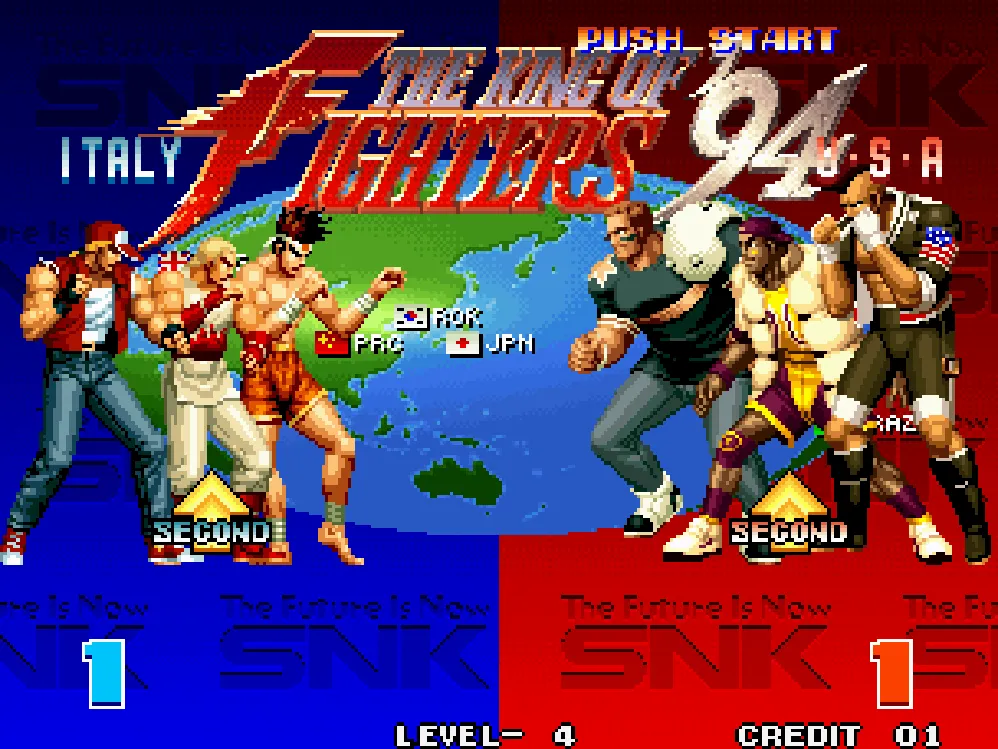
24 fighters from various backgrounds answered the call—or rather, accepted the threat. They were organized into 8 teams of three based on their nationality and origin: the Japan Team led by Kyo Kusanagi, the Fatal Fury Team from South Town, the Art of Fighting Team from Kyokugenryu, the Ikari Team led by Heidern, the Psycho Soldiers Team, the Women Fighters Team led by King, the Korea Justice Team represented by Kim Kaphwan, and a mysterious American Sports Team. All were brought to the tournament venue—a massive aircraft carrier named the "Black Noah."
On the Black Noah, the fighters climbed level by level, defeating the guardians of each floor. When they finally reached the throne room on the top floor, the truth was revealed: "R" was Rugal Bernstein, an international crime lord dealing in arms, drugs, and black-market trade. He kept bronze statues of the world's strongest fighters in his private gallery—every opponent he defeated was turned into a statue, becoming part of his "collection." The sole purpose of this tournament was to add 24 perfect fighter statues to his collection.
This was the starting point for the entire KOF saga. No one knew that Rugal's arrogance was merely the prologue to an epic—the Orochi blood flowing in his veins, his business war with Geese Howard, and his obsessive fixation on Kyo Kusanagi would gradually weave into the grandest mythos in the KOF series.
1.2 Development History
The King of Fighters '94 was first released by SNK on August 25, 1994, for the Neo Geo MVS/AES platform, using a 196-megabit cartridge. The game was born from a simple yet bold idea: SNK wanted to create a "dream match" crossover game where characters from their own fighting games could compete on the same stage.
Producer Masanori Kuwasashi once stated that the initial concept was to have characters from Fatal Fury and Art of Fighting fight each other—an unprecedented crossover idea at the time. As development progressed, the team decided to expand the scale: create a brand-new "Hero Team" and upgrade the original crossover concept into an "All-Star Brawl." Thus, Kyo Kusanagi was born—the flame-wielding warrior who would later become the symbol of SNK was originally just a functional design to make the crossover "look better."
KOF '94 made a revolutionary innovation at the system level: the 3-on-3 team battle. Before this, almost all fighting games were one-on-one, but KOF '94 allowed both sides to field 3 characters, fighting in sequence. Once a character was KO'd, the next would enter until all three were defeated. This design completely changed the strategic dimensions of fighting games—players had to consider character combinations, order of entry, and energy management.
After its release, the game was an explosive success in arcades. The intense 3v3 battles, familiar characters from different SNK titles, and Rugal's suffocating final boss fight made KOF '94 one of the most popular arcade fighting games of 1994, establishing SNK's tradition of releasing a new KOF title every year—a tradition that lasted until 2003.
II. Character Introduction
The King of Fighters '94 features 8 teams and 24 characters (excluding the boss):
Hero / Japan Team
| Character | Fighting Style | Power | Speed | Skills | Overall Rating |
|---|---|---|---|---|---|
| Kyo Kusanagi | Kusanagi-ryu Ancient Martial Arts | ★★★★☆ | ★★★★☆ | ★★★★★ | Protagonist, fire attacks + strong combos |
| Benimaru Nikaido | Shooting | ★★★☆☆ | ★★★★★ | ★★★★☆ | Lightning zoning, fastest speed |
| Goro Daimon | Judo | ★★★★★ | ★☆☆☆☆ | ★★★☆☆ | Highest throw damage, excellent anti-air |
- Pros: The trio complements each other—Kyo's versatility, Benimaru's speed, and Daimon's explosive power.
- Cons: Daimon is extremely slow and can be kited by fast characters.
Fatal Fury Team
| Character | Fighting Style | Power | Speed | Skills | Overall Rating |
|---|---|---|---|---|---|
| Terry Bogard | Martial Arts + Self-taught | ★★★★☆ | ★★★★☆ | ★★★★☆ | Legendary Wolf, balanced and versatile |
| Andy Bogard | Koppo + Shiranui-ryu Ninjutsu | ★★★☆☆ | ★★★★☆ | ★★★☆☆ | Ninja-style, aerial advantage |
| Joe Higashi | Muay Thai | ★★★★★ | ★★★☆☆ | ★★★☆☆ | High explosive power, Hurricane Upper pressure |
- Pros: Terry's versatility, Joe's close-range burst, Andy's aerial game.
- Cons: All three lack long-range zoning tools.
Art of Fighting Team
| Character | Fighting Style | Power | Speed | Skills | Overall Rating |
|---|---|---|---|---|---|
| Ryo Sakazaki | Kyokugenryu Karate | ★★★★☆ | ★★★☆☆ | ★★★★☆ | Ko-oh Ken, representative of projectile/anti-air style |
| Robert Garcia | Kyokugenryu + Kicks | ★★★★☆ | ★★★★☆ | ★★★★☆ | Ryu-geki Ken, diverse kicking techniques |
| Takuma Sakazaki | Kyokugenryu Karate | ★★★★★ | ★★☆☆☆ | ★★★☆☆ | Haoh Shokoken, master of Kyokugenryu |
- Pros: Ryo and Robert's projectile/anti-air combo, Takuma's wide-range attacks.
- Cons: Takuma, like Daimon, is extremely slow.
Ikari Team
| Character | Fighting Style | Power | Speed | Skills | Overall Rating |
|---|---|---|---|---|---|
| Ralf Jones | Military Martial Arts | ★★★★★ | ★★☆☆☆ | ★★☆☆☆ | Heavy punches/kicks, high single-hit damage |
| Clark Still | Military Arts + Throws | ★★★★☆ | ★★☆☆☆ | ★★★★☆ | Super Argentine Backbreaker, throw chains |
| Heidern | Military Assassination Arts | ★★★☆☆ | ★★★★☆ | ★★★★☆ | Storm Bringer, cutting zoning |
- Pros: Heidern's mid-range control, Clark's throw pressure, Ralf's burst damage.
- Cons: Ralf and Clark are slow and struggle against high-speed characters.
Psycho Soldiers Team
| Character | Fighting Style | Power | Speed | Skills | Overall Rating |
|---|---|---|---|---|---|
| Athena Asamiya | Psycho Power + Chinese Martial Arts | ★★★☆☆ | ★★★★☆ | ★★★★★ | Psycho Ball + Phoenix Arrow, full-screen projectiles |
| Sie Kensou | Psycho Power + Chinese Martial Arts | ★★★☆☆ | ★★★★☆ | ★★★☆☆ | Agile and mobile, meat bun healing |
| Chin Gentsai | Drunken Fist | ★★☆☆☆ | ★☆☆☆☆ | ★★★★★ | Unique skills, unpredictable |
- Pros: Athena's full-screen pressure, Chin's tricky skills, Kensou's mobility.
- Cons: Chin moves very slowly and has unique hitboxes.
Women Fighters Team
| Character | Fighting Style | Power | Speed | Skills | Overall Rating |
|---|---|---|---|---|---|
| King | Muay Thai | ★★★★☆ | ★★★★☆ | ★★★☆☆ | Double Venom Strike, stylish Muay Thai fighter |
| Mai Shiranui | Shiranui-ryu Ninjutsu | ★★★☆☆ | ★★★★★ | ★★★☆☆ | Kachosen, aerial advantage |
| Yuri Sakazaki | Kyokugenryu Karate | ★★★☆☆ | ★★★★☆ | ★★★☆☆ | Kyokugenryu beginner, cute moves |
- Pros: All three are agile; Mai has great aerial pressure.
- Cons: All three are "glass cannons" with low overall defense.
Korea Justice Team
| Character | Fighting Style | Power | Speed | Skills | Overall Rating |
|---|---|---|---|---|---|
| Kim Kaphwan | Taekwondo | ★★★★☆ | ★★★★★ | ★★★★☆ | Phoenix Kick, king of aerial combos |
| Choi Bounge | Taekwondo + Claws | ★★☆☆☆ | ★★★★★ | ★★★☆☆ | Tiny hitbox, fastest speed |
| Chang Koehan | Taekwondo + Iron Ball | ★★★★★ | ★☆☆☆☆ | ★★★☆☆ | Massive iron ball attack range |
- Pros: Kim's versatility, Choi's harassment, Chang's range pressure.
- Cons: Choi has very low health; Chang is extremely slow.
American Sports Team
| Character | Fighting Style | Power | Speed | Skills | Overall Rating |
|---|---|---|---|---|---|
| Heavy D! | Boxing | ★★★★★ | ★★★☆☆ | ★★★☆☆ | Heavyweight boxer, close-range destructive power |
| Lucky Glauber | Street Basketball | ★★★☆☆ | ★★★★☆ | ★★★☆☆ | Basketball attacks, mid-range projectiles |
| Brian Battler | American Football | ★★★★★ | ★★☆☆☆ | ★★☆☆☆ | Charge attacks, massive hitboxes |
- Pros: Large hitboxes and attack ranges, a novel combination of boxing, basketball, and football.
- Cons: Overall slow speed and lack of long-range zoning—the reason why this team is consistently crushed by top-tier teams.
The American Sports Team is the most "tragic" team in the KOF series. In the KOF '94 storyline, they were defeated by Rugal before the tournament even started (they appear as playable characters in-game, but are "already eliminated" in the plot). They have only appeared as playable characters this one time in the entire KOF series (until the Dream Match mode in KOF '98). This "one-game-only" status has made them a legend among KOF fans—a "Bring Back the American Sports Team" petition has been active for over a quarter of a century.
III. Controls
3.1 Basic Controls
| Button | Function |
|---|---|
| A | Light Punch |
| B | Light Kick |
| C | Heavy Punch |
| D | Heavy Kick |
| ←/→ | Move Left/Right |
| ↖/↗ | Jump |
| ↓ | Crouch |
| Close →/← + C/D | Normal Throw |
3.2 Team Battle System
KOF '94 pioneered the 3-on-3 Team Battle System, one of the most important innovations in fighting game history:
- Each side selects 3 characters and arranges them in order.
- Characters fight in sequence; there is no "tagging" feature—the next character only enters after the previous one is KO'd.
- Victory condition: A team loses when all 3 characters are KO'd.
- When characters switch, the screen goes black for 1 second; the winner recovers a small amount of health, and the loser exits.
This "3 characters, no tagging" system created a unique strategic tension: should you put your strongest character first (to gain an early lead) or last (for a comeback)?
3.3 Energy System
The energy system in KOF '94 is very primitive and completely different from later KOF titles:
- Charging: Hold A+B+C simultaneously to enter a charging stance; the power gauge fills slowly.
- Consumption: Once the gauge is full, you can unleash a Desperation Move.
- Tactical Significance: You are defenseless while charging—it's a high-risk gamble in intense battles.
- Capacity: Maxes out at one bar; no "MAX" concept or multiple energy bars.
3.4 Special Actions
| Operation | Action | Description |
|---|---|---|
| A+B | Evasion Attack | Short-distance backstep dodge + counter |
| →→ | Dash | Only available to a few characters—the universal dash system was not yet introduced |
| ←← | Backstep | Quick retreat |
Note: KOF '94 does not feature the "Emergency Evasion" (roll), "Blowback Attack," "Hop," or "Hyper Jump" systems. It offers a purer, slower-paced, classic fighting experience.
IV. Boss Guide: Rugal Bernstein
| Attribute | Description |
|---|---|
| Fighting Style | All-around martial arts—incorporating techniques from all over the world |
| Height/Weight | 197cm / 103kg |
| Stage | Black Noah Aircraft Carrier—Throne Room |
| Signature Quote | "Your statue will be the most perfect addition to my collection..." |
Combat Characteristics
Rugal Bernstein is SNK's first final boss and the most iconic villain in the KOF series. His design defined the classic "SNK Boss" archetype:
- Kaiser Wave: A massive, full-screen energy projectile that cannot be jumped over—you must dodge it. It is about 3 times larger than a normal projectile and extremely fast.
- Genocide Cutter: A spinning kick with anti-air coverage spanning half the screen—this is Rugal's most famous move and one of the most oppressive anti-air attacks in KOF history.
- Dark Barrier: A reflector shield that bounces back all projectiles—this makes projectile-based zoning (fireballs + uppercuts) completely ineffective.
- God Press: A rushing throw—grabs the opponent at close range, lifts them high, and slams them down hard.
- Gigantic Pressure: Another version of his rushing throw with a massive hitbox.
Strategy Points
- Abandon Projectiles: Rugal's Dark Barrier will reflect everything. If you use projectile characters like Ryo or Athena, forget about "spamming fireballs." You must fight in close quarters.
- Avoid the Genocide Cutter: This is the deadliest threat. Rugal will almost certainly use it when you jump. Minimize jumping—especially reckless jump-ins.
- Throws are Rugal's Weakness: Rugal's AI is relatively weak against throws. Goro Daimon's "Heaven to Hell Drop" and Clark's "Super Argentine Backbreaker" are your most effective weapons.
- Do Not Engage Head-on: Rugal's normal attacks have a longer reach than yours. Probe at mid-range and wait for his attacks to miss before rushing in.
- Kaiser Wave Timing: The Kaiser Wave has a brief startup animation. If you see him charging at point-blank range, dash forward immediately to pass through the projectile and punish his recovery frames.
Rugal's difficulty is "fair but high-pressure"—compared to the Omega form in 2002 UM, the KOF '94 Rugal feels like a well-designed, high-difficulty boss rather than pure AI cheating. Defeating him requires the right strategy, not luck.
V. Tips and Advanced Strategy
5.1 Basic Survival Tips
- Know Your Team: Among the 8 teams, the Hero, Fatal Fury, and Art of Fighting teams are the easiest to pick up. The Hero Team (Kyo, Benimaru, Daimon) is the most balanced choice for beginners.
- Charging Timing: Don't try to charge during intense combat. The best time is the 1-second gap after KOing an opponent's character before the next one enters.
- Defense is the Best Offense: The overall pace of KOF '94 is slower than later titles. Active defense—blocking combos and countering—is more effective than aggressive attacking.
- No Rolling System: You cannot use A+B to roll away from attacks. Blocking and movement are your only defensive options. Learn to block perfectly.
- Daimon's Throw Hitbox: Daimon's throw hitboxes in this game are massive—his "Heaven to Hell Drop" can grab opponents from about one character's width away. Use this to your advantage.
5.2 Character Strength and Selection
Top Tier: Kyo Kusanagi, Benimaru, Terry, Kim Kaphwan—balanced mobility and damage. Mid Tier: Robert, King, Athena, Heidern—unique advantages but require synergy. Nostalgia Tier: American Sports Team—not because they are strong, but because they only appeared this once.
5.3 General Boss Battle Rules
Rugal is the only boss. His strategy is detailed above. Reiterate the core principle: Do not use projectiles, do not jump recklessly, and prioritize throws.
5.4 Advanced Trivia
- Kyo's Original Design: Kyo in KOF '94 is significantly different from later versions. His "Orochi Nagi" hadn't been created yet; his Desperation Move was a prototype of the "Final Showdown Secret Technique: Mushiki."
- Benimaru's Voice: In early SNK KOF titles, Benimaru's voice acting was very exaggerated—his "Raikoken" shout is one of the most iconic sound effects in the series.
- No Hidden Characters: Unlike later KOF games, KOF '94 has no unlockable characters—the 24 fighters + Rugal are the entire roster.
- US Version Changes: The US Neo Geo AES version removed the win quotes between characters (due to lack of translation), but they are preserved in the MVS version.
VI. Anecdotes and Arcade Legends
6.1 From Crossover Dream to Annual IP
KOF '94 was codenamed "Fighter Brawl" during initial planning, and SNK management only approved 6 months of development time. When Masanori Kuwasashi proposed including 24 characters, the team thought he was crazy—creating 24 completely independent characters (each requiring unique animation frames, hitboxes, and move designs) was a massive undertaking in 1994. Ultimately, SNK gave him 12 months, and KOF '94 became the most ambitious project on the Neo Geo MVS platform in 1994.
6.2 Rugal's "Zoo"
Rugal Bernstein is a legendary name for fighting game fans, but he has a little-known quirk—he keeps a black panther named "Rodem." In official SNK lore, there is a "zoo" area on the Black Noah where he keeps beasts collected from around the world. This makes Rugal feel more like a Bond villain—wealthy, powerful, with a private zoo and a collection of human statues.
6.3 The Tragic Origin of the American Sports Team
According to interviews with the SNK team, the American Sports Team had a more significant role in the original script—they were supposed to be a "champion team invited by Rugal." However, to highlight the Hero Team (Kyo and friends), they were relegated to background characters who were "defeated before the tournament." This anecdote has made them the most sympathetic characters in the KOF community—to this day, "Justice for Team USA" remains an active hashtag.
6.4 Black Noah and Bond Films
The design of the Black Noah aircraft carrier pays heavy homage to the villainous yachts and sea bases in 007 films like The Spy Who Loved Me and The Man with the Golden Gun. SNK's art team was known for their fanatic love of Hollywood action movies—this "arcade game + Hollywood blockbuster" aesthetic became a hallmark of SNK's golden age.
6.5 The Accidental Birth of Kyo Kusanagi
Kyo Kusanagi was not the original protagonist—the plan was for Terry Bogard to be the lead, serving as SNK's unified mascot. During development, Kuwasashi felt that "a crossover brawl needs a brand-new protagonist, a hero who doesn't belong to any old work." Thus, Kyo was born—his Kusanagi-ryu martial arts combined Shinto elements with modern street style, and his outfit was inspired by the then-popular Bōsōzoku culture. This "temporary decision" created one of the most iconic characters in video game history.
6.6 KOF '94 Rebout—A Remake 14 Years Later
In 2004 (the 10th anniversary of KOF), SNK Playmore released The King of Fighters '94 Rebout—a PlayStation 2 exclusive that completely redrew the original with high-resolution 2D graphics, rearranged music, and new modes. However, it was controversial—many old-school players felt the remake lost the "SNK texture" of the original pixel art, while new players complained the gameplay was too "classical" (no rolling, no tagging, no MAX mode). Rebout was a tribute to the start of KOF and an education for a new generation on how "hardcore" the original KOF was.
6.7 Rugal's Voice Actor Legend
Rugal's Japanese voice actor is Norio Wakamoto—the undisputed "Final Boss Specialist" of the Japanese voice acting world. Wakamoto created a unique "polite but deadly" tone for Rugal—he never screams; he delivers the most terrifying lines with an almost diplomatic elegance. This performance was highly praised by the SNK sound team and earned Wakamoto many more boss roles in subsequent fighting games.
6.8 The Evolution of Fighting Games through KOF '94
Looking back at KOF '94, its historical position is profound. In 1994, the Street Fighter II series had been out for three years, and the genre was shifting from a "Street Fighter monopoly" to a "warring states" era. Mortal Kombat, Samurai Shodown, Fatal Fury, and Virtua Fighter each held their ground. KOF '94 charged into this battlefield with its 3v3 team system—at the time, the idea of three fighters teaming up was revolutionary. Without KOF '94, there would be no KOF series spanning over 20 years and 15 main titles. It is a milestone of the Japanese arcade golden age.