1. Game Background
1.1 World Setting
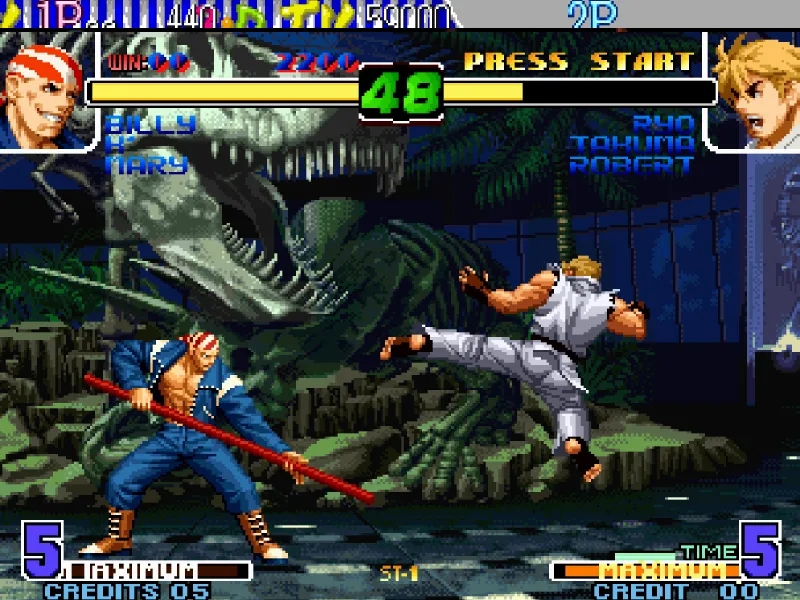
The King of Fighters 10th Anniversary 2005 Unique (also known as KOF 10th Anniversary 2005 Unique) is a special commemorative title released by SNK to celebrate the 10th anniversary of the KOF series. It brings together characters from both the "Orochi Saga" (KOF '94-'97) and the "NESTS Saga" (KOF '99-'01) in a "Dream Match" format, serving as an all-star fighting game dedicated to the fans.
This title features no independent storyline. It is more like a 10th-anniversary gift from SNK to itself and all KOF players—condensing all the popular characters, classic moves, and iconic stages accumulated over a decade into one game. From the debut of KOF '94 on the Neo Geo MVS to this moment in 2005, KOF had spanned ten full years. Ten mainline sequels, dozens of character arcs, and hundreds of iconic fighters—now, they are reunited in a single game.
This "no-plot, pure-celebration" philosophy follows in the footsteps of KOF '98 and KOF 2002. If you enjoy the KOF '98 approach of "locking everyone in a room to see who wins," then the 10th Anniversary edition is the 2005 extension of that concept.
1.2 Development History
The King of Fighters 10th Anniversary was released in 2005 on the Neo Geo MVS arcade hardware. By this time, SNK had already undergone bankruptcy and reorganization (2001), relaunching as SNK Playmore. The 2005 version of SNK Playmore was in a unique transitional period—they had just kicked off the "Ash Saga" in KOF 2003, and KOF XI (released later in 2005) was in development, but the Neo Geo hardware was beginning to show its age.
Releasing a commemorative title on the Neo Geo MVS at this point was a statement in itself—they were still using the old hardware, still releasing KOF, and still celebrating the tenth anniversary. The game's development background differs from standard annual KOF releases: it is not a "sequel" or a "prequel," but a commemorative work that carries no pressure to advance the series' narrative.
A standout feature of this title is the innovation in the character selection system: unlike the traditional 3v3 team mode, the game introduces a system based on free single-character selection. Players choose one fighter from the entire roster and accumulate victory points through win streaks. This design is closer to the single-player versus mode of the Fatal Fury series, which is rare in the KOF series, giving players a fresh game pace—you don't need to worry about team synergy; you only need to focus on your strongest character.
KOF 10th Anniversary has been praised by the player community for its "rich roster and strong sense of nostalgia." Because it is essentially a mashup of the "Orochi Saga" and "NESTS Saga" eras, veteran players can see their most familiar character lineups—for those who started with KOF '97, seeing Kyo Kusanagi and Iori Yagami fighting side-by-side is a core memory; for those who joined during the KOF '99 era, the ice-and-fire rivalry between K' and Kula is their "definitive childhood."
2. Character Roster
The game's roster spans classic characters from KOF '94 to KOF 2003, offering an incredibly luxurious selection.
2.1 Playable Characters
| Era | Representative Characters |
|---|---|
| Orochi Saga (KOF '94-'97) | Kyo Kusanagi, Iori Yagami, Chizuru Kagura, Orochi Team (Yashiro/Shermie/Chris), Terry Bogard, Andy Bogard, Joe Higashi, Ryo Sakazaki, Robert Garcia, Mai Shiranui, Athena Asamiya, Sie Kensou, Benimaru Nikaido, Goro Daimon, Kim Kaphwan, Ralf, Clark, Leona, Heidern |
| NESTS Saga (KOF '99-'01) | K', Kula Diamond, K9999, Angel, Maxima, Vanessa, Ramon, Seth, Whip |
| Hidden Characters | Omega Rugal (Final Form), Awakened Orochi Team (Orochi Yashiro, Orochi Shermie, Orochi Chris) |
2.2 Featured Character Analysis
Orochi Saga Representative: The Destiny of the Three Sacred Treasures (Iori & Kyo)
In this game, the move sets for Kyo Kusanagi and Iori Yagami are largely based on their classic KOF '98 configurations. This means Iori's "Koto Tsuki" and "Ya Otome" combos remain devastating, and Kyo's "100 Shiki: Oniyaki" anti-air priority remains dominant. For veterans, controlling these two heirs of the Three Sacred Treasures in the same game is a nostalgic experience in itself.
NESTS Saga Representative: The Ice and Fire of K' and Kula
K' and Kula from the NESTS Saga utilize their move frameworks from KOF 2001/KOF 2002. K's "Trigger" derivation system (Trigger → Second Shell → Heat Drive) requires high control over speed and rhythm; Kula's "Counter Shell" and "Diamond Breath" contrast sharply with K's aggressive style—one is a wide-ranging fire-based assault, the other is a calm, lockdown-oriented ice control.
3. Controls and Gameplay
3.1 Basic Controls
This game uses a standard 8-way joystick + 4-button layout:
| Button | Function |
|---|---|
| A | Light Punch |
| B | Light Kick |
| C | Heavy Punch |
| D | Heavy Kick |
3.2 Game Modes
The core feature of this title is the variety of match modes provided:
| Mode | Rules | Recommended For |
|---|---|---|
| Best of 5 | Classic single-round loop, first to win 3 rounds wins | Players seeking traditional KOF pacing |
| Single Elimination | Choose 3 characters to fight one by one; all defeated means game over | Players who enjoy character synergy tactics |
| Survival | Choose 1 character to fight multiple opponents in a row | Experts confident in clearing with a single character |
| Time Attack | Defeat as many opponents as possible within the time limit | Challengers chasing high scores |
3.3 General Command List
| Action | Input | Description |
|---|---|---|
| Dash | →→ | Rapid forward dash |
| Backstep | ←← | Backward jump for evasion |
| Hop | Tap ↑ | Low, fast jump |
| Hyper Jump | Rapid ↙↓↘ + ↑ | Long-range arc jump |
| Recovery | A+B upon landing | Quick get-up to avoid follow-ups |
| Emergency Evasion | → + A+B (Forward) / ← + A+B (Backward) | Short invincibility window |
| Super Special Move | Consumes 1 Power Gauge | Varies by character |
| MAX Super Move | Use Super Move while in MAX state | Enhanced animation and damage |
4. Key Battle Strategies
4.1 Selection Strategy
- Prioritize Orochi Saga Characters: In this game, Orochi Saga characters retain the powerful performance of KOF '98, while NESTS Saga characters are closer to their KOF 2001/2002 versions. This means "Old Generation" characters have better mid-range pressure—Iori Yagami, Kyo Kusanagi, and Goro Daimon have clear performance advantages.
- Utilize Survival Mode Endurance: In Survival mode, health does not recover after each match. Choosing characters with high defense and high damage output (like Ralf or Goro Daimon) is more advantageous than choosing "glass cannon" characters.
- Hidden Characters as Wildcards: While Omega Rugal and the Awakened Orochi Team have outstanding performance, they are harder to master. If your opponent is unfamiliar with their move details, switching to these hidden characters can create a tactical information gap.
4.2 Countering the Final Boss
Omega Rugal is designed as an extremely powerful hidden boss, ranking among the top-tier characters alongside the Orochi Team:
| Counter Strategy | Description |
|---|---|
| Recommended Counter | Yashiro (Awakened form: Orochi Yashiro) has special moves that can effectively counter Rugal at mid-range |
| Watch for Kaiser Wave | Rugal's Kaiser Wave has a massive hitbox—do not try to jump over it; use Emergency Evasion (A+B) to dodge |
| Close-Range Advantage | Rugal's long-range pressure is stronger than his close-range combat—Goro Daimon's throws can bypass Rugal's defensive stance |
4.3 Orochi Saga vs. NESTS Saga Comparison
| Dimension | Orochi Saga Characters | NESTS Saga Characters |
|---|---|---|
| Startup Speed | Faster (3-5 frames) | Slightly slower on average (5-8 frames) |
| Combo Damage | Medium-High (40%-55%) | Extremely High (45%-65%, relies on Striker-era rhythm) |
| Complexity | Low to Medium (Classic inputs) | Medium to High (Many derived commands) |
| Pressure | Extremely Strong (e.g., Iori's corner pressure) | Strong (e.g., K's Trigger follow-ups) |
| Beginner Choice | Kyo Kusanagi, Terry, Ralf | K', King |
5. Tips and Advanced Strategy
5.1 Beginner Tips
- Start with Orochi Saga characters: Their move commands are simpler (no complex derivation systems), making them perfect for getting used to the game's overall rhythm.
- Survival mode is the ultimate test: Using a single character to clear Survival mode is the fastest way to master that character.
- Recovery is essential: A core fundamental of the KOF series, and just as critical here.
5.2 Advanced Tactics
- Utilize Character Switching Rhythm: In "Single Elimination" mode, if you win the first round and proceed smoothly, you can use the momentum to apply psychological pressure on your opponent.
- Gauge Management: The energy accumulation rules are similar to the Advance mode in KOF '98. Don't waste energy too early—keep at least 2 bars to use for Emergency Evasion when under pressure.
- Corner Offense: Corner pressure in this game is extremely strong, especially with Goro Daimon's throws, which allow you to control the opponent's wake-up timing—once you have them trapped in the corner, the tide of battle is already in your favor.
6. Trivia
6.1 2005 Neo Geo MVS—The Twilight Hero
When KOF 10th Anniversary was released, the Neo Geo MVS hardware was already 15 years old. In 2005, more modern hardware like the Sega Naomi and Namco System 246 were already mainstream. SNK Playmore's choice to release the 10th-anniversary title on MVS was both nostalgic and pragmatic—the core KOF hardware base was still on this platform, and development costs were manageable.
6.2 The "No-Plot" Tradition
KOF '98 was a Dream Match, KOF 2002 was another, and the 10th Anniversary edition is also a Dream Match—SNK seems to have formed a pattern: whenever a key milestone is reached ('98, 2002, 10th Anniversary), they commemorate it with a plotless all-star title. This style of "honoring history without a plot" is unique in the fighting game genre.
6.3 The Mystery of Character Imbalance
KOF 10th Anniversary is widely recognized in the competitive community for having poor balance. Some characters (especially Iori Yagami and Kyo Kusanagi from the Orochi Saga) have overpowered performance, while some NESTS Saga characters are relatively mediocre. This was not an oversight—since the game is essentially a mashup of "two eras of characters," the development team likely intentionally preserved the original styles of different eras, leading to performance discrepancies. For a commemorative title, competitive balance was not the top priority.