I. Game Background
1.1 World Setting
The King of Dragons is set in a classic Western medieval fantasy world. A once-peaceful kingdom has been invaded by the red dragon Gildiss and his dark army—the dragon descended from the skies, consuming towns and villages in flames. The king's army suffered defeat after defeat, and the entire kingdom plunged into the abyss of despair.
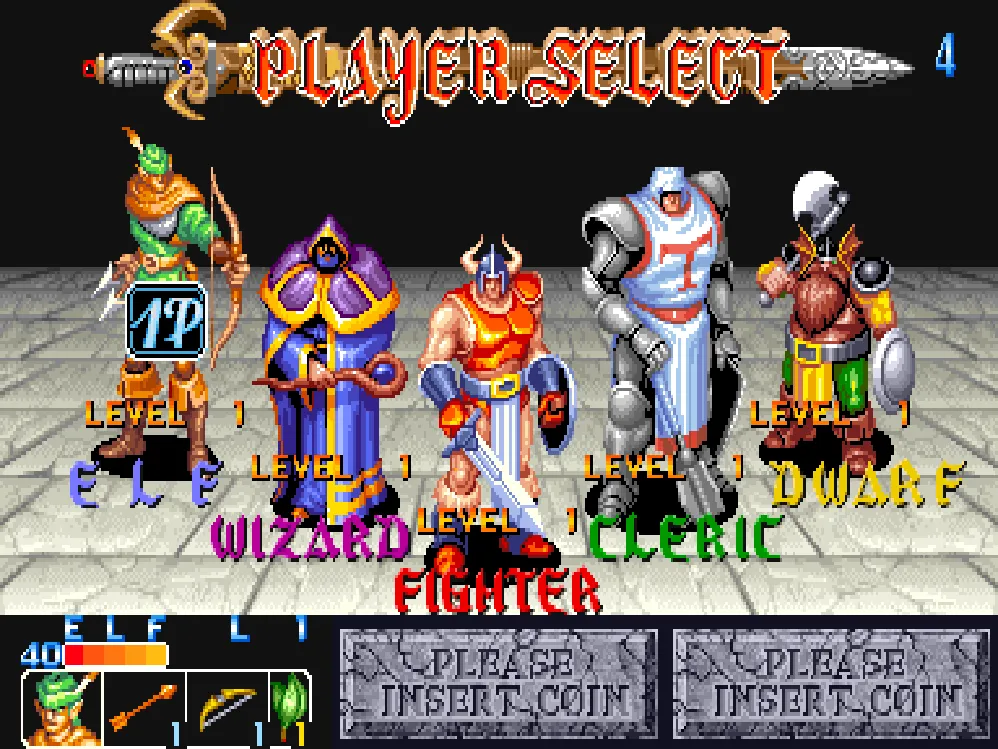
In this critical moment, five heroes from different races answered the kingdom's call: the Fighter, the Elf Archer, the Wizard, the Cleric, and the Dwarf Warrior. They formed the kingdom's final hope, swearing to traverse wilderness, swamps, dungeons, and dragon lairs, cutting down the minions of the dark army to eventually defeat the red dragon Gildiss and restore peace to the realm.
While the world-building is concise, it contains all the core elements of classic fantasy RPGs—knights, mages, archers, healers, dwarves, dragons, and mysterious ancient ruins. From lush plains to eerie graveyards, and from toxic swamps to fiery caverns, sixteen distinct stages present a pure "sword and sorcery" tapestry.
1.2 Development History
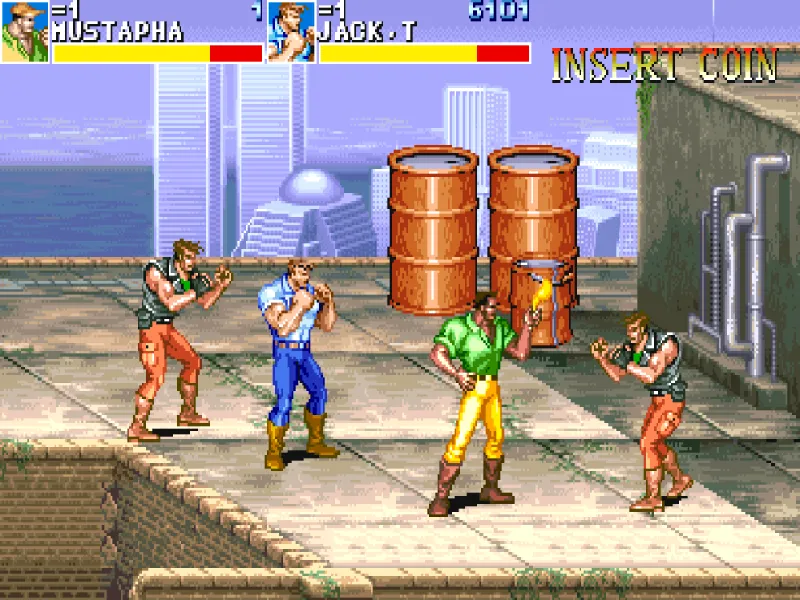
The King of Dragons was released by Capcom in 1991 on the CPS1 (Capcom Play System 1) arcade board. At the time, Capcom was in the golden age of side-scrolling arcade action games—releasing Captain Commando and Warriors of Fate that same year—but The King of Dragons carved out a fresh direction in the fantasy genre.
The game's biggest design highlight was integrating RPG elements into the framework of a side-scrolling beat-'em-up:
- Five classes, each with unique stat growth curves, attack styles, and equipment upgrade paths.
- Leveling mechanism that allows characters to gain experience through points, increasing HP and attack power.
- Equipment system that allows characters to acquire increasingly powerful weapons and armor, with visible changes to their appearance.
- Support for up to four-player co-op, which was quite rare for arcade games in 1991.
The game's working title during development was "Sword & Sorcery." It is said that Capcom originally planned to make a dark fantasy action game closer to the style of Ghosts 'n Goblins, but the team was influenced by American tabletop RPGs (especially Dungeons & Dragons) during development, leading them to add RPG elements and a class selection system. This decision ultimately created the first "RPG-hybrid" in the side-scrolling genre.
The King of Dragons is often seen as an important precursor to Capcom's later fantasy arcade titles like Dungeons & Dragons: Tower of Doom and Shadow over Mystara. It was ported to the Super Nintendo (SNES/SFC) in 1994 and included in the Capcom Arcade Stadium collection in 2021, reborn on modern platforms with HD filters.
II. Character Introduction
The King of Dragons offers five classic fantasy classes, each providing a completely different gameplay experience.
2.1 Fighter — The Iron Wall
| Attribute | Rating |
|---|---|
| Attack | ★★★ |
| Defense | ★★★★★ |
| Speed | ★★★ |
| Difficulty | ★ |
- Strengths: Highest HP and strongest defense; shield automatically blocks frontal projectiles; reliable melee combos.
- Weaknesses: Short attack range; must get close to enemies; lacks ranged options; slow movement speed.
- Equipment Upgrades: Iron Sword → Broadsword → Magic Sword; Wood Shield → Iron Shield → Magic Shield.
- Verdict: The best beginner character. His massive HP and blocking ability allow him to tank significant damage. An irreplaceable front-line tank in multiplayer co-op.
2.2 Elf — The Deadly Sniper
| Attribute | Rating |
|---|---|
| Attack | ★★★★ |
| Defense | ★★ |
| Speed | ★★★★★ |
| Difficulty | ★★★ |
- Strengths: Ranged bow attacks allow for safe distance combat; fastest fire rate; charged shots pierce multiple enemies.
- Weaknesses: Low HP; very fragile if enemies get close; extremely weak melee capabilities.
- Equipment Upgrades: Short Bow → Long Bow → Elf Magic Bow; Arrows → Fire Arrows → Piercing Arrows.
- Verdict: The best choice for solo runs. Maintaining distance while dealing continuous damage is the most efficient strategy. Widely considered the strongest character overall, but requires excellent positioning.
2.3 Wizard — The Power of Destruction
| Attribute | Rating |
|---|---|
| Attack | ★★★★★ |
| Defense | ★ |
| Speed | ★★ |
| Difficulty | ★★★★★ |
- Strengths: Staff magic projectiles deal massive damage; ultimate move is a large-area AOE elemental spell that can clear the screen; highest damage potential.
- Weaknesses: Lowest HP and defense; slow movement; limited magic uses, requiring careful management.
- Equipment Upgrades: Apprentice Staff → Mage Staff → Archmage Staff; Magic Bolt → Fireball → Chain Lightning.
- Verdict: A classic "glass cannon." With teammate protection, the Wizard's AOE spells are screen-clearing tools. Extremely difficult for solo play; not recommended for beginners.
2.4 Cleric — The Holy Guardian
| Attribute | Rating |
|---|---|
| Attack | ★★ |
| Defense | ★★★ |
| Speed | ★★★ |
| Difficulty | ★★ |
- Strengths: The only character with healing skills, capable of restoring HP for self and teammates; decent melee range with staff; strong survivability.
- Weaknesses: Low base damage; damage output relies on sustained attacks rather than burst; no ranged attacks.
- Equipment Upgrades: Wood Staff → Iron Staff → Holy Scepter; Heal → Greater Heal → Group Heal.
- Verdict: An irreplaceable support core in multiplayer. While lacking solo damage, having a skilled Cleric in a four-player team lowers the difficulty of clearing the game significantly.
2.5 Dwarf — The Furious Cyclone
| Attribute | Rating |
|---|---|
| Attack | ★★★★ |
| Defense | ★★★ |
| Speed | ★★★★ |
| Difficulty | ★★ |
- Strengths: Fast axe attacks with fluid combos; higher attack power than the standard Fighter; small stature makes him harder to hit by high-reaching attacks.
- Weaknesses: Shorter attack range than the Fighter; relies entirely on close-quarters combat; cannot block projectiles.
- Equipment Upgrades: Hand Axe → Battle Axe → Dwarf King's Axe.
- Verdict: An all-rounder for melee damage. Fast, fluid, and powerful, he's perfect for players who prefer an aggressive playstyle. Strikes a great balance between damage and survival.
III. Controls
3.1 Basic Controls
The King of Dragons uses the classic Capcom 8-way joystick + 2-button layout:
| Button | Function |
|---|---|
| A | Attack |
| B | Jump |
| Hold A | Charged Attack (Fighter shield bash / Elf power shot / Wizard charge shot) |
| A+B (Wizard/Cleric) | Cast Magic (Wizard: offensive spell / Cleric: healing spell) |
| ↓+B | Crouch; combine with A for a crouching attack (Dwarf exclusive) |
3.2 Universal Move List
| Move | Input | Description |
|---|---|---|
| Normal Combo | A × N | Basic combo by pressing Attack repeatedly |
| Jump Attack | B → A | Aerial attack, can hit grounded opponents after landing |
| Downward Slash | ↓+A at peak of jump | Downward thrust, multi-hit, the strongest opening move |
| Charged Attack | Hold A then release | Class-specific charged skill, higher damage than normal attacks |
| Back-jump Attack | ←+B → A | Attack while jumping backward, a safe retreat-and-attack maneuver |
3.3 Leveling and Equipment System
The King of Dragons features a unique RPG-style growth system:
Leveling System: Characters accumulate experience points by defeating enemies and collecting gold. Each level-up grants a 1-2% increase in max HP and attack power. The current level is displayed above the character's head, capping at roughly 15-20 (varies by character). Maintaining a high score is essential for late-game stages—challenging late-game bosses under-leveled is extremely difficult.
Equipment Upgrades: Weapons and armor have 3-4 upgrade stages. Upgrade items appear in chests (indicated by glowing weapon icons), usually found in prominent locations or hidden rooms. Picking them up visibly changes the character's weapon—the Fighter's iron sword becomes a broadsword, then a magic sword; the Elf's short bow becomes a long bow, then a glowing elf bow.
Shared Experience: Experience points from kills and gold are shared across the team. In multiplayer, there's no need to fight over gold or kills, making team cooperation much more harmonious than in other beat-'em-ups.
IV. Stage Walkthrough & Boss Guide
There are 16 stages in total, covering classic fantasy environments. Below is a detailed guide for all stages.
Stage 1: Green Plains
| Item | Details |
|---|---|
| Setting | Peaceful plains with wandering Goblins and Orcs |
| BOSS | Orc Warlord — Wields a giant axe; wide range but slow attacks |
| Strategy | An entry-level boss to familiarize yourself with controls. Wait for his recovery frames after an axe swing to land a combo, then retreat. Elves can safely output damage from afar |
Stage 2: Dark Forest
| Item | Details |
|---|---|
| Setting | A primeval forest infested with Treants and poisonous mushrooms |
| BOSS | Giant Treant — Rooted in place; uses vines for ranged attacks |
| Strategy | Vine attacks have a wide range but clear telegraphs. Dodge the vines and attack the roots—the roots have no hitboxes. Fire-based attacks (Wizard's Fireball) deal extra damage |
Stage 3: Ancient Ruins
| Item | Details |
|---|---|
| Setting | Crumbling ruins haunted by Gargoyles and Skeletons |
| BOSS | Gargoyle King — Flies and dives; diverse attack patterns |
| Strategy | Only jump attacks or ranged attacks can hit him while he's flying. Elves and Wizards have a clear advantage here. Unleash damage when he lands after a dive |
Stage 4: The Catacombs
| Item | Details |
|---|---|
| Setting | Dark underground catacombs filled with undead |
| BOSS | Lich — Ranged magic attacks + summons skeleton minions |
| Strategy | The Lich isn't difficult, but his summons are annoying. Prioritize clearing the skeletons before focusing on the Lich. The Cleric's healing is crucial here |
Stage 5: Poison Swamp
| Item | Details |
|---|---|
| Setting | Toxic swamp with giant frogs and tentacle monsters |
| BOSS | Hydra — Multiple heads that attack independently |
| Strategy | Each head has its own HP and attack pattern. Focus fire on one outer head at a time to reduce threats. Don't stand directly in front of the heads—they spit poison |
Stage 6: Undead Knight's Castle
| Item | Details |
|---|---|
| Setting | Eerie Gothic castle |
| BOSS | Death Knight — Mounted charge; casts curses |
| Strategy | The charge is powerful but predictable. Counter-attack during the recovery frames after he hits a wall. Curses temporarily weaken your attack; use the Cleric's heal to remove them |
Stage 7: Fire Cavern
| Item | Details |
|---|---|
| Setting | Underground cavern with lava, fire elementals, and hellhounds |
| BOSS | Wyvern — Flight + poison breath |
| Strategy | Staying behind the Wyvern is the safest spot—his frontal range is massive. Move to the other side of the screen when he takes off. Ice attacks (if available) deal extra damage |
Stage 8: Final Battle — Red Dragon's Lair
| Item | Details |
|---|---|
| Setting | A massive dragon's lair filled with gold and bones |
| BOSS | Red Dragon Gildiss — Full-screen fire breath, claw swipes, and tail sweeps |
| Strategy | The ultimate test of skill and patience. Move to the other side of the screen when he lowers his head for fire breath (you can't fully dodge it; jump at the peak to minimize damage). Attack the head during the recovery frames after his claw/tail attacks. Stay calm, don't get greedy, and ensure your gear and level are maxed out |
V. Tips & Advanced Strategies
5.1 Survival Tips
- Downward Slash is your best opener: The downward slash at the peak of a jump has multi-hit properties and long invincibility frames; it's the safest way for everyone (especially Fighters and Dwarves) to approach enemies.
- Use the Fighter's shield: Standing still automatically blocks frontal projectiles. When facing archers or mages, stand your ground and wait for them to attack before advancing.
- Elf positioning is everything: Always stay at the edge of your maximum range. Use "hit-and-run" tactics to kite melee enemies.
- Save Wizard magic for key moments: Magic uses are limited. Don't waste them on mobs; save them for large groups or when a boss is below 50% HP.
- Don't skip mobs: Every enemy is experience. Rushing to the boss room under-leveled is suicide. Clear every stage.
- Don't miss chests: Equipment upgrades determine how far you can go. Search every area for chests.
5.2 Multiplayer Tips
- Classic 4-player lineup: Fighter (Tank) + Dwarf (Melee DPS) + Elf (Ranged DPS) + Cleric (Healer/Support). This lineup excels even on the highest difficulty.
- Shared XP means no kill-stealing: XP is split equally. Teamwork is more important than individual performance—protecting a low-HP Wizard is more valuable than stealing a kill.
- Cleric's healing range is limited: Teammates must move close to the Cleric to be healed. Don't fight solo—late-game boss fights require tight coordination around the Cleric.
- Equipment distribution: Upgrades are shared—when one player picks one up, everyone gets the upgrade. This design was very ahead of its time, preventing team conflict.
5.3 Boss Fight Rules
- Observe patterns first: Every boss has a fixed attack loop. Watch 1-2 cycles, memorize the telegraphs, then plan your attack windows.
- Dodge > Tank: Even the Fighter can't tank everything. Prioritize movement to dodge, then attack in the gaps.
- Low HP = Danger: Most bosses enter a "rage mode" below 30% HP—attack frequency and damage increase significantly. Save AOE spells and group heals for this phase.
- Stay calm: Boss fights are long. Rushing leads to mistakes. Patience and steady rhythm are more effective than greed.
5.4 Advanced Knowledge
- Level Cap: Max level is around 15-20. After hitting the cap, you can't increase stats further—you must rely on skill, not stats.
- JP vs. US Versions: The Japanese version has faster leveling but higher enemy damage (encouraging continues); the US version has slower leveling but lower enemy damage (to accommodate the "one coin, long play" habit).
- Elf Piercing Arrows: At max level, arrows pierce multiple enemies—a massive boost to crowd control.
- Hidden Rooms: Some stages have hidden rooms triggered by attacking specific walls or walking to specific spots. They usually contain extra chests and upgrades.
VI. Trivia & Arcade Legends
6.1 The Secret of "Sword & Sorcery"
During development, The King of Dragons was codenamed "Sword & Sorcery." The original pitch was a dark fantasy game closer to Ghosts 'n Goblins—a single protagonist and a much grimmer world. However, feedback from Capcom USA suggested adding multiplayer and class selection to capitalize on the "D&D craze" in American arcades. This transformation turned it from "just another beat-'em-up" into an RPG pioneer.
6.2 The Same Year as Captain Commando
In 1991, Capcom released both The King of Dragons and Captain Commando on the CPS1. They shared developers and art assets. However, Captain Commando's cyberpunk theme and faster pace brought it more fame and commercial success, while The King of Dragons quietly cultivated its niche in medieval fantasy. Looking back, its ambition (leveling, upgrades, class differentiation) was actually more advanced than Captain Commando—but being ahead of one's time doesn't always mean being a hit.
6.3 Influencing the "D&D Arcade Series"
In 1993 and 1996, Capcom released two officially licensed Dungeons & Dragons arcade games: Tower of Doom and Shadow over Mystara. These are considered the pinnacle of the genre, and their core design—class selection, leveling, equipment, limited magic, and co-op—can all be traced back to The King of Dragons. Without this game's experimentation, those two masterpieces might not have existed.
6.4 Elf: The Underrated Solo Queen
In the community, there's a consensus: the Elf is the strongest character for solo play. Her ranged attacks allow her to stay outside the boss's reach. This "imbalance" was actually meaningful—her low HP meant players needed excellent positioning to make her shine, which served as a soft difficulty balance.
6.5 SNES Port: Four Players to Three
Due to hardware limitations, the 1994 SNES port only supported three players. This meant players had to give up two of the five classes. While some graphics and sound were downgraded, the SNES version added exclusive items and slightly adjusted stage layouts. It is still considered a "sincere, if imperfect" port.
6.6 A Thirty-Year Legacy
In 2021, Capcom Arcade Stadium brought The King of Dragons to Steam, Switch, PS4, and Xbox One. While the graphics and sound remain faithful to the arcade original, modern features like save states, rewind, and online leaderboards were added. The developers in 1991 likely never imagined people would play this on 4K TVs with wireless controllers thirty years later—but the pure "sword and sorcery" fun has truly stood the test of time.