1. Game Background
1.1 World Setting
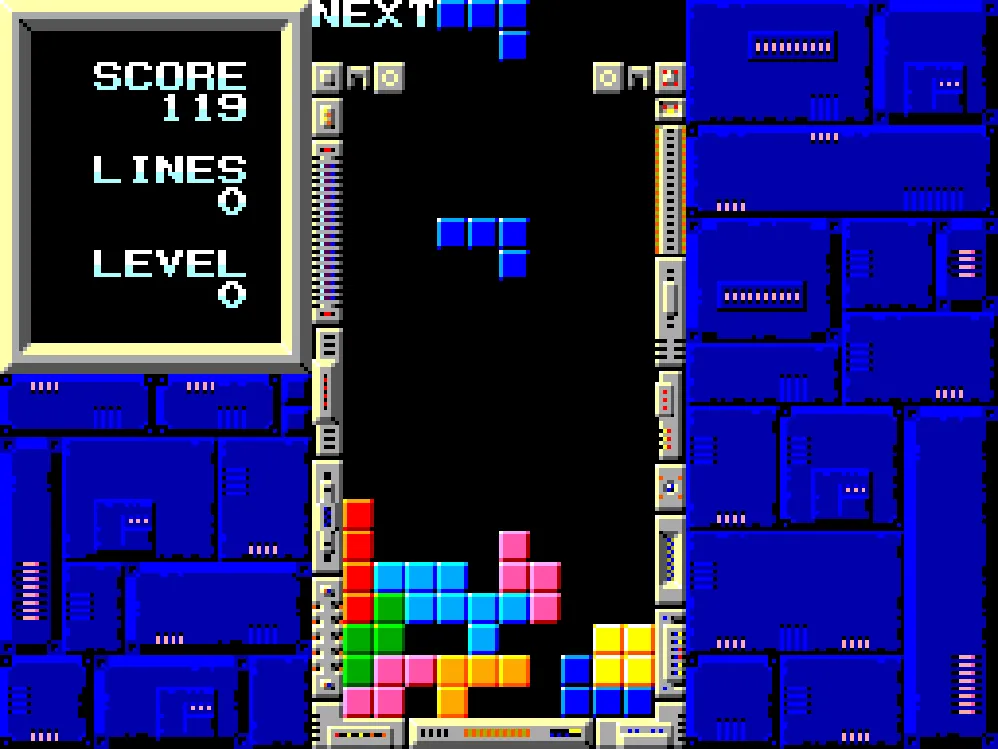
Tetris is a game without a plot, characters, or cutscenes. It features a single, pure, and abstract mechanic: blocks of different shapes fall from the top of the screen, and players must rotate and move them to form complete horizontal lines at the bottom. Completing a line clears it; if the blocks stack to the top, the game ends.
Yet, it is this minimalist design that made Tetris the best-selling and most widely ported video game in history. It transcends language, culture, and borders—whether in a Tokyo arcade, a California game room, or a Soviet computer lab in Moscow, people have always been focused on the same goal: fitting the blocks together perfectly. Tetris is the ultimate proof that video games are an art form: the greatest designs are often the simplest.
1.2 Development History
The birth of Tetris is a story steeped in the Cold War. On June 6, 1984, Alexey Pajitnov, a researcher at the Soviet Academy of Sciences' Computing Center, created the game on an Elektronika 60 computer. Inspired by the game of pentominoes, Pajitnov simplified it into tetrominoes (shapes made of four blocks). He coined the name "Tetris" by combining the Greek word "tetra" (four) with his favorite sport, "tennis."
The original version ran on the text-only Elektronika 60, using spaces and brackets to represent blocks. Pajitnov's colleague, Vadim Gerasimov, ported it to the IBM PC, adding color graphics and a scoring system. From there, Tetris spread among colleagues at the Academy and quickly diffused into computer circles in Budapest, Warsaw, and other Eastern European cities.
The international licensing of the game was incredibly complex. British software entrepreneur Robert Stein secured rights from Pajitnov himself—but the Soviet government argued that software copyright belonged to the state, not the individual. Subsequently, companies like Nintendo, Atari Games, and Tengen became embroiled in a complex legal battle. Eventually, Nintendo secured the home console rights and bundled Tetris with the Game Boy—a move that became one of the most successful hardware-software pairings in history, with the Game Boy version alone selling over 35 million copies.
The arcade version of Tetris was released by Atari Games in 1988 (officially mass-produced in February 1989), led by legendary designer Ed Logg (creator of Asteroids and Gauntlet). Compared to Nintendo's NES version released a year earlier, the Atari arcade version featured a smoother difficulty curve, avoiding the "cliff-like" difficulty spikes of the NES version, and is considered by many core players to have superior feel and pacing. The arcade version is also one of the few to support a two-player cooperative mode, allowing players to work together to clear lines.
2. Game System Explained
2.1 Basic Rules
The core rules of Tetris can be summarized in three points:
- Seven Tetrominoes (I, O, T, S, Z, J, L) fall from the top of the screen in a random sequence.
- Players can move, rotate, and accelerate the fall of the blocks, aiming to stack them tightly at the bottom.
- Complete horizontal lines are automatically cleared, and blocks above shift down. If the stack reaches the top, the game ends.
There is no victory condition—the goal is not to "win," but to survive as long as possible and achieve a high score. This "infinite challenge" design was revolutionary at the time, making Tetris a game that can never truly be "beaten."
2.2 The Seven Tetrominoes
| Shape | Name | Color | Strategy Tip |
|---|---|---|---|
| ■■■■ | I-Piece | Cyan | The most critical piece—the only one that can clear four lines at once; always save space for it |
| ■■ / ■■ | O-Piece | Yellow | Cannot be rotated; stable but can create uneven stacks |
| ■■■ + ■ | J-Piece | Blue | Great for filling gaps on the left |
| ■■■ + □■ | L-Piece | Orange | Mirror of the J-piece; great for filling gaps on the right |
| □■■ / ■■□ | S-Piece | Green | Changes orientation when rotated; requires foresight |
| ■■□ / □■■ | Z-Piece | Red | Mirror of the S-piece; often the most frustrating for beginners |
| □■□ / ■■■ | T-Piece | Purple | Versatile; fills various gaps and is the core of the T-Spin |
2.3 Controls
| Action | Description |
|---|---|
| Move Left/Right | Shift the falling piece one column left or right |
| Rotate Clockwise | Rotate the piece 90° to fit different gaps |
| Soft Drop | Accelerate the piece's descent |
| Hard Drop (Some versions) | Instantly drop the piece to the bottom (not in original arcade version) |
| Hold (Some versions) | Store the current piece for later use (not in original arcade version) |
The Atari arcade version's control feel is a core advantage. Ed Logg spent significant time tuning the DAS (Delayed Auto Shift) and rotation system response curves, making the arcade version's feedback more precise and fluid than contemporary home versions.
2.4 Scoring System
| Lines Cleared | Name | Base Score | Description |
|---|---|---|---|
| 1 Line | Single | 100 | Basic clear |
| 2 Lines | Double | 300 | Clear two lines at once |
| 3 Lines | Triple | 500 | Clear three lines at once |
| 4 Lines | Tetris | 800 | Clear four lines with an I-piece—the highest honor in Tetris |
Scores increase with the current level. The Atari arcade version also grants bonuses based on the height at which lines are cleared—clearing lines higher up yields more points, encouraging aggressive stacking strategies.
3. Advanced Tips and Strategies
3.1 Beginner Tips
- Keep the stack flat: Uneven surfaces make it hard to place future pieces. Use J, L, and T pieces to fill low spots. A flat surface is the foundation of high-level play.
- Leave an I-piece channel: Keep at least one vertical column open for the I-piece to clear four lines. The classic method is to leave the far left or right column open.
- Don't clear just to clear: Instead of clearing one or two lines, wait patiently for the I-piece to clear four lines at once. The score and satisfaction are far greater.
- Anticipate S and Z pieces: These pieces are mirror images and easy to confuse. Plan where they go before they drop to avoid creating jagged, hard-to-fix gaps.
- Watch the Next queue: The "Next" piece display is crucial for planning your strategy. Adjust your current placement based on what's coming next.
3.2 Advanced Strategies
- Deep Stacking: Not every row needs to be perfectly flat. In some cases, intentionally creating "wells" to accommodate specific shapes can improve overall efficiency.
- Continuous Rotation and Micro-management: Experts can perform complex rotation and movement sequences in milliseconds. Practice moving pieces quickly—at high levels, a 0.1-second hesitation can be fatal.
- Pacing Control: When the stack gets high, slow down your pace to give yourself time to think. Don't panic—at high difficulty, calm judgment is more important than raw speed.
- Look-ahead and Planning: Great players don't just react to the current piece; they plan the placement of the next 2-3 pieces in their heads. This "deep look-ahead" is what separates pros from casual players.
3.3 Speedrunning Techniques
In speedrunning (40-line Sprint), top players can clear 40 lines in under 20 seconds. With over 2 actions per second, every move is muscle memory built through thousands of hours of practice.
- Finesse: Using the minimum number of keystrokes to place a piece. For example, moving a piece from the center to the edge in 5 presses instead of 10.
- T-Spin: Using the T-piece's rotation to "tuck" it into seemingly inaccessible gaps. In most modern versions, T-Spins grant bonus points and are a key differentiator for experts.
- Perfect Clear: Clearing the entire screen from the start using precise opening patterns.
3.4 Arcade vs. Home Versions
| Feature | Atari Arcade | Nintendo NES | Game Boy |
|---|---|---|---|
| Release | 1988/1989 | Oct 1989 | Jun 1989 |
| Designer | Ed Logg | Nintendo | Nintendo |
| 2-Player | Co-op | None | Link Battle |
| Difficulty | Smooth | Sharp Spikes | Progressive |
| Reputation | Core favorite | Most popular | Best-selling |
4. History and Cultural Impact
4.1 The Tengen Version and Copyright War
Tengen (an Atari Games subsidiary) released an unlicensed NES version of Tetris in 1989. It featured a two-player co-op mode and was ranked 48th on IGN's Top 100 NES games—the official Nintendo version didn't even make the list. However, after Nintendo won in court, a judge ordered all existing Tengen cartridges to be destroyed. About 100,000 were sold, and 268,000 were recalled and destroyed, making the Tengen version a "holy grail" for collectors.
4.2 The Most Ported Game in History
Tetris holds the Guinness World Record for the "most ported video game"—appearing on over 65 platforms, from arcades and consoles to calculators, oscilloscopes, and digital signage. This unparalleled reach makes Tetris a truly universal game.
4.3 Modern Competition and Artistic Revival
In recent years, community-driven versions like Tetr.io and Jstris have pushed online competition to new heights, while official titles like Tetris 99 (Battle Royale) and Tetris Effect (audiovisual masterpiece) have redefined the game. In 2022, 13-year-old Blue Scuti became the first human to "beat" the NES version of Tetris—reaching level 157, where the game crashed due to an integer overflow, a milestone moment for the community.
4.4 Film Adaptation
In 2023, Apple TV+ released the film Tetris, starring Taron Egerton, telling the dramatic true story of the copyright battle. The film weaves together Cold War geopolitics, KGB interference, and corporate maneuvering, showing a new generation the thrilling history behind the simple block game.
5. Trivia and Culture
5.1 A 35-Year Cultural Phenomenon
Tetris is one of the most culturally pervasive video games ever. Its music—especially the Game Boy version's arrangement of the 19th-century Russian folk song "Korobeiniki"—has become an auditory symbol for video games themselves. The block shapes appear on T-shirts, mugs, LEGO sets, and even fashion runways. In 2019, the Tetris theme was added to the U.S. Library of Congress's National Recording Registry.
5.2 The "Tetris Effect"
Psychologists have found that long-term players often "see" blocks falling in their minds when they close their eyes—a phenomenon known as the "Tetris Effect." Studies suggest that regular play can increase gray matter in the brain and improve spatial cognition, and it has even been used as an aid in PTSD therapy to reduce the recurrence of traumatic imagery.
5.3 1989 Nintendo World Championships
In 1989, Nintendo held the "Nintendo World Championships" across the U.S. Contestants competed for high scores in Tetris, Super Mario Bros., and Rad Racer. The winner took home a car, a 40-inch projection TV, and a gold cartridge. That gold cartridge remains one of the most expensive collectibles in gaming, having sold for over $100,000 at auction.
5.4 AI and Infinite Play
In 2019, Google DeepMind researchers used reinforcement learning to train an AI to play Tetris. After millions of self-play games, the AI mastered advanced techniques like T-Spins and Perfect Clears. Ultimately, the AI could play indefinitely—proving that Tetris is theoretically an "infinite" game, though for humans, the limit usually lies between levels 20-30.
5.5 The First Game Played in Space
In 1993, Tetris became the first video game played in space. Russian cosmonaut Aleksandr Serebrov played it on a Game Boy aboard the Mir space station. The Game Boy and cartridge were later returned to Earth and auctioned off as the "game cartridge from space."
5.6 Pajitnov's Long Wait
Pajitnov created Tetris in 1984, but he didn't start receiving royalties until he moved to the U.S. after the Soviet Union collapsed in 1996. Before that, all proceeds were collected by ELORG, the Soviet state organization. Pajitnov once joked: "I created the world's best-selling game, but it took me 12 years to earn my first penny from it."