1. Game Background
1.1 World Setting
In 1987, four ordinary pet turtles were exposed to a mysterious mutagen, causing them to undergo genetic mutation. Under the guidance of their master, Splinter, they became the guardians of New York City's underground: the Teenage Mutant Ninja Turtles. The game's plot closely follows the animated series: reporter April O'Neil is kidnapped by the Foot Clan while investigating criminal activity, and the villainous Shredder uses her to lure the Turtles into a trap. The four Turtles must traverse the most dangerous corners of New York City, from burning buildings and sewers to interdimensional spaces and the high-tech Technodrome, to rescue April and stop Shredder's evil plans.
The game masterfully captures the core charm of the 80s cartoon: gritty, street-level stage designs, humorous character-driven dialogue, and that fearless teenage hero spirit. Each level feels like an episode of the show, taking players from sewers to city streets and into the realm of Krang, offering an interactive TMNT animated movie experience.
1.2 Development History
Developed and published by Konami in 1989, the TMNT arcade game was one of the company's most significant coin-op projects of the era. Running on Konami's proprietary hardware, the game utilized 16-bit color to deliver vibrant, crisp visuals that perfectly recreated the aesthetic of the '87 series. The Japanese title was Teenage Mutant Ninja Turtles: Super Kame Ninja, while the European version was released as Teenage Mutant Hero Turtles.
The game's most landmark innovation was its dedicated four-player arcade cabinet—a rarity in 1989, where four joysticks and eight buttons on a single machine was almost unheard of. Four players could control the four Turtles simultaneously, creating a multiplayer beat-'em-up experience that caused a sensation. It became Konami's highest-grossing arcade title ever and the top-earning dedicated arcade game in the U.S. in 1990. Its massive success directly paved the way for the iconic sequel, Turtles in Time. The game is also famous for its digitized voice samples, with character shouts and the classic theme song becoming some of the most recognizable sounds in arcades at the time.
2. Character Introduction
Each of the four Turtles wields a unique weapon, which dictates their attack range, speed, and combat style. Understanding these differences is key to choosing your character.
| Character | Weapon | Range | Attack Speed | Movement Speed | Specialty |
|---|---|---|---|---|---|
| Leonardo | Katana | Medium | Fast | Medium | Most balanced, ideal for beginners |
| Michelangelo | Nunchucks | Short | Very Fast | Fast | Highest combo density, strong close-range pressure |
| Donatello | Bo Staff | Very Long | Slow | Medium | Best crowd control, most efficient at clearing mobs |
| Raphael | Sai | Short | Very Fast | Fast | Highest burst damage, great for quick boss kills |
Donatello's bo staff is a strategic advantage in beat-'em-ups; his normal attacks hit enemies both in front of and behind him, making him excellent in surrounded situations. Raphael deals the highest damage but requires getting close to enemies, balancing high risk with high reward. Leonardo is the default choice for beginners due to his balanced stats. Michelangelo's nunchucks are the fastest, but require precise positioning when facing bosses.
3. Controls
3.1 Basic Controls
The four-player cabinet uses the classic beat-'em-up layout: an eight-way joystick and two buttons.
| Button | Action | Description |
|---|---|---|
| Joystick | 8-Way Movement | Control character positioning |
| A (Attack) | Normal Attack | Press repeatedly for combos |
| B (Jump) | Jump | Press A while jumping for a jump attack |
| A+B | Special Move | Consumes a small amount of HP for a screen-clearing attack |
3.2 Advanced Mechanics
Jump attacks are the most important advanced maneuver. Pressing the attack button while jumping over an enemy triggers a downward strike, dealing extra damage and briefly knocking them down. Additionally, when an enemy is grounded, you can approach them to perform a finishing move; each Turtle has a unique animation for these.
The combo system allows players to string together 3-4 hits by rhythmically pressing A, with the final hit launching enemies. You can weave jump attacks into combos to bridge aerial and ground attacks. The flying kick (Forward, Forward + Jump) is a core skill for breaking through enemy lines and repositioning.
Special Moves consume a portion of your health, and the range varies slightly between Turtles. While highly effective when the screen is crowded, the health-cost mechanic means they should be used judiciously.
4. Level Walkthrough & Boss Strategy
The TMNT arcade game features 7 main levels, covering iconic locations across NYC and beyond.
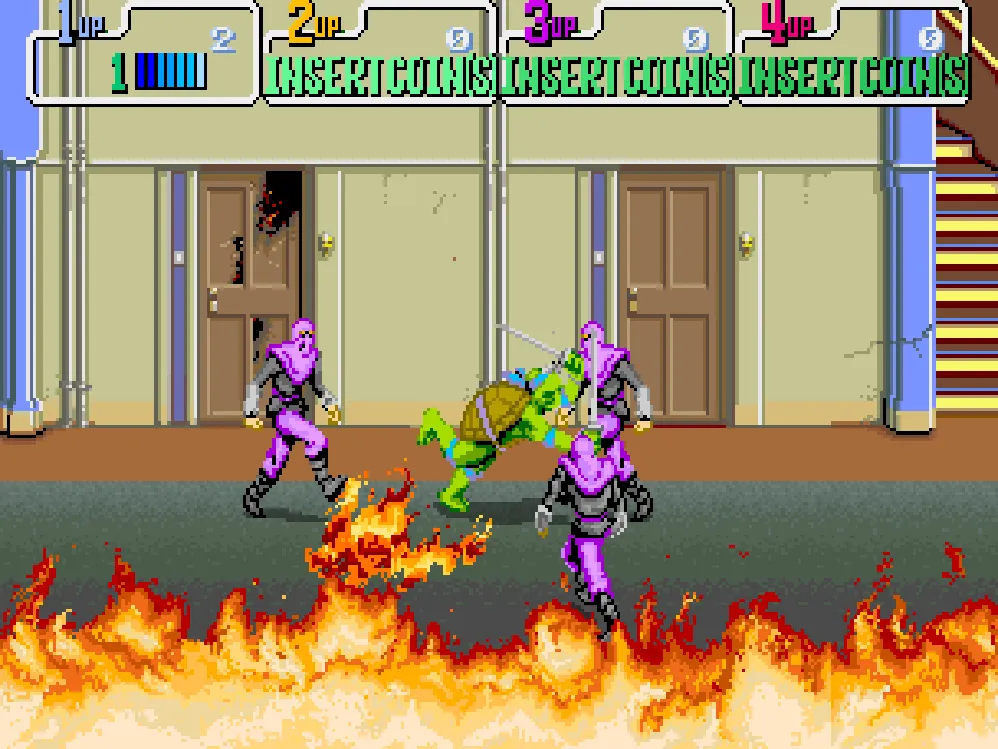
Level 1: Burning Apartment Building
| Item | Content |
|---|---|
| Setting | A burning apartment hallway where April is trapped |
| Boss | None; ends with a cutscene rescuing April |
| Strategy | Fire erupts from walls and floors; prioritize clearing Foot Soldiers and don't linger in the flames. Use A+B to clear space if surrounded |
Level 2: NYC Streets
| Item | Content |
|---|---|
| Setting | Downtown Manhattan streets and underground parking |
| Boss | Rocksteady |
| Strategy | Rocksteady's charge is dangerous. Keep your distance and attack when he's stunned after hitting a wall. Don't let him charge between you |
Level 3: Sewers
| Item | Content |
|---|---|
| Setting | New York City sewer system |
| Boss | Bebop |
| Strategy | Bebop fights like Rocksteady but is faster. Use the narrow terrain to your advantage. Jump attacks are effective for dodging his melee strikes |
Level 4: City Highway
| Item | Content |
|---|---|
| Setting | Moving trucks and cars on the highway |
| Boss | Baxter Stockman (in his fly mech) |
| Strategy | Stockman hovers in the air; wait for him to descend into range. Clear the minions first before focusing on him |
Level 5: Krang's Dimension
| Item | Content |
|---|---|
| Setting | Krang's high-tech alien dimension |
| Boss | Granitor (Rock Golem) |
| Strategy | Granitor's rock throws are homing; keep moving. He has a long recovery time after his melee smash—capitalize on this |
Level 6: Technodrome (Final Level)
| Item | Content |
|---|---|
| Setting | The Technodrome fortress |
| Boss | Shredder |
| Strategy | Shredder is fast and hits hard. Clear minions first to create space. Use jump attacks to dodge his charges and strike when he's stunned. His armor breaks as he takes damage |
5. Tips & Advanced Strategy
5.1 Survival Tips
- Pizza Priority: Always save full-health pizzas for the teammate with the lowest HP. Don't hesitate to eat one when surrounded—eating pizza grants invincibility frames.
- Corner Rule: Never let yourself get pinned in a corner; Foot Soldiers swarm quickly. Use flying kicks to break out before you're surrounded.
- Jump Strike Control: Downward strikes knock down most enemies instantly, especially effective against shield-wielding Foot Soldiers. Master the rhythm of following up with a normal attack upon landing.
- Special Move Timing: A+B is best used when surrounded by 3+ enemies. Don't waste health on just 1-2 foes.
- Cooperation: In 4-player mode, don't crowd together. Spread out to cover more ground. Donatello should control the sides, while Raphael breaks through the center.
- Boss Rhythm: Bosses almost always start with a charge or jump-smash. Keep your distance, wait for them to land, then counter-attack. Greedily attacking is the #1 cause of death for beginners.
6. Trivia & Arcade Legends
6.1 Pizza Hut Product Placement
The pizza-based health recovery wasn't random—Pizza Hut was a major sponsor of the TMNT cartoon at the time, making the in-game pizza a form of soft product placement. It fit so perfectly that players accepted it as canon: of course the Turtles love pizza.
6.2 The European "Hero" Censorship
In Europe, the title was changed to Teenage Mutant Hero Turtles because authorities in countries like the UK were uncomfortable with the word "Ninja." Michelangelo's nunchucks were also edited or removed in some versions. Interestingly, the cartoon was also retitled, and all mentions of "Ninja" were redubbed.
6.3 The 4-Player Legend
Launching a 4-player cabinet in 1989 was a massive gamble. Konami invested heavily in the 25-inch screen and four-joystick setup. It paid off—the cabinet became a "money magnet" in arcades, with kids lining up just to watch. It remains one of the few arcade games to truly master 4-player cooperative play.
6.4 The Digital Voice Revolution
The game's voice samples were considered cutting-edge—the "Cowabunga!" shout, played through high-fidelity chips, sounded far superior to most arcade games of the time. The arcade arrangement of the theme song, produced by Konami's internal music team, still instantly transports players over 30 back to their childhood.