I. Game Background
1.1 Bringing Volleyball to the Arcade
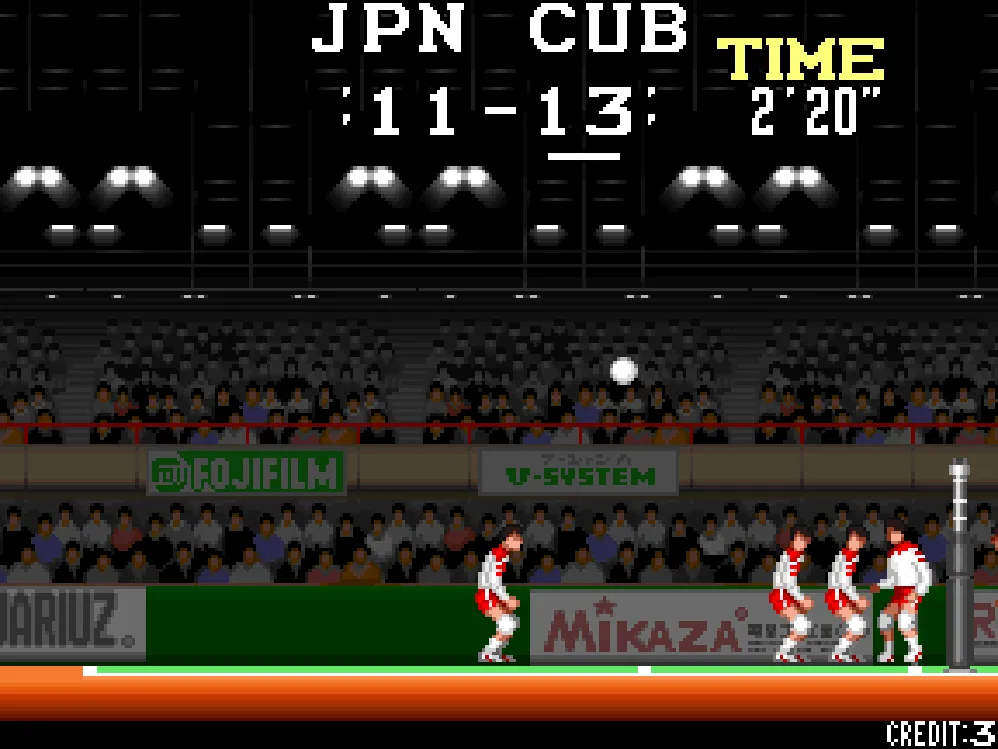
Super Volleyball is a sports game that brings the authentic experience of six-a-side indoor volleyball to the arcade screen. There are no magical special moves, no sci-fi mechs, and no supernatural flaming spikes—just your six-player team. You must precisely execute the three-touch sequence—bump, set, and spike—to break through the opponent's defense.
This was a bold design choice for the 1989 arcade market. Contemporary sports titles like NBA Jam, Double Dribble, and Super Sidekicks typically focused on high-speed sports like basketball or soccer, often utilizing exaggerated mechanics to boost excitement. Super Volleyball chose the relatively niche sport of volleyball and stuck to a simulation system close to real-world rules—a rarity for arcade sports games at the time.
The game features 8 national teams, allowing players to represent global volleyball powerhouses and battle their way to the championship in a tournament format.
1.2 Development History
Super Volleyball was developed by the Japanese company V-System (Video System). It debuted in Japanese arcades in August 1989 and was published in North America by Data East in September of the same year. V-System was a Japanese developer known for sports and shooting games—the Power Spikes series (a volleyball/tennis hybrid) and Aero Fighters (a shooter) are among their most famous later works.
The game was ported to the PC Engine (TurboGrafx-16) in 1990 and the Sega Genesis (Mega Drive) in 1991. The Genesis version received a 17/40 rating from the American magazine Electronic Gaming Monthly, which criticized its "repetitive gameplay and dated 2D mechanics." However, in fairness, balancing pure simulation with arcade-style visual flair was a difficult challenge for home console sports games in 1991.
In August 2022, Hamster Corporation brought Super Volleyball to the Nintendo Switch and PlayStation 4 via its Arcade Archives series, having acquired the full rights to Video System's library. This marked the game's first official release on modern platforms since the 1990s.
II. Game Mechanics Explained
2.1 Basic Volleyball Rules
Super Volleyball faithfully simulates the standard rules of six-a-side indoor volleyball:
| Rule | Description |
|---|---|
| Six-a-side | 6 players on court: 3 front-row (spiking/blocking) and 3 back-row (receiving/defense) |
| Three Touches | Teams must return the ball within three touches: Bump (receive) → Set (toss) → Spike (attack) |
| Rotation | Players rotate one position clockwise after regaining the serve |
| Scoring | Side-out scoring: Only the serving team scores points; the receiving team earns the serve upon winning a rally |
| Net Foul | Touching the net while hitting the ball is a foul, awarding a point to the opponent |
| Out of Bounds | The attacking team loses the point if the ball lands outside the court lines |
2.2 The Eight National Teams
| Country | Type | Characteristics |
|---|---|---|
| Japan | Balanced | Well-rounded stats, smooth transitions between sets and spikes—ideal for beginners |
| USSR | Power | Highest spike power and block height—but slower movement speed |
| USA | All-Rounder | Strong stats across the board, best overall performance—suitable for advanced players |
| Brazil | Speed | Fastest movement speed and widest defensive coverage—but lower spike power |
| China | Defensive | Most forgiving reception and defensive hitboxes—highest error tolerance |
| Cuba | Explosive | Spike power second only to the USSR, but weaker reception and defense |
| Italy | Technical | Most precise setting—largest window for tactical coordination |
| South Korea | Speed | Movement speed similar to Brazil, but with slightly better blocking ability |
III. Controls and Gameplay
3.1 Basic Controls
Super Volleyball uses a simple 8-way joystick + 2-button layout. Famitsu praised its "simple controls," which hide a deep tactical layer:
| Action | Input | Description |
|---|---|---|
| Move | Directional Pad | Control the currently selected player's movement on the court |
| Receive/Bump | A Button | Bump the ball when receiving or defending—accuracy depends on positioning and angle |
| Set/Toss | Auto-switch + A Button | Toss the ball toward the net—height and position determine spike quality |
| Spike | Auto-switch + A Button + Direction | Press at the right moment to spike—directional input controls the angle |
| Block | Front-row + B Button | Jump at the net to block—precise timing can shut down an opponent's spike |
| Serve | Serve turn + A Button + Direction | Jump serve or float serve—power and angle depend on timing and direction |
| Switch Player | Automatic | The system automatically selects the player closest to the ball's landing spot |
3.2 Tactical Core
While the controls are simple, the competitive depth comes from positioning and timing:
- Reception Quality is Everything: If your reception is off-target or too low, the window for a good set becomes narrow, making a powerful spike nearly impossible. The first touch is the foundation of your offense.
- The Setter is the Tactical Commander: You control the height and lateral position of the set. High sets allow for longer run-ups and more power; low sets allow for quick attacks but with reduced spike force.
- Spike Angle Determines Placement: Use the directional pad to control the flight path. Straight spikes are fast but easily blocked; diagonal spikes can bypass blockers but are more likely to go out of bounds.
- Blocking Timing is Key: Front-row players must jump the moment the opponent spikes. Jumping too early gets you faked out; jumping too late means the ball has already passed. Mastering this timing separates novices from experts.
IV. Tournament Flow and Strategy
The game uses a knockout tournament format—players start from the quarterfinals and must win three consecutive matches to take the title.
| Round | Opponent | Characteristics | Strategy |
|---|---|---|---|
| Quarterfinals | Random low-seed | Low stats, slow AI blocking reaction | Focus on spiking—the AI's blocking is not a major threat here |
| Semifinals | Mid-seed | Improved AI blocking and reception—higher chance of spikes being blocked | Use varied spike angles—diagonal spikes are essential to bypass the block |
| Finals | Top-seed (e.g., USSR or USA) | Extremely powerful spikes and precise blocking—one mistake can lead to a point streak | Defense over offense. Prioritize reception quality—a shaky first touch can collapse the rally. Use blocks to drain the opponent's stamina. Victory often goes to the player with fewer reception errors |
V. Tips and Advanced Strategies
5.1 Basic Tips
- Reception is Key: Ensure your player is directly under the ball when receiving. Receiving from the side causes the ball to veer off-course, leaving the setter unable to recover.
- Keep the Setter Mid-Court: This is a fundamental volleyball principle. If your setter is too far from the net when receiving, a strong spike is nearly impossible.
- Don't Always Spike at Full Power: A "dink" or soft shot can fool opponents who have already jumped to block. Dropping the ball over the net just as the blockers start to descend is the most efficient way to steal points.
- Don't Jump for Every Block: Frequent jumping drains stamina. Only jump when the opponent's spiker shows a clear jump animation.
- Japan is the Best Choice for Beginners: Balanced stats mean you won't have any fatal weaknesses—a lack of major flaws is the best insurance for a first-time clear.
5.2 Advanced Strategies
- Serving Tactics: Aim for the opponent's weakest receiver—usually the players on the back-row corners. Serving to the back-row sidelines maximizes the chance of a reception error.
- Rotation Management: After every rotation, your best spiker moves to a new position. Check immediately if they are in the front or back row. If they are in the back, shift your offensive focus to the other front-row player.
- Stamina Management: Constant jumping (spiking/blocking) drains stamina, reducing jump height and spike power. Avoid unnecessary jumps in low-stakes rallies to save energy for critical points.
VI. Trivia and Arcade Legends
6.1 A "Gentleman's Sport" in the Arcade
In an era dominated by Final Fight, Golden Axe, and Ninja Gaiden, Super Volleyball offered a unique experience—no violence, no enemies, no death. Two cabinets placed face-to-face often drew crowds as players engaged in intense volleyball duels, creating a social atmosphere that was quite rare for the time.
6.2 V-System's Sports Legacy
Starting with this title, V-System went on to develop Power Spikes (1991) and Power Spikes II (1994), evolving from six-a-side volleyball into a more aggressive volleyball/tennis hybrid. The Power Spikes series became one of the most popular sports franchises on the Neo Geo. Super Volleyball stands as the origin of this evolution, proving that "authentic sports simulation" could find its own audience in the arcade.
6.3 The 2022 Surprise Return
When Hamster Corporation added Super Volleyball to the Arcade Archives series in 2022, many modern players experienced it for the first time. Reactions were polarized: older players relived their 1989 arcade memories on the Switch, while younger players were surprised by the "must touch three times" rule—a stark contrast to modern sports games where a single button press often triggers a flashy, instant spike.