1.1 World Setting
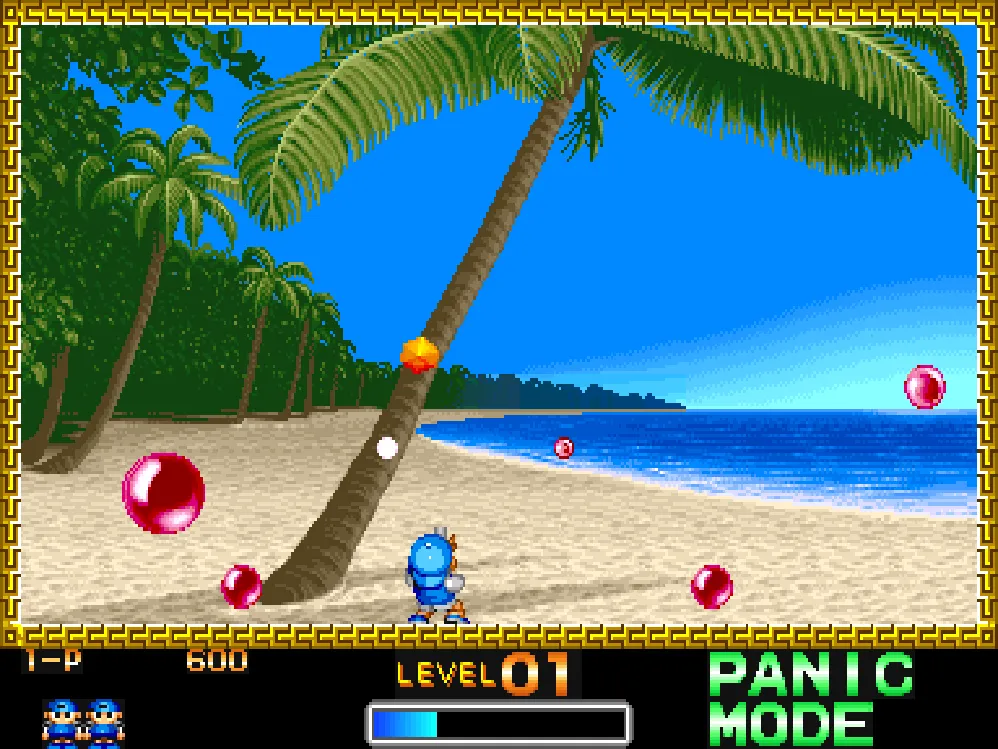
Super Pang is the second installment in the Pang series, developed by Japan's Mitchell Corporation and published by Capcom in 1990. Played from a top-down perspective, players take on the roles of two adventurers armed with harpoon guns, shooting at bubbles that bounce incessantly across the screen. These mysterious bubbles have swept across iconic cities worldwide, and players must follow their trail, embarking on a global adventure to clear them from famous landmarks like the Eiffel Tower in Paris, Big Ben in London, the Egyptian Pyramids, and the Statue of Liberty in New York.
While the game lacks a complex narrative, its core premise is simple yet urgent: bubbles constantly split and bounce, and touching one results in an instant loss of life. The player's mission is to clear all bubbles from the screen within a limited time while dodging their collisions. This "split-and-eliminate" mechanic forms the series' core gameplay DNA and laid the foundation for its many sequels.
1.2 Development History
The first game in the series, Pang (known as Buster Bros in North America), was released by Mitchell Corporation in 1989. With its simple, intuitive controls and addictive split-and-eliminate mechanics, the original title quickly became a hit in arcades. In 1990, Mitchell capitalized on this success by releasing Super Pang, which featured comprehensive upgrades while retaining the core gameplay.
Compared to its predecessor, Super Pang saw significant improvements in graphics, level variety, and the item system. The background stages expanded from abstract, single-screen settings to real-world landmarks, featuring more vibrant colors and distinct visual styles. The variety of items grew from a few basic types to include rapid fire, double shots, time stops, force fields, and dynamite, greatly enhancing the game's strategic depth and replayability. Capcom's involvement as a publisher also provided broader distribution, making Super Pang one of the most well-known titles in the series globally.
II. Character Introduction
Super Pang offers a two-player cooperative mode, where players control 1P and 2P respectively. The 1P character wears blue, while the 2P character wears red. Both characters are identical in ability and control, with no attribute differences. This symmetrical design ensures fairness in two-player mode, where victory depends entirely on the players' skills and coordination.
In two-player mode, both players share the same screen space and must coordinate their movements to avoid interfering with each other while working together to clear the bubbles. Cooperation can significantly lower the difficulty, as players can divide the screen to handle different areas, but it also requires high levels of synergy—if one player makes a mistake and gets hit, the other is left to face the remaining challenge alone.
III. Controls and Gameplay
3.1 Basic Controls
Super Pang's controls are extremely simple and intuitive, requiring only a joystick and a single attack button. The joystick moves the character left and right at the bottom of the screen, while the attack button fires the harpoon upward. The harpoon travels in a straight line; hitting a bubble causes it to split. Players cannot jump and must stay on the ground, meaning dodging bubbles relies entirely on positioning, prediction, and timing.
The game uses a health system where touching a bubble of any size results in an immediate loss of a life. There is a brief period of invincibility after being hit, but the overall margin for error is extremely low. Each level also has a time limit; failing to clear all bubbles before time runs out results in a game over.
3.2 Bubble Splitting and Item System
The bubble-splitting mechanic is the heart of Super Pang. When a large bubble is hit, it splits into two medium bubbles; medium bubbles split into two small ones; small bubbles are eliminated upon being hit. Bubbles bounce continuously, and their movement patterns change after splitting, making late-game clearing increasingly unpredictable.
The item system is a major evolution from the original. Breaking bubbles randomly drops various items that take effect upon collection:
- Rapid Fire: Significantly increases firing speed for a short time.
- Double Shot: Fires two parallel harpoons, covering a wider vertical range.
- Stop Time: Freezes all bubble movement for several seconds.
- Force Field: Provides a temporary shield that absorbs one bubble collision.
- Dynamite: Destroys all bubbles within a certain range of the player.
- Hourglass: Extends the time limit for the current level.
- Bonus Items: Includes fruits, food, etc., providing extra points.
IV. Level Progression and Strategy
Super Pang features dozens of levels themed around a world tour. The game starts in Paris, set against the Eiffel Tower at night; then moves to London, fighting in front of Big Ben by the Thames; continues to Egypt, challenging denser bubbles against the backdrop of the Pyramids and the Sphinx; and finally heads to New York for intense battles among skyscrapers. Each region features unique background art and color palettes, keeping the visuals fresh.
Difficulty increases progressively. Early levels have fewer, slower-moving bubbles, giving players time to adapt. By mid-to-late game, the number of bubbles surges, their initial sizes increase, and their movement patterns become more complex, often with over a dozen bubbles of varying sizes on screen at once. The game does not feature traditional boss fights; the challenge of each level is simply clearing all the bubbles. However, in certain stages, the spawn positions and initial trajectories of the bubbles are meticulously designed.
V. Tips and Advanced Strategy
5.1 Basic Survival Tips
The first rule of survival is to prioritize large bubbles. They are large, slow, and relatively easy to hit. If left unchecked, they split into numerous smaller bubbles, quickly leading to an uncontrollable situation. It is recommended to fire at the nearest bubble as soon as the level starts to eliminate as many as possible before they spread out.
Regarding positioning, the core principle is to avoid standing directly under a bubble. The harpoon fires vertically, so if you aren't under the bubble's path, you won't hit it. The correct approach is to predict where the bubble will land, move to the spot in advance, and fire. Always keep moving—never stay in one spot for more than a second, as bubble paths can change at any moment.
In terms of items, the Stop Time is one of the most precious. Use it when the screen is crowded and the situation is dire to catch your breath. Don't use it immediately upon pickup; save it for when you truly need it. Dynamite is best used in dense areas to clear large groups of bubbles at once. Use the Force Field when bubbles are numerous and space is limited to provide a safety net.
For two-player cooperation, it is best for each player to take one side of the screen to avoid collisions. When one player is in danger, the other should immediately shoot nearby large bubbles to relieve the pressure. Agree on item distribution beforehand to avoid fighting over the same power-up and leaving yourselves vulnerable.
VI. Trivia and Arcade Legends
Super Pang is known by different names in different regions. In Japan and Asia, it is called Super Pang, while in North America, it was released as Super Buster Bros. This multi-naming phenomenon was quite common for arcade games in the 90s.
There is a popular legend regarding the game's origin: the Mitchell Corporation development team supposedly got the idea while playing with a bouncy ball during a break. They noticed the hypnotic fun of the splitting process and turned it into the game's core mechanic. While never officially confirmed, this story remains a staple in the Japanese arcade community.
In arcade culture, Super Pang became one of the most popular games for couples and friends due to its two-player mode. The experience of fighting side-by-side made it a classic example of social arcade gaming. The game also appeared in several 90s films and TV shows, becoming a cultural symbol of that era.
Since its debut in 1989, the Pang series has continued to grow, releasing Pang, Super Pang, and Pang 3 in arcades, later arriving on home platforms like PlayStation, Game Boy, and Sega Genesis, and being re-released in modern collections. To this day, Super Pang is considered the definitive entry that best captures the essence of the series, with its simple yet profound design still attracting many loyal players.