I. Game Background
1.1 Setting the Stage
Street Fighter Alpha: Warriors' Dreams is set on the timeline between the original Street Fighter and Street Fighter II. As a "prequel," it explores the origins of many iconic elements within the series.
At this point in the story, Ryu has just defeated Sagat, but the "Satsui no Hado" (Surge of Murderous Intent) is beginning to stir within him—a dark power slowly corrupting his mind. Ken Masters, sensing his friend's inner turmoil, sets out to find him. Chun-Li, an Interpol agent, has just begun investigating the Shadaloo organization; her father is still alive, but she can already sense the encroaching danger. Guile's comrade, Charlie Nash, is deep undercover investigating Shadaloo, a mission that will lead to one of the most heartbreaking sacrifices in the series.
At the center of this conspiracy, M. Bison—the dictator of Shadaloo—is perfecting his Psycho Power, preparing to execute a plan that will change the world forever.
1.2 Development History
Capcom developed the game on the CPS2 (Capcom Play System 2) hardware, officially releasing it in 1995. The game's origins were unique: players worldwide were anxiously awaiting news of Street Fighter III, but development was moving much slower than expected. The Alpha project was quickly greenlit as a "bridge" title to fill the market gap between SF2 and SF3.
However, it ultimately transcended its role as a mere "bridge."
It introduced three innovations that had a profound impact on the series:
- Alpha Counter: Allows players to spend a level of their Super Meter while blocking to launch a counter-attack, breaking the passive nature of defense.
- Chain Combo: Light attacks can be canceled into each other in a natural rhythm, significantly lowering the barrier to entry for combos.
- New Art Style: Legendary artist Bengus (CRMK) led the character design and key animation, establishing a heavy-stroked, anime-inspired aesthetic that differed sharply from SF2. This visual language remained a staple through Alpha 3 and continues to influence the series in SF4 and SF5.
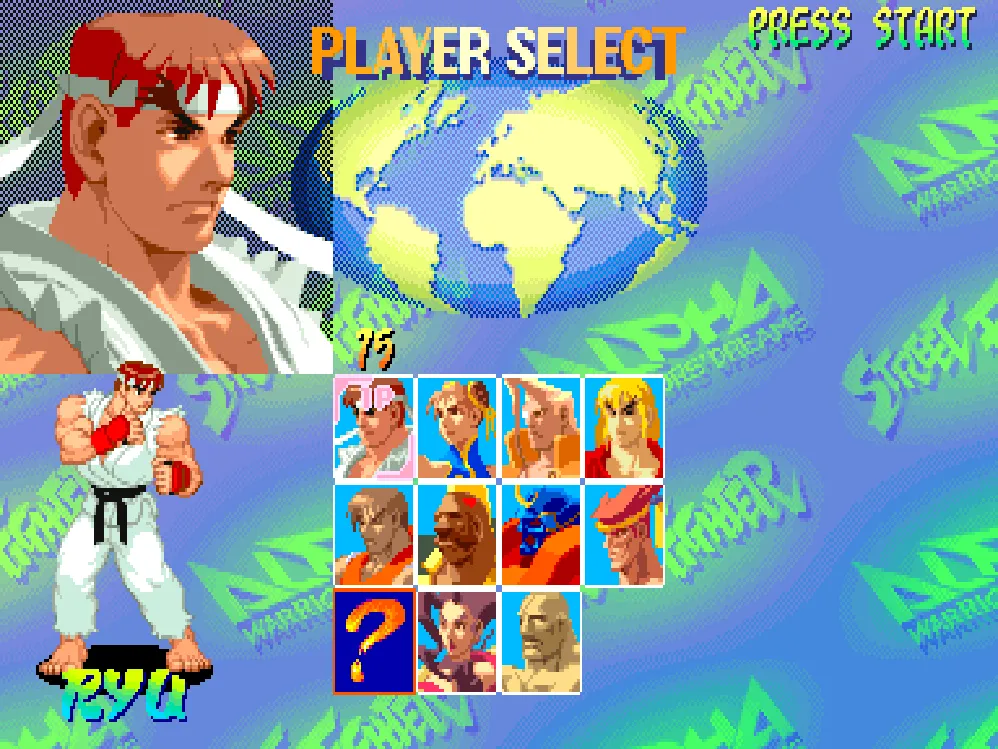
The game launched with 13 characters, later expanding to 18 in Alpha 2 and 28 in Alpha 3. Together, the Alpha trilogy forms one of the most creative chapters in Street Fighter history.
II. Character Profiles
2.1 Core Characters
Ryu — Prisoner of the Satsui no Hado
| Attribute | Rating |
|---|---|
| Attack | ★★★★ |
| Speed | ★★★ |
| Versatility | ★★★ |
- Strengths: Standard Hadoken + Shoryuken + Tatsumaki Senpukyaku setup; smooth combos via Chain Combo.
- Weaknesses: Moves are highly standardized, making them easy for skilled opponents to predict.
- Verdict: The Alpha version of Ryu feels heavier than his SF2 counterpart—his eyes reveal the struggle against the Satsui no Hado. The new "Shakunetsu Hadoken" is his signature upgrade in this title.
Ken Masters — The Fighter Searching for His Friend
| Attribute | Rating |
|---|---|
| Attack | ★★★★ |
| Speed | ★★★★ |
| Versatility | ★★★★ |
- Strengths: Flaming Shoryuken has incredible multi-hit priority; excellent close-range pressure.
- Weaknesses: Hadoken range is shorter than Ryu's.
- Verdict: The Alpha version of Ken is more proactive than in SF2. He spends most of his time searching for Ryu, and this urgency is reflected in his fighting style—more aggressive and uncompromising.
Chun-Li — The ICPO Investigator
| Attribute | Rating |
|---|---|
| Attack | ★★★ |
| Speed | ★★★★★ |
| Versatility | ★★★★ |
- Strengths: Fastest character, excellent normal move priority, and strong pressure with Hyakuretsukyaku.
- Weaknesses: Lower damage per hit.
- Verdict: Alpha Chun-Li features the smoothest light attack Chain Combos in the series. Her storyline focuses on investigating Shadaloo—at this point, she has not yet lost her father, creating a subtle tension between her mission and the tragedy to come.
Charlie Nash — The Tragic Hero
| Attribute | Rating |
|---|---|
| Attack | ★★★★ |
| Speed | ★★★★ |
| Versatility | ★★★★ |
- Strengths: Sonic Boom is faster and has better priority than Guile's; Somersault Kick has excellent priority.
- Weaknesses: Some players consider his practical performance slightly weaker than Guile's in this title.
- Verdict: Nash is the most important narrative character in this game. He goes deep into Shadaloo and ultimately sacrifices himself in a confrontation with M. Bison. His death is one of the most significant plot drivers in the entire series—all of Guile's subsequent actions stem from the obsession to avenge his comrade. His return as "Zombie Nash" 20 years later in Street Fighter V brought many veteran players to tears.
2.2 Quick Look at Other Characters
| Character | Type | Description |
|---|---|---|
| Guile | Defensive | Sonic Boom + Somersault Kick; the most reliable defensive character. |
| M. Bison | Final Boss | Psycho Power-driven; dominates the entire screen. |
| Rose | Psychic | Italian fortune teller; uses soul energy; the antithesis of M. Bison. |
| Sagat | Zoning | King of Muay Thai; Tiger Shot has massive priority. |
| Birdie | Grappler | Returning from SF1; chain attacks have incredible range. |
| Adon | Speed | Sagat's former student; high-speed Jaguar Kick assaults. |
| Dan Hibiki | Joke/Hidden | Capcom's parody of SNK; his Hadoken barely travels an arm's length. |
III. Controls and Gameplay
3.1 Basic Controls
Uses the classic Capcom 6-button layout (Light/Medium/Heavy Punch + Light/Medium/Heavy Kick) + 8-way joystick:
| Action | Input | Description |
|---|---|---|
| Dash | →→ | Quick forward dash |
| Backstep | ←← | Quick backward dash |
| Throw | Close →/← + Med/Heavy P or K | Grab and throw |
| Recovery | Press any two buttons when knocked down | Quick get-up |
| Super Art | Consumes Super Meter | Character-specific |
3.2 Core Innovative Systems
Alpha Counter: Press ↓↘→ + P/K while blocking (consumes one level of Super Meter) to launch a counter-attack. This system completely changed the passive nature of defense—players under pressure can now spend resources to instantly flip the momentum. Alpha Counter later became a key reference for the "Guard Cancel" design in The King of Fighters series.
Chain Combo: Light attacks can be canceled into each other in a natural rhythm—Light Punch → Light Punch → Light Kick → Heavy Punch is the basic combo formula. Unlike the frame-perfect "plinking" or "links" required in SF2, Chain Combos feel more like a "rhythm tap," significantly lowering the barrier to entry for beginners.
Super Meter: Built by attacking and taking damage, up to three levels. Consuming one level allows you to unleash a Super Art—no need to be at low health like in SF2 Turbo. This was one of the most fundamental and important innovations the Alpha series brought to fighting games.
IV. Tips and Strategies
4.1 Beginner's Guide
- Chain Combos are the best starting point: Light Punch → Light Punch → Light Kick → Heavy Punch. This basic formula works for most characters. Use it to get a feel for combos before learning more complex links.
- Alpha Counter isn't for damage, it's for "breathing room": When you're being overwhelmed by an opponent, Alpha Counter is your only escape. Always save at least one level of Super Meter for this.
- Ryu's Shakunetsu Hadoken: Deals more damage than a standard Hadoken but has a longer recovery. Use it as pressure when an opponent is getting up—don't throw it out randomly at mid-range.
- Nash's Sonic Boom: Faster than Guile's. You can fire two in quick succession to apply pressure—this is Nash's core tool in the neutral game.
4.2 Matchup Quick-Check
| Matchup | Key Strategy |
|---|---|
| Ryu vs. M. Bison | Use Hadoken to zone at mid-range; use Shoryuken to anti-air Bison's jump-ins. |
| Nash vs. M. Bison | Use Sonic Booms to punish the gaps in Bison's Psycho Crusher. |
| Chun-Li vs. Sagat | Use your speed advantage to close the distance and avoid Sagat's Tiger Shot range. |
V. Trivia and Arcade Legends
5.1 The "Bridge" That Took Over
Alpha was initially positioned internally by Capcom as a "bridge title until SF3 arrives." No one expected it to become an epic trilogy with 28 characters and the triple-ISM system. The commercial success of Alpha even made Capcom reconsider the necessity of SF3 (which eventually launched in 1997, though it performed less successfully than the Alpha series).
5.2 The Death of Nash — The Most Important Event in the Series
Charlie Nash dies in this game's story while fighting M. Bison. His death is the primary narrative driver for the entire Street Fighter series—Guile, Chun-Li, Ryu, Ken—almost every SF2 protagonist's story is intertwined with this event. Every action Guile takes afterward—entering every tournament, hunting Bison—stems from his obsession with avenging his friend. The return of "Zombie Nash" in 2016's Street Fighter V remains one of the most emotionally impactful moments in the series.
5.3 Dan Hibiki — Capcom's "Friendly Jab" at SNK
Dan is one of the most famous joke characters in fighting game history. He is a parody of Robert Garcia and Ryo Sakazaki from SNK's Art of Fighting: his "Gadoken" is a pathetic fireball that barely travels an arm's length; his "Koryuken" is just a hop in place; his signature victory pose involves a thumbs-up that turns into a thumbs-down.
This character was originally a humorous response to SNK "borrowing" (Art of Fighting heavily referenced Street Fighter). However, Dan survived from the Alpha series all the way to SF4, SF5, and SF6, evolving from an inside joke into one of the most beloved characters in the series.
5.4 Bengus's Art Revolution
The heavy-stroked, anime-inspired style established by artist Bengus (CRMK) for the Alpha series became the standard for Capcom fighting games throughout the late 1990s—from Darkstalkers to Marvel vs. Capcom, Bengus's influence is everywhere. His character expressions are exaggerated and dynamic, and his key animation frames are so kinetic that many fighting game artists still treat them as a textbook today.
5.5 The Alpha Trilogy Structure
Alpha 1 (1995, 13 chars) → Alpha 2 (1996, 18 chars) → Alpha 3 (1998, 28 chars + ISM system). Over three years, the series evolved from a "bridge project" to the peak of CPS2 fighting game depth. Many critics consider the Alpha trilogy structure to be Capcom's most successful content release strategy—every generation gave players a compelling reason to upgrade.