I. Game Background
1.1 World Setting
Puzzle Bobble 2 (Bust-A-Move Again) continues the lighthearted and cute fantasy world of its predecessor. The protagonists are a pair of green and blue dinosaur brothers—Bub and Bob—who live in a rainbow-colored bubble kingdom. One day, an evil wizard invades the kingdom with magic bubbles, shrouding the sky in colorful spheres. Bub and Bob must use their magical ability to shoot bubbles to clear them all and restore peace to the kingdom.
The game's background is filled with bright colors, sunflowers, and cute castle architecture, creating a fairy-tale atmosphere. Although it is a puzzle game, this simple and charming world allows players to feel warmth and joy while clearing bubbles—one of the core reasons the Bubble Bobble series appeals to players of all ages and genders.
1.2 Development History
Puzzle Bobble 2 was released by Taito in 1995, running on Taito's F3 arcade system board. It is the direct sequel to the 1994 original, Puzzle Bobble (Bust-A-Move).
The birth of this series was a beautiful accident. Taito did not originally plan to make a puzzle game for Bubble Bobble (the 1986 platform action game), but a programmer created a prototype of a matching game using Bubble Bobble assets in his spare time. When company executives saw it, they decided to put it into formal development—the result was that the original Puzzle Bobble's profits exceeded almost every other arcade game Taito had at the time. Development of the sequel began immediately.
While inheriting the core gameplay—aiming, shooting, and matching bubbles of the same color—Puzzle Bobble 2 featured comprehensive upgrades to visual performance and game mechanics. Taito adopted a more vibrant color palette and richer background animations, and for the first time, introduced a versus-exclusive item system and an enhanced chain reaction mechanism. This title also introduced a full character selection screen for the VS mode, with each character possessing unique special abilities and AI behavior patterns, significantly increasing the game's depth and replayability.
The game was subsequently ported to multiple platforms including PlayStation, Sega Saturn, Nintendo 64, Game Boy Color, and PC, with each version adding its own exclusive content. To this day, Puzzle Bobble 2 is widely considered one of the best and most popular entries in the series.
II. Characters and Opponents
2.1 Protagonists: Bub and Bob
| Attribute | Bub (Green Bubble Dragon) | Bob (Blue Bubble Dragon) |
|---|---|---|
| Color | Green | Blue |
| Role | 1P Default Character | 2P Default Character |
| Special Ability | Standard | Standard |
| Performance | Identical | Identical |
Bub and Bob come from Taito's 1986 classic action game, Bubble Bobble. In the original, they were human boys cursed to become bubble dragons, needing to trap and defeat enemies by blowing bubbles to break the curse. In the puzzle series, they retain their cute bubble dragon appearance, but the gameplay shifts to shooting colored bubbles to clear them—an interesting nod to their original setting of trapping enemies in bubbles.
2.2 Main Opponents in VS Mode
In the VS mode of Puzzle Bobble 2, players face a series of unique opponents. Each opponent has their own special abilities and AI behavior patterns:
| Opponent | Type | Special Ability | Difficulty |
|---|---|---|---|
| Witch | Disruptor | Increases bubble descent speed | ★★ |
| Robot | Defensive | Clears interference bubbles from own screen | ★★ |
| Purple Dragon | Balanced | Randomly changes bubble colors | ★★★ |
| Yellow Dragon | Aggressive | Sends large amounts of interference bubbles | ★★★ |
| Ghost | Reversal | Flips the opponent's screen | ★★★ |
| Evil Wizard | Final Boss | Multiple combined abilities | ★★★★★ |
Each opponent is visually distinct—the robot is made of metal parts, the witch rides a broom, and the ghost is translucent and flickering. This detailed character design makes the VS mode more than just a competition of clearing bubbles; it is a fun, cartoonish character interaction.
III. Controls
3.1 Basic Controls
Controls for Puzzle Bobble 2 are extremely simple and intuitive—a key reason it attracts a wide audience:
| Action | Description |
|---|---|
| Move Left/Right | Move the aiming cursor to adjust direction |
| Fine-tune Angle | Adjust aiming angle slightly |
| Shoot Button | Shoot a bubble in the aimed direction |
| Bubble Swap (Some versions) | Swap current bubble with reserve bubble |
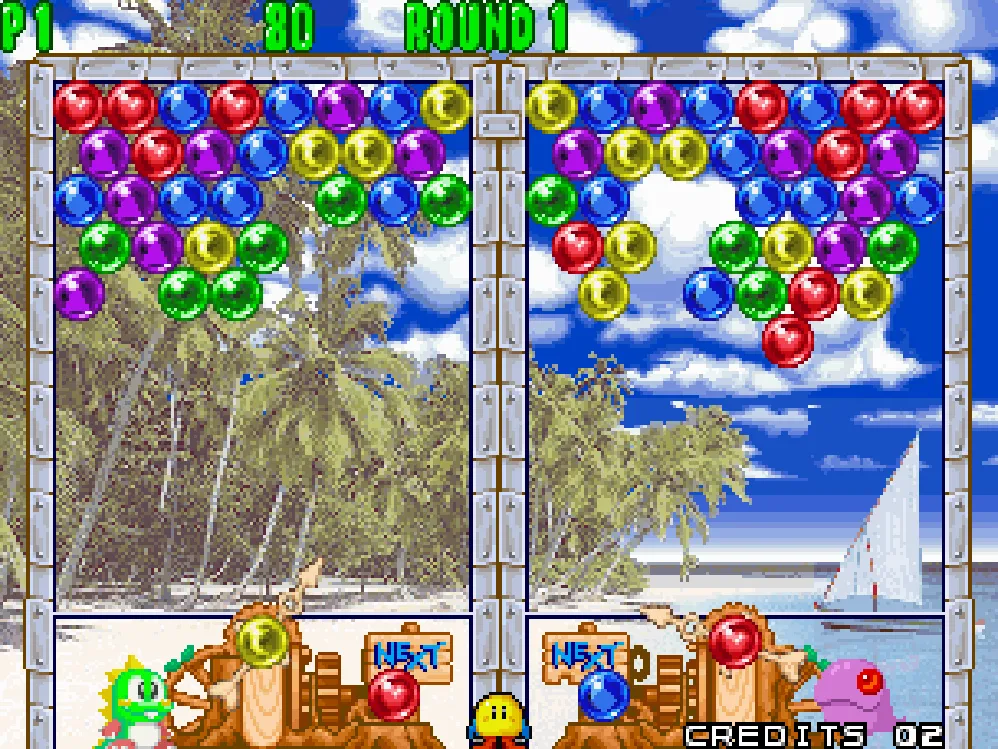
The aiming line always shows the current trajectory, and the bubble will fly in a straight line to the target position and attach to the bubble stack. When three or more bubbles of the same color are connected, they pop and fall from the stack. The core mechanism is: all bubbles hanging below the cleared ones that are no longer connected to the top will also fall—this is the key to high scores and chain reactions.
There is a "danger line" at the top of the screen; the game ends if the bubble stack drops below this line. Every few shots (usually 5-6), the ceiling adds a new row of bubbles, increasing the pressure.
3.2 Chain Reactions and VS System
Key system innovations in this title include:
Chain Drop Mechanism: The drops caused by clearing bubbles are more than just bonus points. In VS mode, every time you trigger a drop, the opponent's screen receives interference bubbles—these transparent bubbles only become clearable after you match them with adjacent normal bubbles. Large drops → massive interference → increased pressure on the opponent → higher chance of mistakes, creating a positive snowball effect.
Special Item System: This title adds various VS-exclusive items that appear randomly on the screen. Clear the bubble containing the item to activate its effect:
| Item | Effect | Best Time to Use |
|---|---|---|
| Aiming Extension | Extends aiming line for precision | When aiming at difficult spots |
| Color Change | Changes current bubble to random color | When current bubble doesn't match the area |
| Time Slow | Temporarily slows bubble descent | When stack is near the danger line |
| Screen Flip | Flips opponent's screen display | When opponent is about to clear bubbles |
| Bubble Clear | Clears a portion of bubbles | A last-resort life-saver |
3.3 Bank Shot Technique
Bubbles bounce off walls, a technique advanced players must master. Using banks allows you to send bubbles to positions unreachable by direct aiming—such as blind spots hidden behind large clusters. The basic rule of bank shots: the angle of incidence equals the angle of reflection. Mastering this allows you to find paths in seemingly impossible situations.
IV. Level Progression and Boss Strategy
4.1 Single Player Progression
| Stage | Levels | Bubble Colors | Difficulty Features |
|---|---|---|---|
| Beginner World | 1–8 | 4 colors | Basic tutorial, simple arrangements |
| Intermediate World | 9–16 | 5 colors | Complex arrangements and obstructions appear |
| Advanced World | 17–24 | 5–6 colors | Lower initial stack, tighter time limits |
| Boss 1 | After Level 8 | 4 colors | VS mode, opponent starts using interference |
| Boss 2 | After Level 16 | 5 colors | Stronger opponent, higher interference frequency |
| Final Boss | After Level 24 | 6 colors | Evil Wizard, multiple combined abilities |
4.2 Boss Battle Strategy
Boss battles differ from normal levels: the boss stands on one side of the screen (usually the right), and both sides have their own bubble stacks. The player's goal is to clear their side first while sending interference to the opponent through chain drops.
| Boss | Strategy Tips |
|---|---|
| Witch | She likes to use speed-up items to compress your time. Prioritize clearing bubbles near the danger line; don't worry too much about chains |
| Robot | Defensive AI that actively clears your interference. You need to create massive chain drops to "drown" its defensive capabilities |
| Purple Dragon | Balanced opponent. The key is to strike first before it triggers a massive drop—learn to save specific colors for the best clearing window |
| Evil Wizard | Final boss with the smartest AI and most frequent interference. Staying calm is the top priority—don't be distracted by the chaotic screen. Use items to counter-attack and save color-change items for critical moments |
V. Tips and Advanced Strategy
5.1 Beginner Tips
- Clear edges before the center: Prioritize clearing bubbles on the sides of the screen—they become harder to aim at as the stack descends. The center usually has more access paths.
- Don't clear just because you can: Instead of shooting at every small group of three, learn to "save up"—wait for the color that triggers a massive chain reaction to clear the board in one go.
- Aim for top connection points: Observe which bubbles are the "key points" connecting large clusters to the top. Breaking these points causes all unrelated bubbles below to fall at once.
- Use banks to bypass obstacles: When the target area is blocked by other colors, use wall bounces to reach unreachable spots.
- Don't hoard items: Use color-change items immediately when your current bubble doesn't match—delaying only brings the stack closer to the danger line.
5.2 Advanced VS Strategy
- Rhythm control of chain drops: Don't send massive interference all at once—small, sporadic interference is often more likely to cause opponent errors. Save large drops for critical moments before the boss attacks.
- Read the opponent's screen: While clearing your own, keep an eye on the opponent's screen. Send interference when their stack is near the danger line—this timing is often fatal.
- Tactical value of screen flip: The flip item is the strongest interference. Use it when the opponent is attempting a high-difficulty precision shot to force a mistake.
- Anti-interference strategy: When receiving a lot of interference, prioritize using color-change items to match the colors near the interference bubbles to clear them quickly.
5.3 Advanced Trivia
- Color probability rules: Bubble colors are generated by an algorithm that ensures each color's probability is roughly balanced. Generally, the probability of the current color appearing again shortly is slightly reduced—use this to plan your next few moves.
- Maximum yield from hanging clears: Theoretically, if over 60% of the bubbles are hanging from a single key point, a single shot can clear the entire screen. Finding these structural weaknesses is a hallmark of high-level players.
- Home version extras: The N64 and Saturn versions added a Puzzle Edit mode, allowing players to customize bubble arrangements; the PS version added a Challenge Mode.
VI. Trivia and Arcade Legends
6.1 A Glorious Transformation
The transition of the Bubble Bobble series from a 1986 platformer to a 1994 puzzle game is one of the most successful IP crossovers in video game history. When the original Puzzle Bobble debuted in arcades in 1994, many players thought it was a sequel to the action game, only to discover completely different gameplay after inserting a coin. However, most were hooked by the "match-3 + physics bounce" core gameplay after just one round. This "accidental discovery" user experience became a catalyst for the success of Puzzle Bobble.
6.2 A Commercial Miracle from a Side Project
A story circulates within Taito: Puzzle Bobble was originally a "weekend project" a programmer wrote in his spare time using Bubble Bobble graphic assets. He made a simple demo—a stack of colored bubbles at the top, and you use a cannon to shoot matching bubbles to clear them. When he showed it to colleagues, the entire office became addicted. Within 48 hours of seeing the demo, executives approved formal development. As a result, this "weekend project" became one of the most profitable product lines in Taito's history, surpassing classics like Space Invaders and Darius.
6.3 The Legend of the Coin-Eater
In an American arcade, it is rumored that a Puzzle Bobble 2 machine had a hardware failure where it would "eat coins without recording scores." Normally, the owner should have fixed or replaced it—but according to player community rumors, the owner chose to keep it because even without tracking scores, "the daily revenue was enough to pay the electricity bill for the entire arcade." While the details may be exaggerated, it reflects an undeniable fact: Puzzle Bobble 2 was indeed one of the highest-earning arcade machines in the mid-1990s.
6.4 A Killer Game for All Ages and Genders
In the 1990s, the primary audience for fighting and shooting games was young men. Puzzle Bobble 2 was a rare exception—it attracted a large number of female players, couples, and families with children. Arcade owners found that by placing a Puzzle Bobble 2 machine between rows of King of Fighters and Street Fighter cabinets, the arcade's customer base became significantly more diverse. This effectively made Puzzle Bobble 2 a pioneer of early "family-friendly" arcade games.
6.5 A Design Template for Matching Games
From Candy Crush to thousands of mobile matching games, the DNA of the Puzzle Bobble series can be found in their design. In particular, the core mechanism of "matching colors + hanging drops" remains one of the most mainstream design paradigms in the genre 30 years later. The Japanese programmers in 1995 probably never imagined that the simple physical rules they designed would influence the gaming experience of billions over the next three decades.