1. Game Background
1.1 World Setting
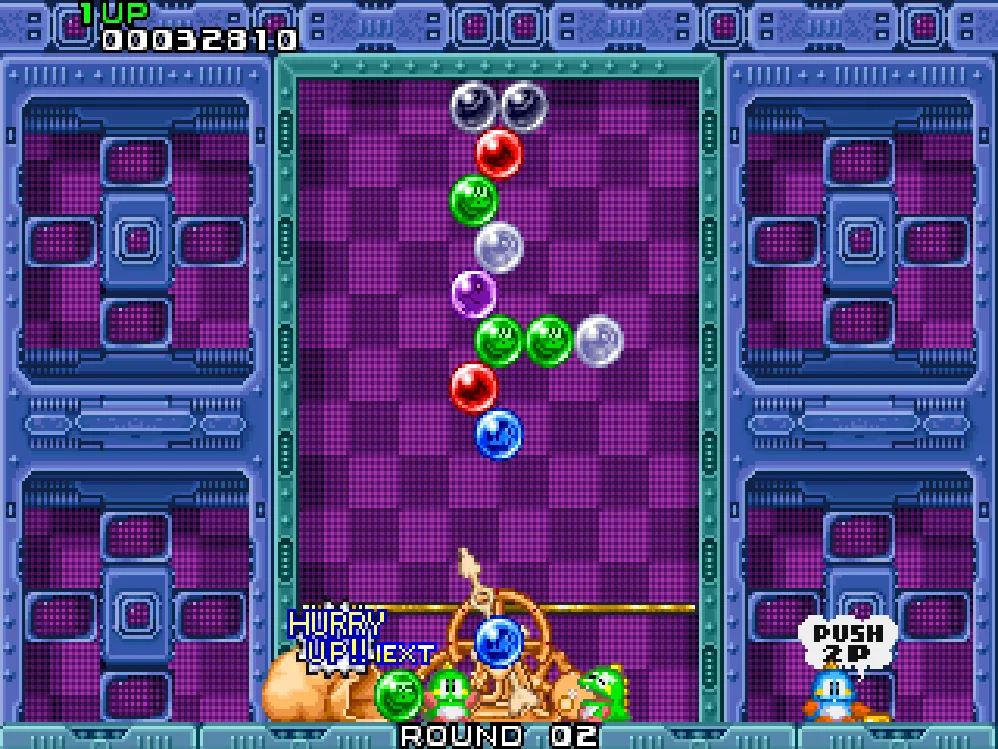
Puzzle Bobble (known as Bust-a-Move in Western markets) is an arcade puzzle game released by Taito in 1994, derived from the classic platformer Bubble Bobble. The protagonists remain the two adorable little bubble dragons—Bub (green) and Bob (blue). However, this time, instead of trapping enemies in bubbles, they stand at the bottom of the screen, firing matching colored bubbles at the descending array above.
The premise is simple yet engaging: Bub and Bob's bubble world is under threat from a mysterious force, causing colorful bubbles to rain down from the sky. If not cleared, these bubbles will crush the entire Bubble Kingdom. The two dragons must use their bubble launchers to group three or more bubbles of the same color, triggering chain reactions to clear the threat. Behind this simple setup lies a deep puzzle experience that is easy to learn but difficult to master.
1.2 Development History
Puzzle Bobble was born from a clever shift in gameplay within Taito. The 1986 Bubble Bobble was a massive success as a platformer, defined by its core mechanic of trapping enemies in bubbles. By 1994, Taito’s development team explored how to extend this IP into a new genre. Designers proposed a brilliant idea: combine "match-three" puzzle mechanics with Bub and Bob’s bubble-launching concept to create an entirely new type of puzzle game.
This concept resulted in one of the most successful arcade puzzle games in history. The arcade version of Puzzle Bobble launched in Japan and the US in 1994, immediately winning over players with its vibrant graphics, crisp sound effects, and addictive gameplay. The VS mode was particularly successful—two players competed on the same screen to see who could clear their bubbles faster, with the loser being the one whose bubbles crossed the line first. This fast-paced competitive experience made Puzzle Bobble a staple in arcades. It was subsequently ported to almost every major platform, including the Super Nintendo, Sega Saturn, and PlayStation, spawning dozens of sequels and variants that continue to be released today.
2. Character Introduction
While the core characters are inherited from the platforming era, they take on new roles in this puzzle iteration:
| Character | Appearance | Role |
|---|---|---|
| Bub | Green Dragon | 1P controlled character, operates the launcher at the bottom |
| Bob | Blue Dragon | 2P (VS mode) or selectable character in single-player |
In single-player puzzle mode, Bub is the default character. There are no stat changes, HP, or item systems—the game's depth comes entirely from the player's mastery of angles, color matching, and chain reactions. In VS mode, Bub and Bob appear on opposite sides of the screen, each facing their own bubble array, interfering with each other through successful clears.
3. Controls
3.1 Basic Controls
| Control | Function |
|---|---|
| Joystick (Left/Right) | Rotate the aiming pointer to adjust the launch angle |
| Launch Button | Fire the current bubble in the direction of the pointer |
Controls are extremely simple—just rotate and fire. This minimalist design is why Puzzle Bobble attracts so many casual players: anyone can learn the basics in ten seconds, but achieving spectacular chain reactions requires practice and spatial awareness.
3.2 Aiming System and Bank Shots
Players use a fixed pointer at the bottom of the screen to adjust the angle. Bubbles travel in a straight line and attach to the first surface they hit (following a hexagonal grid). Skilled players utilize "bank shots": firing bubbles against the side walls to reach gaps that are impossible to hit directly. Mastering the angle of reflection is key to high-level play. Because of the hexagonal grid, each bubble has six neighbors, requiring players to develop a unique spatial model compared to standard square-grid puzzles.
4. Progression and Boss Strategy
Single-player mode consists of a series of stages, each with a pre-set initial bubble array:
| Stage | Characteristics | Strategy |
|---|---|---|
| 1-5 | Simple layout, fewer colors (3-4) | Learn basic aiming and rhythm |
| 6-15 | Increasing complexity, more colors | Practice chain reactions and color management |
| 16-25 | Larger area, faster descent | Prioritize clearing bottom anchors to prevent sinking |
| 26-30 | High difficulty, 5-6 colors | Every shot counts; blind firing leads to quick failure |
VS mode has no fixed stages; it is a continuous battle until one player is overwhelmed. The key to victory is creating chain reactions—clearing large groups of bubbles sends "garbage bubbles" (usually transparent or multi-colored) to the opponent's screen, creating extra obstacles.
5. Tips and Advanced Strategy
5.1 Basic Survival Tips
- Clear from the bottom up: If the anchor points at the bottom are broken, the entire section above will fall. Prioritize attacking these anchors to clear large areas at once.
- Color management is vital: The waiting area shows the current and next bubble. Pros plan two moves ahead rather than reacting to the current bubble.
- Master bank shots: When a target is blocked, use the side walls. Remember: the angle of incidence equals the angle of reflection.
- Avoid filling the top: The game ends if bubbles touch the top line. Keep an eye on the lowest point and prioritize clearing areas near the danger zone.
- Chain reactions are the most efficient: When you clear 3+ bubbles, any bubbles attached only to those will fall. Use this to clear massive sections.
- VS mode tactics: Don't just clear fast. Save up large groups of colors to trigger massive chain reactions, dumping a flood of garbage bubbles on your opponent at once.
6. Trivia and Arcade Legends
6.1 A Brilliant Genre Shift
Puzzle Bobble is one of the most successful genre transitions in gaming history. The original Bubble Bobble (1986) was a pure platformer. When Taito released the puzzle version in 1994, many fans were confused. However, the new game captivated everyone by retaining the iconic characters and the "bubble" theme while introducing a deep, addictive puzzle mechanic. Such successful IP pivots are rare in gaming.
6.2 An Everlasting Empire of Sequels
Puzzle Bobble has one of the highest numbers of sequels in arcade puzzle history. Since 1994, the series has seen over 20 titles across arcades, consoles, handhelds, and mobile. Remarkably, the core gameplay remains unchanged—aim, fire, match. This "if it isn't broken, don't fix it" philosophy proves the perfection of the original design. Recent versions even include VR online play.
6.3 Naming Confusion: Puzzle Bobble vs. Bust-a-Move
Regional naming caused significant confusion. In Japan and Asia, it was always Puzzle Bobble. In North America, Taito's US branch felt the name wasn't catchy enough and rebranded it Bust-a-Move. To make matters worse, Sony released an unrelated dancing game called Bust a Move in 1998, forcing Western versions to alternate between names. Today, Puzzle Bobble is the official global title, though many veteran players still call it Bust-a-Move.
6.4 The Social Magic of VS Mode
For many, the VS mode of Puzzle Bobble was the most social arcade experience. Unlike the high-tension adrenaline of fighting games, Puzzle Bobble matches were relaxed yet intense. Two players standing side-by-side, focusing on their own arrays while trying to sabotage the other, created a unique "back-to-back" competitive atmosphere that fostered many arcade friendships and rivalries.