1.1 World Setting
In 1989, a seemingly harmless threat descended upon Earth—countless elastic bubbles fell from the sky, invading famous landmarks across the globe. These were no ordinary soap bubbles; they bounced, tracked, and were lethal upon contact. Two young brothers stepped up, armed with specialized harpoon guns, and embarked on a journey around the world to eliminate the bubble menace.
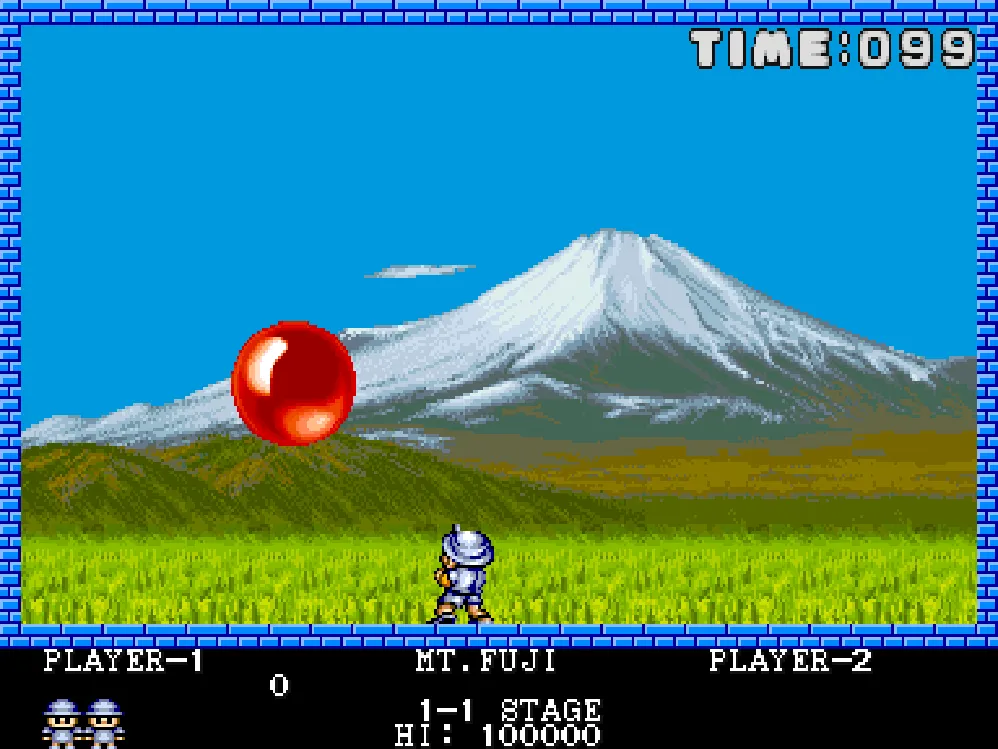
The game's journey spans numerous world-famous sites, starting from Mount Fuji in Japan, passing through Angkor Wat in Cambodia, Big Ben in London, the Eiffel Tower in Paris, the Statue of Liberty in New York, and the Sydney Opera House in Australia. Each stage features meticulously drawn backgrounds of these landmarks, giving the game impressive visual flair for its time. As players pop bubbles, they feel as if they are embarking on a global tour.
Pang (known as Pomping World in Japan and Buster Bros in North America) built an addictive experience on incredibly simple rules: fire a harpoon at a bubble, watch it split into smaller pieces, and keep shooting until they vanish. This simple splitting cycle creates endless variety and intense excitement.
1.2 Development History
Pang was developed by the Japanese company Mitchell Corporation and published by the arcade giant Capcom. Mitchell Corporation was founded in 1988, and Pang was their first—and most successful—title.
The game debuted in arcades in 1989, quickly winning over players worldwide with its intuitive controls and addictive gameplay. As the publisher, Capcom brought the game to the global market, ensuring Pang had a massive player base across North America, Europe, and Asia.
The success of Pang spawned an entire series: the 1990 sequel Super Pang continued the core gameplay while adding more levels and items; the 1995 release Pang 3 introduced new compressed bubble mechanics and character abilities; later entries included Mighty Pang and various home console ports. The original Pang is still considered a classic of the series, and its design philosophy has influenced countless casual action games since.
II. Character Introduction
The protagonists are a pair of brothers named Pang and Pom (names vary slightly by regional version). Both brothers wear adventure gear and carry harpoon guns specifically designed to combat the bubbles. In single-player mode, the player controls the 1P character (usually the younger brother), while in two-player co-op mode, both players control the brothers side-by-side.
Interestingly, the brothers are identical in appearance and ability, with the only difference being the color scheme for 1P and 2P—a common design choice at the time, though rare in modern games that emphasize character differentiation. For Mitchell Corporation, the core fun of the game lay in the gameplay itself, rather than performance differences between characters.
III. Controls and Gameplay
3.1 Basic Controls
Pang's controls are extremely simple, requiring only three inputs: move left, move right, and fire harpoon. Players move their character along the bottom of the screen, aiming their harpoon at the bubbles above. The harpoon travels vertically and hits the bubble upon contact.
Characters cannot jump and can only move horizontally. This creates a unique sense of spatial awareness—players must predict the bubbles' bouncing trajectories and fire their harpoons at the right place and time. Platforms or beams sometimes provide extra opportunities for players to dodge bubbles (depending on the specific level design).
3.2 Bubble Splitting Mechanism
The bubble splitting mechanism is the essence of Pang's core gameplay. Bubbles come in three sizes: large, medium, and small. When a player's harpoon hits a large bubble, it splits into two medium bubbles that bounce to the left and right. Hitting a medium bubble splits it into two small ones. Hitting a small bubble eliminates it entirely.
This splitting mechanic means that every time a player shoots, the number of bubbles may actually increase, raising the stakes. Players must find a balance between clearing bubbles and avoiding being surrounded. Generally, the wiser strategy is to clear bubbles from the edges of the screen toward the center, rather than shooting large bubbles indiscriminately.
Bubble trajectories follow physical laws, but unlike real bouncy balls, their speed and angles become increasingly tricky as the game progresses. In later levels, with multiple bubbles bouncing simultaneously, players must execute precise shots and dodges in tight spaces, creating intense pressure.
IV. Level Progression and Bosses
Pang features approximately 50 levels set against backdrops of famous global landmarks. Levels typically progress screen by screen, with a set number of bubbles appearing in each. Once all bubbles on the current screen are cleared, the game automatically advances to the next level.
Different stages of the game correspond to different world regions. Early levels (like the Mount Fuji stage) are relatively simple, with fewer bubbles and gentler trajectories. As the game progresses, the number, initial size, and bounce speed of the bubbles gradually increase. By the time you reach London, Paris, or New York, the initial distribution is much denser, sometimes starting with multiple large bubbles bouncing rapidly from the very beginning.
The original Pang does not feature traditional boss battles. The challenge comes from the ever-increasing number of bubbles, faster speeds, and more complex level terrain. Fixed or moving platforms in certain levels affect both the bubbles' bounce paths and the player's mobility.
V. Tips and Advanced Strategy
5.1 Basic Survival Tips
First, never fire at large bubbles in the center of the screen recklessly. The best clearing strategy is to start with the bubbles at the edges and work your way inward. This ensures that newly split bubbles have enough room to bounce away, reducing the risk of being surrounded.
Second, make good use of power-ups. Various items drop throughout the game, including shoes that increase movement speed, upgrades for faster harpoon fire, clocks that temporarily freeze all bubbles, and double harpoons for wider coverage. The double harpoon is particularly powerful, allowing players to fire two shots at once and significantly increasing clearing efficiency.
Third, in two-player co-op mode, players should divide tasks: one person handles the left side, the other handles the right, preventing situations where both players fire at one side while the other side goes out of control. Coordination between teammates is often more important than individual skill.
Finally, note that the harpoon's flight speed is not instantaneous. There is a very short cooldown after firing, during which you cannot shoot again. This window can be fatal in later levels, so ensure every shot has a clear purpose.
VI. Trivia and Arcade Legends
The fact that Pang used different names in different regions is a story in itself. In Japan, the game was called "Pomping World," a name that hints at the sound effect of bubbles bouncing. In North America, Capcom renamed it "Buster Bros" to improve market recognition, while in Europe and most other regions, it was simply known as "Pang."
There is a legend among arcade players: if a player could beat Pang in a single "credit" (without using continues), their status in the arcade would instantly reach a new level. While this is hard to verify, the high-speed bubbles in the later levels certainly make a "one-credit clear" a highly challenging achievement.
Mitchell Corporation continued to focus on casual action games, but they never quite surpassed the success of Pang. As the 1990s arcade market shifted toward fighting and shooting games, Pang's minimalist style became a classic hallmark of an era.