1. Game Background
1.1 World Setting
Dynasty Wars is based on the manga of the same name by Hiroshi Motomiya, serialized in Weekly Shonen Jump. The manga began in 1984 but ended abruptly after about a year, concluding just as the warlords gathered to defeat Dong Zhuo. While based on Romance of the Three Kingdoms, the story incorporates heavy fantasy elements: Liu Bei, Guan Yu, and Zhang Fei must pass the Dragon King's trials to gain divine power; the Yellow Turban Rebellion is depicted as a conspiracy by the Demon King of the Phantom Bell; and warlords like Dong Zhuo and Cao Cao are portrayed as villains possessed by evil spirits, giving the story a distinct Japanese shonen manga flair.
The arcade version of Dynasty Wars largely follows the manga's narrative, focusing on the Yellow Turban Rebellion and the subsequent campaign against Dong Zhuo. Players take the perspective of Liu Bei's forces, starting from the suppression of the Yellow Turbans and battling various warlords until finally defeating Dong Zhuo. The game is played entirely on horseback, with players charging into enemy lines, capturing the intense battlefield action of the manga in a unique arcade style. Notably, the manga's premature ending posed a challenge for Capcom's developers—many generals who did not appear in the manga had their character portraits drawn by young Capcom designers mimicking Motomiya's art style.
1.2 Development History
Dynasty Wars was first released by Capcom in Japan in April 1989, with a global release following in July. It ran on the then-new CPS-1 (Capcom Play System) hardware, which featured an MC68000 main CPU and a Z80 audio CPU, supporting 384x224 resolution and a 4096-color palette. It was the fourth game released for the CPS-1 (CP-S No.04), produced by the legendary Yoshiki Okamoto, with design by Noritaka Funamizu and others, and a soundtrack composed by Manami Matsumae.
This was the first entry in Capcom's Tenchi wo Kurau (Dynasty Wars) series and an early exploration of the side-scrolling action genre on the CPS-1. Unlike the later Final Fight (December 1989), Dynasty Wars is defined by its core horse-mounted combat, which is extremely rare for the genre. The game was later ported by Tiertex to home computers like the ZX Spectrum, Commodore 64, and Amiga, and received a Japan-exclusive port for the PC Engine Super CD-ROM² by NEC Avenue in 1994.
2. Character Introduction
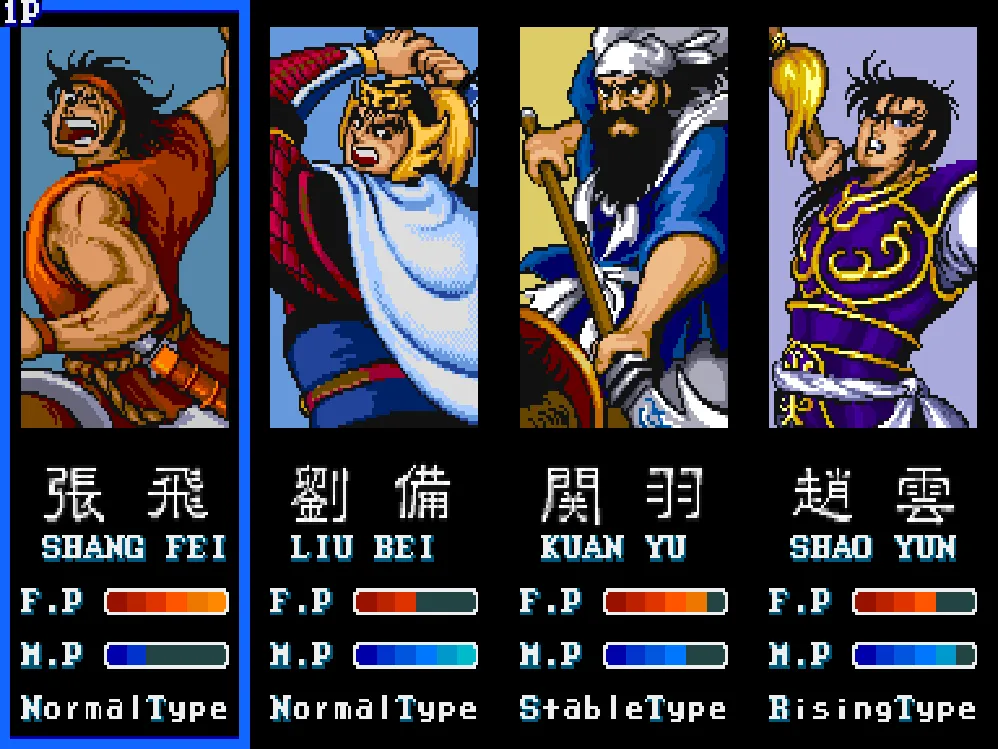
The game features four playable characters, all from the Shu Han faction. Each character has unique weapons, attack speeds, and charge attack power, creating a clear trade-off between speed and strength. Additionally, each character can summon a unique lieutenant to assist in battle when using a special attack.
| Character | Weapon | Attack Speed | Charge Attack | Lieutenant | Ability |
|---|---|---|---|---|---|
| Liu Bei | Twin Swords | Fast | Weak | Zhou Chao | Chain Hammer |
| Guan Yu | Green Dragon Blade | Slow | Powerful | Huo Hu | Bomb Throw |
| Zhang Fei | Serpent Spear | Slow | Powerful | Song Ren | Sword Assist |
| Zhao Yun | Spear/Sword | Fastest | Weak | Song Yong | Bow & Arrow |
Liu Bei and Zhao Yun are agile characters with fast attacks but weaker charges, making them suitable for beginners or players who prefer aggressive playstyles. Guan Yu and Zhang Fei are power-based characters; their attacks are devastating but slower, requiring better anticipation. Zhao Yun is the fastest, making him excellent for crowd control. Health is displayed numerically at the top of the screen, and character portraits change based on their status—gritting teeth while charging, roaring during attacks, and frowning when hit.
3. Controls
3.1 Basic Controls
The game uses an 8-way joystick and a 3-button layout, which was standard for 1989 arcade games.
| Button | Function | Description |
|---|---|---|
| Button 1 | Attack Left | Attacks enemies on the left side |
| Button 2 | Attack Right | Attacks enemies on the right side |
| Button 3 | Special (Ambush) | Summons a lieutenant for a powerful attack |
| Joystick | Movement | Controls movement in 8 directions |
This directional attack system requires players to decide which button to press based on the enemy's position, rather than the single-button-plus-direction input common in modern games. The game does not support auto-fire; each press triggers exactly one attack.
3.2 Charge Attacks and Mounted Combat
Charge attacks are the game's core advanced mechanic: holding the attack button builds up power. Once fully charged, releasing the button unleashes a powerful strike covering nearly half the screen, capable of depleting an entire health bar from a boss. If a boss moves behind you while charging, you can switch the direction of the attack by holding the opposite attack button, releasing the original, and then releasing the new one.
Mounted combat is the game's most iconic feature. The four protagonists remain on horseback throughout the entire game, allowing for faster movement but making precise positioning and turning more difficult. You cannot dismount; the entire campaign is fought from the saddle. The horses do not have independent health; damage taken is reflected on the rider. This "constant mounted" design is unique among side-scrolling action games.
4. Stages and Boss Guide
There are 8 rounds in total, each corresponding to a battlefield from the Three Kingdoms era. Players must defeat enemy soldiers and generals to liberate each region.
| Round | Location | Mid-Boss | End-Boss | Strategy Tip |
|---|---|---|---|---|
| 1 | Yingchuan | Deng Mao | Cheng Yuanzhi | Introductory stage. Low enemy density; perfect for learning controls. Use charge attacks to clear crowds. |
| 2 | Wancheng | None | Soldier Legion | Pure mob stage. Focus on crowd control. Collect yellow and blue orbs to upgrade weapons. |
| 3 | Guangzong | Zhang Bao, Zhang Liang | Zhang Jiao | Final battle against the Yellow Turbans. Keep distance from Zhang Jiao while charging. |
| 4 | Sishui Gate | Hu Zhen | Hua Xiong | The anti-Dong Zhuo campaign begins. Use lieutenant summons to create space against Hua Xiong. |
| 5 | Hulao Gate | Li Jue, Guo Si | Lu Bu | The hardest stage. Lu Bu is fast and deadly. Use charge attacks and lieutenants; do not get greedy. |
| 6 | Outside Chang'an | Fan Chou | Zhang Ji | Increased archer presence. Use charge attacks to manage the distance. |
| 7 | Inside Chang'an | Xu Rong | Li Ru | Li Ru's fire attacks have a large hitbox. Stay mobile in tight spaces. |
| 8 | Meiwu | Lu Bu, Dong Min | Dong Zhuo | Final battle. Save your charge for the start. Use lieutenants to cycle damage against Dong Zhuo. |
After defeating Dong Zhuo, Cao Cao appears in the ending, setting the stage for the sequel.
5. Tips and Advanced Strategy
- Charge Attacks are Key: They cover half the screen and deal massive damage. Always look for safe windows to charge.
- Manage Health: Health does not auto-refill between stages. Pick up food items whenever possible.
- Master Directional Switching: If an enemy moves behind you while charging, use the button-switch technique to redirect your attack.
- Use Continues Wisely: In the ARCADE version, inserting more coins and pressing START increases your maximum health cap—a vital survival tool for boss fights like Lu Bu.
- Upgrade Regularly: Yellow orbs grant experience for health upgrades; blue orbs upgrade your weapon.
- Use Lieutenants: Summon them before boss fights to maximize your damage output.
- Prioritize Archers: Ranged enemies will interrupt your charge. Clear them first.
6. Trivia and Arcade Legends
Manga vs. Game: Hiroshi Motomiya's manga is a loose, fantasy-heavy interpretation of history, which was quite bold and popular with young readers at the time.
Overshadowed by the Sequel: Most players know the series from the 1992 sequel, Warriors of Fate (Tenchi wo Kurau II), which shifted to a standard Final Fight-style brawler. The original's mounted combat remains a unique, distinct experience.
Capcom's "Ghost" Artists: Because the manga ended early, Capcom's young designers had to create portraits for characters like Lu Bu and Dong Zhuo by mimicking Motomiya's style. These were so well-made that many fans still believe they were drawn by Motomiya himself.
Bloody Executions: The final execution of Dong Zhuo is surprisingly graphic for 1989, featuring clear blood splatter, though the developers intentionally omitted this for older, non-boss generals.
Arcade Success: According to Game Machine magazine (May 15, 1989), Dynasty Wars was the second most popular tabletop arcade game in Japan at the time.