Caveman Ninja (Joe & Mac) -- Arcade Game Overview
1. Game Background
1.1 Setting the Scene
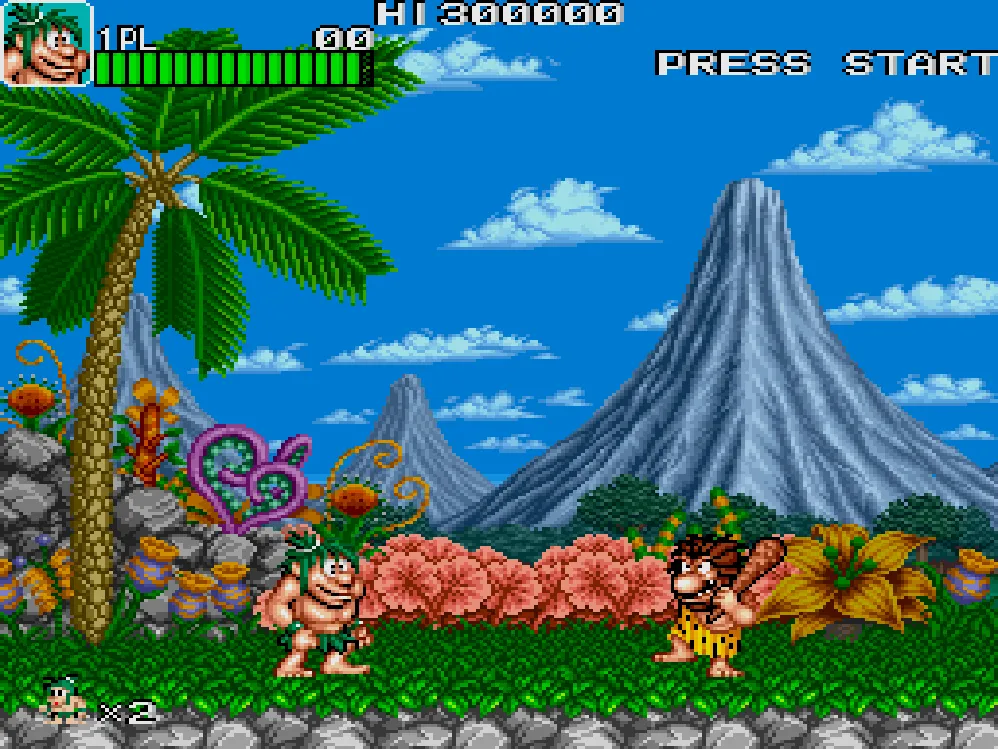
Set in a prehistoric world where dinosaurs and cavemen coexist, the story begins when a peaceful tribe is attacked by invaders. Barbarians from a rival tribe raid the village and kidnap all the cave maidens. Two brave cavemen hunters, Joe and Mac, step up, arming themselves with primitive yet effective weapons to embark on a rescue mission across a dangerous prehistoric continent.
This world is vibrant and exaggerated. From lush, dense jungles to erupting volcanoes, and from frozen ice ages to deep, mysterious cave labyrinths, Joe and Mac must traverse extreme landscapes. Along the way, they face enemies ranging from bone-club-wielding savages to ferocious prehistoric beasts, including T-Rexes and Pterodactyls. The game’s tone isn't a serious survival adventure, but rather a lighthearted, humorous romp—from the characters' expressive faces to the comical animations of defeated enemies, the developers clearly prioritized fun and comedy.
1.2 Development History
Caveman Ninja was developed and published by the legendary Japanese company Data East in 1991 for the arcade platform. Known for hits like Bad Dudes and Dark Seal, Data East was a master of high-octane action games. The development team poured significant effort into the art design, utilizing bright, vivid colors and fluid animation frames, making the game's visuals far superior to most platformers of that era.
In Japan, the game was released as Caveman Ninja, while the North American version was rebranded as Joe & Mac. This was a common practice in the arcade market, as publishers believed Western players would more easily remember character names than abstract concepts. The game ran on Data East's proprietary Medium Resolution System, supporting a 512x240 resolution. Following its arcade success, it was ported to numerous home consoles, including the SNES, Sega Mega Drive/Genesis, Amiga, NES, and Game Boy. The SNES and MD versions were particularly successful, becoming staples of the 16-bit era's cooperative gaming library.
2. Character Profiles
The game features two protagonists, allowing for two-player co-op:
Joe is the caveman in the green vest. He is steady and reliable, specializing in heavy close-range strikes with his bone club. His attack speed and feel are largely identical to Mac's, though some home console versions may feature slight variations in weapon preference.
Mac wears a blue vest. He is slightly taller than Joe and has a more impulsive, energetic personality. In co-op mode, teamwork between Joe and Mac is key to clearing levels; players can pick up different weapons to complement each other—one focusing on crowd control while the other deals heavy damage to bosses.
Enemy variety is vast, ranging from basic green-skinned savages to red savages who throw bones, and from swooping Pterodactyls to falling boulder monsters. Bosses include the T-Rex, giant Pterodactyls, man-eating plants, mammoths, and the final rival chieftain, each with unique attack patterns and weaknesses.
3. Controls
3.1 Basic Controls
| Action | Input | Description |
|---|---|---|
| Move | D-Pad/Joystick | 8-way free movement |
| Attack | A Button | Use current weapon |
| Jump | B Button | Jump (can adjust trajectory with D-Pad) |
| Jump Attack | A in mid-air | Attack while jumping for wider coverage |
3.2 Weapon Switching System
One of the game's highlights is its weapon system. Players can pick up weapon icons dropped by defeated enemies, which appear next to the character. Main weapons include: Boomerangs (default, limited range), Stone Wheels (roll along the ground, long range), Bone Clubs (melee, high power), Fireballs (short-range, high damage), and Lightning Orbs (piercing, great for crowd control). You can switch weapons at any time, but keep an eye on your ammo or duration—when the icon flashes, it's about to run out, so find a replacement quickly. In certain stages, you can also ride prehistoric creatures like Pterodactyls for extra firepower.
4. Level Flow and Boss Strategy
| Level | Setting | Boss | Strategy Tip |
|---|---|---|---|
| Level 1 | Jungle | T-Rex | Keep your distance; jump-attack its head when it lowers to bite |
| Level 2 | Volcano | Giant Pterodactyl | Dodge the dive attacks and counter with the long-range Stone Wheel |
| Level 3 | Ice Cave | Mammoth | Avoid ice shards and charges; attack during the recovery frames after it charges |
| Level 4 | Village | Man-eating Plant | Watch the vine range; prioritize clearing the small spores first |
| Level 5 | Dark Cave | Giant Bats | Use the piercing effect of the Lightning Orb to clear the screen |
| Final | Rival Tribe | Chieftain | The final boss has multiple phases; switch weapons flexibly and be patient |
5. Tips and Advanced Strategy
5.1 Survival Tips
-
Always keep at least one boomerang-type weapon. When your main weapon runs out, the boomerang is your only reliable backup, preventing you from being defenseless.
-
Coordinate in co-op. One player should focus on the left side of the screen while the other handles the right to avoid overlapping fire.
-
Don't get greedy while riding Pterodactyls. While your attack power increases, your hitbox also grows. If you see dense projectiles, dismount to dodge.
-
Check your weapon status before boss fights. There are usually supply areas before bosses; stock up on Fireballs or Lightning Orbs, as they deal the most damage to bosses.
-
Use the jump's invincibility frames. There is a brief moment of invulnerability during the ascent of a jump, which can be used to pass through large boss attacks.
6. Trivia and Arcade Legends
The US Rebranding
Data East's US branch felt the title "Caveman Ninja" was too abstract for American players. After internal discussions, they decided to use the names of the two protagonists, "Joe & Mac," as the title. This proved to be a smart move, as the simple name boosted marketing in North America. However, it led to a thirty-year confusion where many Western players never realized Joe & Mac was actually Caveman Ninja.
Home Console Port Controversies
While the SNES version of Joe & Mac tried to replicate the arcade's visuals and music, hardware limitations forced the removal of several levels and the simplification of some bosses. The Sega Genesis version retained more level content but lacked the vibrant color palette of the SNES version. This led to the classic 16-bit console wars debate: which version was superior?
Data East's Prehistoric Passion
Following the success of Caveman Ninja, Data East developed a fondness for the prehistoric theme. They went on to create Joe & Mac 2: Lost in the Tropics (SNES exclusive) and Joe & Mac Returns (Arcade), even adding female cavemen in later titles to build a complete series. While these sequels didn't always reach the heights of the original, a loyal fan base remains active to this day.