I. Game Background
1.1 World Setting
In the winter of 1945, World War II had just ended, but true peace remained elusive. A mysterious military organization known as C.A.N.Y. emerged from the post-war chaos, seeking to dominate the globe using super-weapon technology left behind by the war. To counter this threat, the world's top pilots formed a secret task force—the Strikers.
In the story of the original Strikers 1945, the Strikers successfully destroyed C.A.N.Y.'s aerial fortress, crushing their ambitions. However, peace was short-lived. A new organization called F.G.R. utilized leaked C.A.N.Y. weapon data to quickly arm a terrifying mechanical legion. F.G.R. not only inherited C.A.N.Y.'s giant robot technology but also integrated unknown alien tech to create weapons far beyond human understanding at the time.
Facing this new threat, the Strikers assembled once more. This time, six ace pilots took to the skies in six of the most iconic WWII-era fighters—from the P-38 Lightning to the Ta152 Focke-Wulf, and from the Spitfire to the Zero—forming a legendary aerial squadron to strike at the heart of F.G.R. Players take on the role of one of these pilots, traversing the deserts of Arizona, the ice fields of Greenland, the rainforests of Brazil, and the ruins of French cities. Across eight life-or-death battles, you must shatter F.G.R.'s conspiracy and delve deep into the Earth's core for a final showdown against alien entities.
1.2 Development History
Strikers 1945 Plus was developed by the renowned Japanese shooter developer Psikyo in 1999 and published by SNK for the Neo Geo MVS arcade platform. This title is essentially a remastered, enhanced version of 1997's Strikers 1945 II, though the decision to use the Neo Geo hardware instead of Psikyo's customary Psikyo SH-2 board was a bold move at the time.
Founded in 1992 by former Video System employees, Psikyo became famous for shooters like Sengoku Ace and Gunbird. The Strikers 1945 series is one of Psikyo's most iconic IPs; the original, released in 1995, quickly became a benchmark for arcade shooters. The sequel, Strikers 1945 II, further refined the visuals, bullet patterns, and charge-shot systems, cementing the series' core gameplay. The Plus version, while inheriting all content from the second game, introduced significant improvements for the Neo Geo platform: bullet speeds were slightly reduced, but bullet patterns and colors were completely redesigned, shifting from traditional high-speed bullets to bright pink and blue orbs for a more modern visual effect. The screen orientation was also changed from vertical to horizontal to fit the standard Neo Geo MVS arcade cabinet.
Notably, the game's music was composed by Masaki Izutani, injecting every dogfight with intensity and urgency. The Neo Geo's powerful Yamaha YM2610 audio chip provided a significant upgrade in soundtrack quality compared to the Psikyo SH-2 board. Strikers 1945 Plus was released globally on December 24, 1999, becoming a cross-century arcade classic. While the arcade version received generally positive reviews (GameFan gave it 82/100), the 2009 PSP port was met with mediocre reception due to a lack of vertical display modes and content (Metacritic 53/100), which only served to reinforce the legendary status of the original arcade version.
II. Character Introduction
Strikers 1945 Plus offers six fighters to choose from, each based on real or experimental WWII-era aircraft, featuring unique sub-weapons, charge attacks, and bomb support skills.
Fighter Attribute Overview
| Fighter | Prototype | Speed | Firepower | Charge | Bomb | Difficulty |
|---|---|---|---|---|---|---|
| P-38 Lightning | Lockheed P-38 Lightning | ★★★ | ★★★ | ★★★★ | ★★★ | Medium |
| Flying Pancake | Vought XF5U | ★★ | ★★★★★ | ★★★★★ | ★★★★★ | Easy |
| Spitfire | Supermarine Spitfire | ★★★★ | ★★★★ | ★★★ | ★★★ | Medium |
| Ta152 Focke-Wulf | Focke-Wulf Ta 152 | ★★ | ★★★★ | ★★★★★ | ★★★★ | Hard |
| Zero | Mitsubishi A6M Zero | ★★★★★ | ★★★ | ★★★ | ★★★ | Easy |
| Fiat G-56 | Fiat G.56 | ★★★ | ★★★ | ★★★★ | ★★★ | Medium |
P-38 Lightning
Pros:
- Charge Attack: Fires two powerful homing missiles from secret wing bays with excellent tracking.
- Sub-weapon is a homing missile, highly effective against fast-moving targets.
- Balanced overall performance, suitable for various combat scenarios.
Cons:
- No standout specialized ability.
- Maneuverability is slightly lacking in dense bullet-hell scenarios.
Verdict: A series veteran, this is an all-rounder suitable for both beginners and experts. The homing missiles are extremely useful against high-speed bosses.
Flying Pancake
Pros:
- Strongest firepower in the game: Sub-weapon is a devastating homing laser.
- Does not slow down while using charge attacks—a unique privilege among all fighters.
- Bomb summons two giant flying wings that last a long time and block enemy bullets.
Cons:
- Slower movement speed; requires precise positioning to dodge dense bullet patterns.
- Larger hitbox compared to other fighters.
Verdict: A true "newbie's best friend." Its immense firepower and defensive capabilities allow even beginners to progress easily. The ability to charge without slowing down makes it a favorite for high-score chasers.
Spitfire
Pros:
- Extremely fast with outstanding maneuverability.
- Sub-weapon is an incendiary bomb, highly effective against ground targets.
- Can dodge almost any bullet pattern at high speeds.
Cons:
- Charge attack power is average, inferior to the Focke-Wulf or Flying Pancake.
- Bomb coverage is limited.
Verdict: Similar to an improved version of the Mosquito from the second game, focusing on speed and fire attacks. The top choice for high-mobility players.
Ta152 Focke-Wulf
Pros:
- Sub-weapon is a high-speed linear rocket with long range.
- Charge attack fires a massive electric orb with incredible power and wide coverage.
- Bomb launches a giant, non-exploding missile that destroys everything in its path.
Cons:
- One of the slowest fighters.
- Charge attack takes a long time to build up.
Verdict: The ultimate pure-firepower fighter—slow but hits like a truck. The size of the electric orb changes with charge time, perfectly showcasing the charm of the charge system.
Zero
Pros:
- Fastest speed in the game.
- Small and lightweight with the smallest hitbox.
- Extremely smooth handling.
Cons:
- Lower firepower output.
- Lost the signature "storm-summoning" skill from the original Strikers 1945.
Verdict: A completely reimagined Zero for the Plus version—now fires rockets from its wings with a fresh look. While it lost the weather-control ability of its predecessor, its extreme speed and agility make it the top choice for speedrunners.
Fiat G-56
Pros:
- Balanced overall performance.
- Charge attack is a dense bullet barrage.
- Wide bomb coverage.
Cons:
- No significant standout advantages.
- Less effective than specialized fighters in certain scenarios.
Verdict: The Italian eagle, the most balanced choice among the six. Perfect for players who dislike extreme characteristics and prefer stable output.
III. Controls
3.1 Basic Controls
| Action | Key | Description |
|---|---|---|
| Move | ↑↓←→ (WASD) | 8-way free movement |
| Shoot | A Key (J) | Continuous main weapon fire |
| Bomb | B Key (K) | Consumes one bomb to summon ally support |
| Charge Attack | Hold A, then release | Release charged energy for a powerful attack |
| Insert Coin | Shift | Start game or continue |
| Start | Enter | Confirm selection and start game |
3.2 Universal Character Controls
| Command | Effect |
|---|---|
| Normal Shot (Tap A) | Continuous main weapon fire; lower power but wide coverage |
| Charge Shot (Hold A, Release) | Consumes one charge bar to release a powerful special attack |
| Bomb (B Key) | Summons a large ally fighter to sweep and block enemy bullets for a few seconds |
| Collect P Item | Increases main weapon power level; drops if hit |
| Collect B Item | Increases bomb count (max capacity varies by fighter) |
| Collect Gold Bar | Scoring item; consecutive collection triggers score multipliers |
3.3 Charge System Explained
Strikers 1945 Plus features a core Charge Bar system. Unlike typical shooters:
- Charging: Fills the bar by hitting enemies, rather than relying on automatic time-based recovery.
- Multiple Storage: Different fighters can store different amounts of charges (Flying Pancake can store up to 3).
- Tactical Choice: Players must choose between "frequent small charges" and "saving up for multiple consecutive releases."
- No-Slowdown Privilege: Flying Pancake is the only fighter that doesn't slow down during charge shots.
This system adds immense strategic depth. In high-difficulty scenarios, managing your charge bar is often the difference between life and death.
IV. Level Flow and Boss Guide
Strikers 1945 Plus has 8 levels. The first 5 appear in a random order, while the last 3 follow a fixed sequence. This randomization adds significant replay value.
Level 1: Arizona Desert
| Item | Details |
|---|---|
| Setting | Red desert in the US Southwest; cacti and rock mountains cast long shadows in the sunset |
| Boss | Giant Desert Tank—equipped with rotating turrets and multi-tube rocket launchers |
| Strategy | Introductory level, low difficulty. Watch out for the tank's two-layer bullet pattern: an arc-shaped scatter shot on top and straight high-speed shots below. Stay in the lower half of the screen and use charge attacks to break through armor quickly |
Level 2: Greenland Ice Field
| Item | Details |
|---|---|
| Setting | Arctic landscape; broken ice shelves float on the frozen sea, with F.G.R. outposts visible in the snowstorm |
| Boss | Giant Ice Battleship—features four main guns and two missile launchers |
| Strategy | Reflections on the ice can make bullets hard to see. The missile launchers fire 3 homing missiles from each side; stay at mid-range and prioritize destroying the launchers before focusing on the bridge |
Level 3: Brazil Rainforest
| Item | Details |
|---|---|
| Setting | Over the dense Amazon rainforest; winding rivers and occasional Mayan pyramid ruins |
| Boss | Jungle Heavy Mech—large humanoid mech with a cannon on the left arm and a chainsaw on the right |
| Strategy | Two phases: first phase uses frontal cannons, second phase releases rotating chainsaw bullet patterns. Follow the rotation pattern of the chainsaw bullets; moving counter-clockwise is effective for dodging |
Level 4: France City Ruins
| Item | Details |
|---|---|
| Setting | War-torn French city; the remains of the Eiffel Tower stand in the distance, with debris burning in the streets |
| Boss | Armored Railgun Train—modified armored train with a giant cannon and multiple anti-aircraft turrets |
| Strategy | The train moves left and right on the tracks; watch for the charge flash before it fires. Clear the anti-aircraft turrets first to reduce bullet density. Movement pattern: Left → Stop → Fire → Right → Stop → Fire, repeating |
Level 5: Japan
| Item | Details |
|---|---|
| Setting | Japanese shrine at sunset; torii gates and pagodas burn amidst explosions, with cherry blossom petals mixing with gunfire |
| Boss | Giant Castle Mech—super-weapon disguised as a Japanese castle; the top floor transforms into a flying attack unit |
| Strategy | The boss splits: the top flies off to circle and strafe, while the base maintains fixed bullet output. Focus fire on the flying unit first, then handle the base. Ninja-type small enemies appear in the mid-stage to distract you |
Level 6: Dam Defense
| Item | Details |
|---|---|
| Setting | Giant hydroelectric dam; rushing water pours from the spillway, and the dam surface is covered in F.G.R. defenses |
| Boss | Giant Underwater Submarine—can submerge and surface from different positions to attack |
| Strategy | The challenge is the environment—the dam walls create a narrow combat space. The sub's surfacing/submerging is unpredictable; stay alert. Prioritize attacking the missile ports when it surfaces. Small torpedoes will harass you throughout |
Level 7: Blockade
| Item | Details |
|---|---|
| Setting | F.G.R.'s core defense line—a bottomless shaft surrounded by dense mechanical pipes and defensive turrets |
| Boss | Blockade Assembly Mech—a giant robot assembled on-site from multiple parts in mid-air |
| Strategy | Hardest level in the game! The two mid-bosses in the shaft are brutal—a high-speed mechanical claw and a multi-turret rotating cannon. Even worse, when you think the level is over, the real boss assembles before your eyes—core first, then arms and head, then weapons. Bullet density is extreme; save at least 3 bombs for this level |
Level 8: Secret Base
| Item | Details |
|---|---|
| Setting | Through the crust and mantle to the Earth's core—F.G.R.'s final base surrounded by magma and mysterious blue energy |
| Boss | Alien Disguised Core—an alien entity disguised as the base core, with multi-layered protection and large laser weapons |
| Strategy | The final boss is an alien organism. Phase 1 requires breaking three shells (each with different bullet patterns); Phase 2 exposes the core, which releases full-screen lasers and homing orbs. Key: Don't get greedy with damage; survival is priority. Flying Pancake's bombs are precious here as they block enemy bullets |
V. Tips and Advanced Strategy
5.1 Basic Survival Tips
- Stay in the lower-middle area: Most bullets come from above or the sides; staying in the bottom 1/3 of the screen maximizes reaction time.
- Prioritize small movements: Avoid large, sweeping motions—fine-tuning your position to slip through gaps is safer than circling.
- Charge bar management: Don't fire every time it's full—save charges during sparse bullet sections and release them consecutively during boss fights or dense areas.
- Bombs aren't a last resort: Bombs are tools for both survival and damage. Use them when a boss exposes a weak point to gain invincibility and deal massive damage.
- P-item priority: Maintaining max firepower is crucial. If hit, prioritize re-collecting P-items, even using a bomb to secure them safely if necessary.
- Learn the random level order: Levels 1-5 change order. Identify the sequence early to prepare mentally for subsequent stages.
5.2 Co-op Tips
- Clear division of labor: One player handles frontal damage, the other clears side enemies.
- Alternate bombs: Don't use bombs simultaneously—taking turns doubles the invincibility coverage time.
- Share items: Don't fight over P and B items—distribute them reasonably based on current firepower status.
- Cross-cover: When one player is trapped, the other can use a charge attack to clear an escape path.
5.3 Boss Fight Rules
- Observe the first attack cycle: Most bosses have fixed patterns; spend 5-10 seconds observing before going all-out.
- Destroy sub-weapons first: Boss turrets and missile launchers are the main source of bullets; clearing them significantly lowers difficulty.
- Utilize boss stun time: Some bosses pause briefly after large attacks—this is the best window for charge attacks.
- Watch boss health nodes: Most bosses switch patterns at 50% and 25% health; anticipate these shifts.
- Don't get greedy: You're most likely to die when the boss is almost defeated—stay calm until the very end.
5.4 Advanced Knowledge
- Gold bar combo system: Collecting gold bars consecutively (without missing any) triggers multipliers. Experts can rack up huge scores in specific levels.
- Charge cancel technique: Pressing the bomb button while charging cancels the charge while keeping the bar—an advanced move useful when you can't safely release a charge.
- Hitbox awareness: The actual hitbox is much smaller than the visual model—usually just a small point in the center. Use this to slip through seemingly impossible gaps.
- Plus version differences: Compared to Strikers 1945 II, bullet speed is slower but density is higher, and colors are bright orbs. Veterans of the original need to re-adjust their visual judgment.
- Hidden score items: Some ground buildings drop hidden gold bars when destroyed—try bombing suspicious building clusters.
VI. Trivia and Arcade Legends
6.1 The Legend of the "Flying Pancake"
The Flying Pancake is one of the most iconic hidden fighters in the Strikers 1945 series, based on the real WWII-era US Navy experimental fighter Vought XF5U "Flying Flapjack." The real plane had an extremely flat design, looking like a flying pancake. Although the XF5U never saw combat—only two prototypes were built, with the first flight in 1947—Psikyo included it in the game and gave it near-overpowered abilities, fulfilling a "combat dream" for this "should-have-been-great" plane.
6.2 The Neo Geo Gamble
In 1999, when most shooter developers were moving to advanced 3D boards like Sega NAOMI, Capcom CPS-2, or Sony ZN, Psikyo chose to release Strikers 1945 Plus on SNK's Neo Geo MVS—an old platform dating back to 1990. This decision sparked debate: some saw it as a step down, while others praised Psikyo's respect for the Neo Geo community. The choice proved beneficial: the massive global install base of the Neo Geo allowed Plus to reach a wider audience than other Psikyo SH-2 games.
6.3 The Technical Challenge of Horizontal Conversion
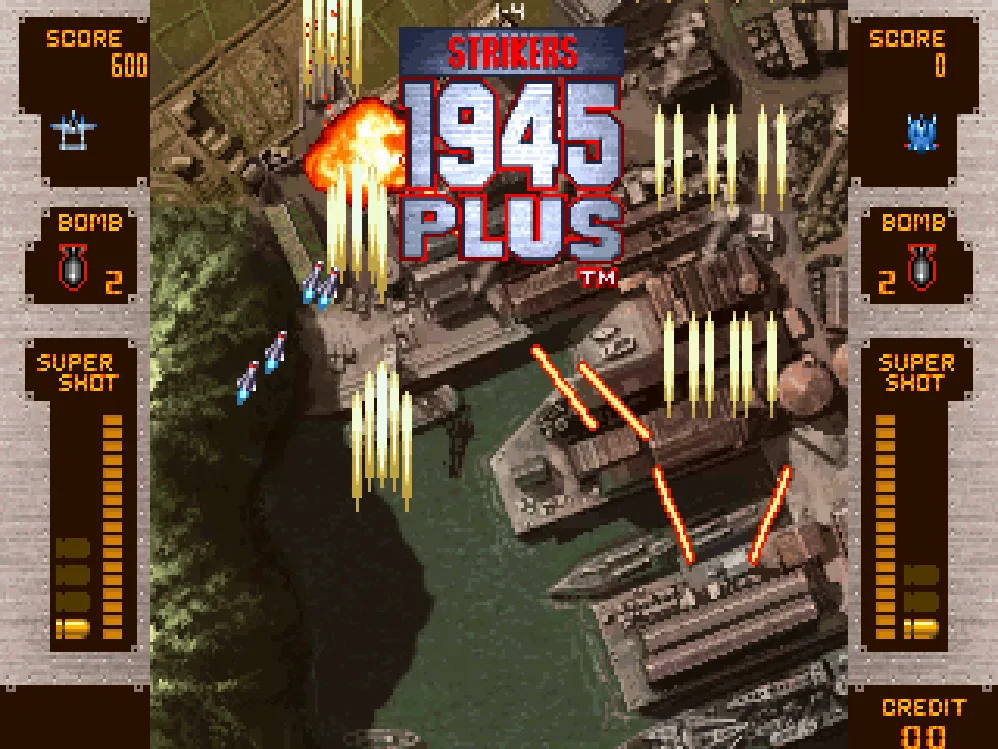
Neo Geo MVS cabinets used horizontal (4:3) screens, while the Strikers 1945 series was originally vertical. Psikyo's solution was creative: pillarboxing the game, displaying the gameplay on the left and a giant "STRIKERS" title and status info on the right (with 2P status in co-op). While this reduced the actual gameplay area, the UI design became a signature visual feature of the Plus version. The 2009 PSP port was criticized for lacking a vertical mode, and while the 2010 iOS version supported vertical display, it was panned for poor touch controls.
6.4 The Boss Assembly Show
The Level 7 Blockade boss—the giant robot that assembles before your eyes—is one of the most memorable in the series. When you think the level is over, the core appears, followed by mechanical arms, head, and weapons assembling in sequence... the process takes about 5 seconds, enough to leave first-time players stunned. Better yet, you can attack while it's assembling—it doesn't change the outcome much, but the feeling of "striking before the boss is ready" is incredibly satisfying.
6.5 The Alien Plot Reveal
The Strikers 1945 series never shied away from mixing WWII fighters with aliens. The original ended with a flight to the moon to fight aliens; the Plus ending reveals the F.G.R. base core is an alien organism. This "WWII pilot vs. Alien" setting, while logically shaky, perfectly fit the 1990s Japanese arcade aesthetic: fun gameplay beats logic every time.
6.6 Masaki Izutani's Musical Legacy
Composer Masaki Izutani's soundtrack for Strikers 1945 Plus is a masterpiece of Neo Geo-era shooter music. The Yamaha YM2610 chip offered 15 FM channels and 7 PCM channels, far superior to most contemporary boards. The score blends the grandeur of military marches with futuristic synth, perfectly matching the theme of "1940s fighters vs. future weapons."
6.7 The Lost Strikers 1950
There is an unconfirmed legend in the arcade scene: after Strikers 1945 Plus, Psikyo planned a sequel called Strikers 1950, moving the timeline to the Korean War and introducing early jets like the F-86 Sabre and MiG-15. It's said the project was shelved early on as Psikyo shifted to Gunbird 2. This rumor has never been officially confirmed but remains a staple of fan community lore. (Unconfirmed, community legend)
6.8 The Strikers Craze in Japanese Arcades
From 1999-2000, Strikers 1945 Plus sparked a shooter craze in Japanese arcades. According to Game Machine magazine, it ranked 16th in arcade revenue in March 2000—a very respectable figure for a shooter. More importantly, player retention was high: experienced players could 1CC it, but most players kept pumping in coins, creating stable, long-term revenue.