I. Game Background
1.1 World Setting
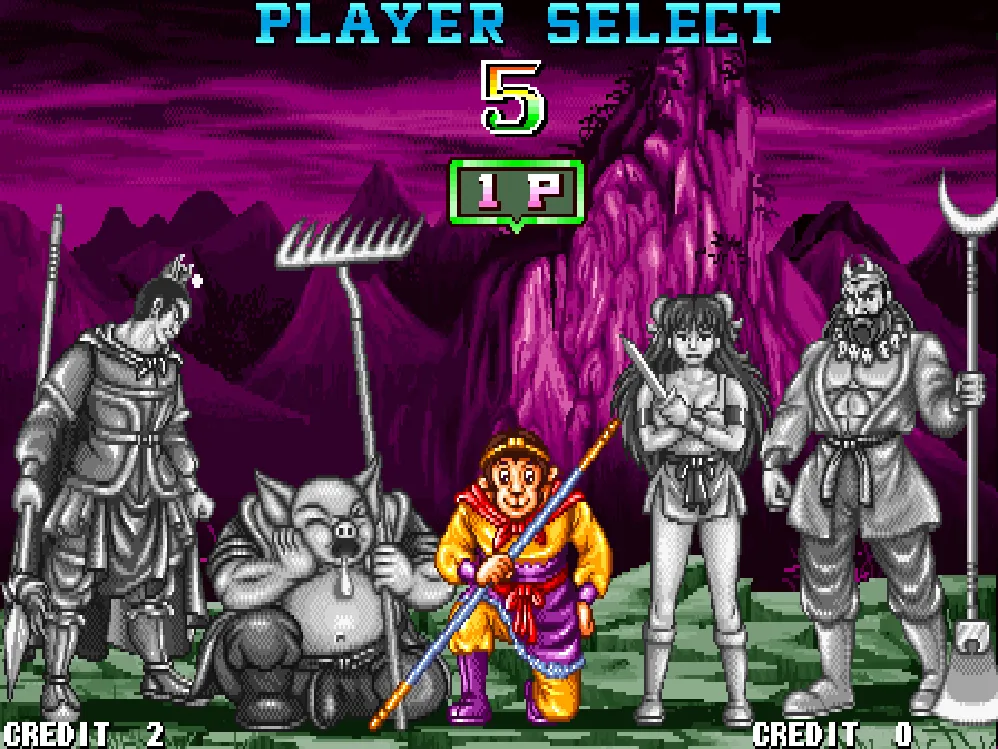
The story of Oriental Legend is directly adapted from one of the Four Great Classical Novels of Chinese literature, Journey to the West by Wu Cheng'en. The game follows the five pilgrims—Sun Wukong (The Monkey King), Zhu Bajie (Pigsy), Sha Wujing (Sandy), the Dragon Horse (the incarnation of the White Dragon Horse), and the Dragon Princess—as they face various demons and monsters on their quest to the West.
The game features a vast array of characters from Chinese mythology: the White Bone Demon, the Spider Demon, the Bull Demon King, Princess Iron Fan, Red Boy, King Gold Horn, King Silver Horn, the Yellow-Robed Monster, and the Golden-Winged Peng. Each boss retains their core characteristics from the original novel, reimagined as challenging side-scrolling stage bosses. The Bull Demon King’s immense strength, Princess Iron Fan’s wind-based magic, and Red Boy’s Samadhi Fire are all translated into unique combat mechanics.
Journey to the West is deeply woven into the cultural DNA of Chinese players. Every boss, every scene, and every magical item carries the weight of childhood memories for generations. When players in the arcade controlled Sun Wukong to swing his Golden Cudgel or unleash his 72 transformations, it wasn't just "playing a game"—it was a moment of cultural resonance and identity.
1.2 Development History
Oriental Legend was developed and published by the Taiwanese company IGS (International Games System) in 1997, running on IGS’s proprietary PolyGame Master (PGM) arcade hardware. IGS is one of the most iconic arcade developers in Taiwan and one of the few non-Japanese Asian companies to secure a significant foothold in the global arcade market.
Oriental Legend marked a major breakthrough for IGS in the side-scrolling beat-'em-up genre, which was previously dominated by Japanese giants like Capcom (Final Fight, Warriors of Fate). IGS’s strategy was to enter the market with a theme that Chinese players couldn't resist—not just any IP, but Journey to the West, a story every Chinese person knows by heart.
It is said that the development team drew heavily from the character designs and settings of the 1986 Journey to the West television series, while extracting rich material for enemies and magical items directly from the original novel. Released in 1997 in arcades across mainland China and Taiwan, the game was an instant sensation. In many arcades, Oriental Legend was one of the few games that could compete with The King of Fighters '97 for machine popularity. Its success led to the 1998 sequel Oriental Legend 2 and the 2004 Oriental Legend Super.
Oriental Legend also provided the crucial foundation for IGS’s later hit, Knights of Valour (1999). The two games share many system design concepts, such as item combinations, team-up attacks, and hidden treasures. It is no exaggeration to say that without Oriental Legend, there would be no Knights of Valour.
II. Character Profiles
2.1 Sun Wukong — The Almighty Monkey King
| Attribute | Rating |
|---|---|
| Strength | ★★★★ |
| Speed | ★★★★★ |
| Skills | ★★★★★ |
- Weapon: Golden Cudgel—Excellent attack range and hit detection.
- Magic: 72 Transformations (brief invincibility + displacement), Somersault Cloud (high-speed movement), Clone Technique (creates illusions).
- Pros: Highest mobility in the game, most versatile skill set, strongest combo potential.
- Cons: Low HP—a classic "glass cannon" character.
- Verdict: The most popular choice for experts. The range of the Golden Cudgel and fluid combo transitions give Sun Wukong an incredibly high skill ceiling. Pros can pull off dazzling combos—Somersault Cloud to reposition → Golden Cudgel sweep → 72 Transformations to escape → re-enter the fray. For beginners, however, his low HP is a constant risk.
2.2 Zhu Bajie — The Gluttonous Tank
| Attribute | Rating |
|---|---|
| Strength | ★★★★★ |
| Speed | ★★ |
| Skills | ★★★ |
- Weapon: Nine-Tooth Rake—High melee damage, larger range than the cudgel but significantly slower.
- Magic: Thick Skin (passive high defense), Gluttonous Devour (grapple move that drains enemy HP).
- Pros: Highest defense and HP in the game. The life-steal effect of Gluttonous Devour provides excellent sustainability in long battles.
- Cons: Slowest movement and attack speed.
- Verdict: The most beginner-friendly character. High HP + high defense + life-steal = very low risk of death. In multiplayer, he is an irreplaceable front-line tank—soaking up damage and creating a safe environment for teammates to attack.
2.3 Sha Wujing — The Silent, Reliable Support
| Attribute | Rating |
|---|---|
| Strength | ★★★★ |
| Speed | ★★★ |
| Skills | ★★★★ |
-
Weapon: Demon-Subduing Staff—Medium attack range, consistent damage.
-
Magic: Water Escape (sets water traps), Diamond Body (brief invincibility).
-
Pros: Balanced offense and defense; trap magic deals continuous damage during boss fights.
-
Cons: Well-rounded stats—lacks any explosive advantages.
-
Verdict: A balanced character. His water traps provide steady damage output during boss fights, even while you are dodging attacks. Diamond Body is a lifesaver in emergencies. He is the most reliable "second character"—a choice that never goes wrong in a team.
2.4 Dragon Horse — The White Dragon's Incarnation
| Attribute | Rating |
|---|---|
| Strength | ★★★ |
| Speed | ★★★★ |
| Skills | ★★★★ |
- Weapon: Dragon Tooth Sword—Fast attack speed, fluid combos.
- Magic: Dragon Soar (aerial dash), Ice Seal (freezes enemies).
- Pros: Speed second only to Sun Wukong; high mobility with aerial dash. Ice Seal is invaluable for crowd control during boss fights.
- Cons: Low HP, average defense.
- Verdict: A technical speedster. Ice Seal is one of the most important control skills in the game—freezing a boss at the start of a fight gives the whole team a safe window to attack. Solo play requires high skill, but he is an extremely valuable support character in a team.
2.5 Dragon Princess — The Mysterious Power
| Attribute | Rating |
|---|---|
| Strength | ★★ |
| Speed | ★★★ |
| Skills | ★★★★★ |
- Weapon: Dual Swords—Short range but fast speed.
- Magic: Nectar Healing (team heal), Heavenly Flower Scatter (full-screen attack), Guanyin Shield (defensive barrier).
- Pros: The only character with a team-wide healing skill. Highest magic attack power—Heavenly Flower Scatter is a screen-clearing powerhouse.
- Cons: Lowest HP and defense in the game; low single-hit physical damage.
- Verdict: A classic "glass cannon + healer" hybrid. In multiplayer, having a Dragon Princess means the team's sustainability is doubled. However, solo play is extremely challenging—requiring high-level positioning to compensate for her fragility.
III. Controls
3.1 Basic Controls
Uses the IGS standard 8-way joystick + 3-button layout:
| Button | Function |
|---|---|
| A | Attack |
| B | Jump |
| C | Use Magic/Item |
| A+B | Emergency Escape (consumes a small amount of HP to knock back enemies) |
| ↓↘→ + A | Character-specific Special Move (consumes energy) |
3.2 Magic and Item Combination System
The magic system is the game's signature feature and a core design element that IGS later perfected in Knights of Valour. Players can pick up various magical items from the original novel:
| Item | Origin | Effect |
|---|---|---|
| Banana Leaf Fan | Princess Iron Fan | Releases a massive gust of wind to blow away all enemies |
| Purple Gold Gourd | King Gold Horn | Sucks in enemies in front to deal heavy damage |
| Wind-Fixing Bead | Lingji Bodhisattva | Briefly grants immunity to wind attacks and knockback |
| Fire-Proof Cover | Moon Palace | Grants immunity to fire damage (crucial for Red Boy and Flaming Mountain) |
| Golden Headband | Buddha | Briefly traps the boss, creating a safe window for attacks |
Items appear as hidden objects in stages—usually behind walls or in treasure chests. Combining items is the key to advanced strategy: Banana Leaf Fan to blow them away → Purple Gold Gourd to suck them in → Golden Headband to trap them—a full combo leaves the boss helpless.
3.3 Team-Up Attacks
In multiplayer, two or more players standing together and unleashing their special moves simultaneously triggers a Team-Up Attack—dealing damage and covering a range far exceeding individual specials. The visual spectacle of these attacks (especially the Wukong + Bajie "Cudgel & Rake" combo) is one of the most memorable sights in the arcade.
IV. Stages and Boss Strategy
Stage Overview
| Stage | Setting | Boss | Strategy Tips |
|---|---|---|---|
| 1 | Five Elements Mountain | Tiger Power Immortal | Introductory stage; get familiar with controls and items. |
| 2 | Black Wind Mountain | Black Bear Demon | High attack power; let Bajie tank in the front. |
| 3 | White Bone Cave | White Bone Demon | Three transformations: Human → Skeleton → True Form. Attack patterns change completely each time. |
| 4 | Spider Cave | Spider Demon | Multiple bosses appear at once. Dragon Princess’s Heavenly Flower Scatter is great for clearing the screen. |
| 5 | Flaming Mountain | Red Boy + Bull Demon King | Red Boy’s fire covers large areas—Fire-Proof Cover is mandatory. After Red Boy, the Bull Demon King appears—use Dragon Princess’s Ice Seal to control him. |
| 6 | Lotus Cave | Gold Horn + Silver Horn | Two bosses at once—split up to handle them. Purple Gold Gourd has a special bonus effect here. |
| 7 | Great Thunder Monastery | Yellow-Robed Monster + Golden-Winged Peng | Fast speed and wide aerial range. Requires perfect team coordination. |
| 8 (Final) | Heavenly Palace | Buddha’s Trial | The "boss" is actually a test—survive for a set time to win. The ending reveals the entire journey was a final test for the pilgrims. |
V. Tips and Advanced Strategy
5.1 Survival Tips
- Don't hoard items: Items like the Banana Leaf Fan and Purple Gold Gourd are your strongest assets. Beginners often save them for the final boss and miss the best opportunities to use them—you can't reach the end without using resources.
- Use the emergency move: A+B costs HP, but the value of surviving when surrounded is far greater than the small amount of health lost.
- Team-up attacks are the strongest tool: Coordinate with teammates to trigger these for massive damage. Use them when a boss is below 30% HP to end the fight quickly.
- Memorize hidden item locations: Key items like the Fire-Proof Cover are hidden in specific stages—it's nearly impossible to clear the Flaming Mountain without it.
- Define roles: Bajie tanks, Wukong deals damage, Dragon Princess heals/supports, and Dragon Horse/Sha Wujing fill gaps. For solo play, Bajie is the best choice for survival.
5.2 Advanced Knowledge
- Five Elements Affinity: Some bosses have hidden elemental affinities. Fire items deal extra damage to Metal bosses. This is a deep system mastered through repeated play.
- Hidden Ending: It is rumored that clearing the final Buddha trial without taking any damage (extremely difficult) triggers a special hidden ending animation. This legend has circulated in the player community for years.
VI. Trivia and Arcade Legends
6.1 "An Arcade Game More Eastern Than the Japanese"
In 1997, when Capcom and SNK ruled the global arcade market, Oriental Legend was a "Chinese arcade game" in the truest sense. From the theme and art to the music and design, every detail was rooted in Chinese culture. For Chinese players, seeing Sun Wukong swing his cudgel wasn't just "another side-scroller"—it was a game of our own culture.
6.2 The Precursor to Knights of Valour
Oriental Legend (1997) and Knights of Valour (1999) share the same core design DNA—item combinations, team-up attacks, and hidden treasures. Oriental Legend served as the "testing ground" for IGS’s design philosophy, where many systems later perfected in Knights of Valour were first validated.
6.3 The PGM Legend
The PGM (PolyGame Master) was IGS’s self-developed arcade hardware. It is one of the few arcade platforms independently designed by a Chinese company. Games on the PGM—including Oriental Legend, Knights of Valour, and Photo Y2K—became staples in Chinese arcades, rivaling Japanese CPS/CPS2 boards. It proved that a Chinese company could carve out its own place in the global arcade market.