I. Game Background
1.1 Setting
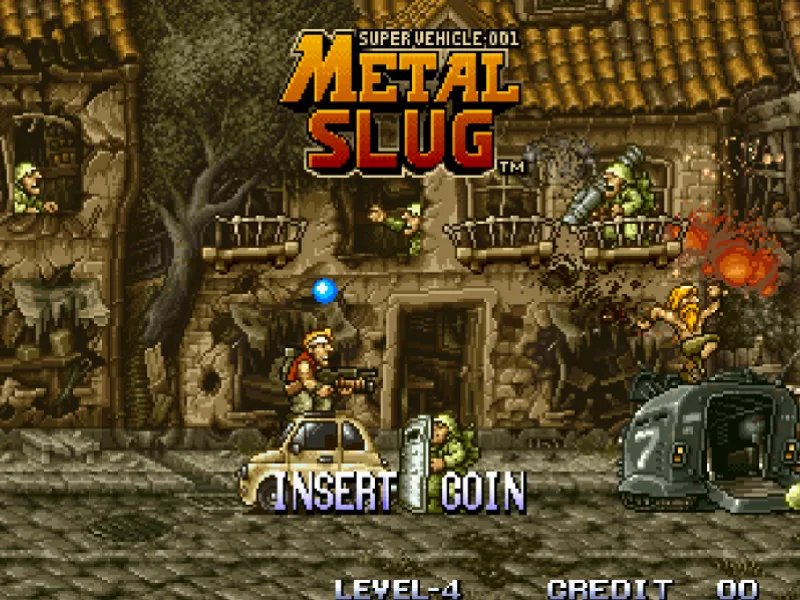
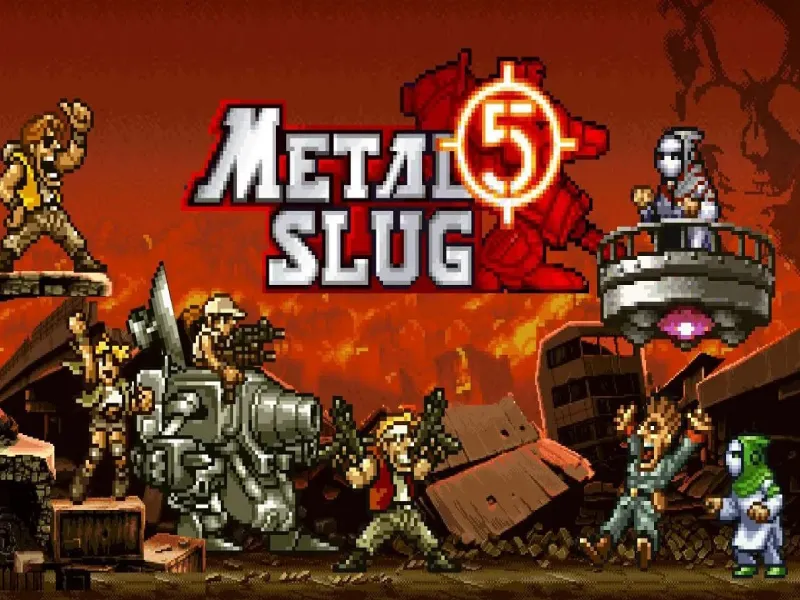
The story of Metal Slug 5 moves away from the "General Morden + Aliens" narrative that defined the first four entries, introducing a brand-new antagonist: the Ptolemaic Army.
A mysterious ancient relic—a device known as the "Metal Slug Project Core Data Disc"—is unearthed during an archaeological excavation. This disc contains deep secrets regarding the Metal Slug tank project and holds an unknown, immense power. The Ptolemaic Army, an underground military organization specializing in archaeology and intelligence, steals the disc and begins establishing strongholds across the globe.
The Peregrine Falcon Strike Force is tasked with tracking the Ptolemaic Army, leading them through battlefields across four continents—from South American jungles to the streets of New York, and from the Australian outback to Osaka, Japan. During the pursuit, a mysterious masked figure appears, seemingly the mastermind behind the Ptolemaic Army. When the regular army finally breaches the enemy's core base, the power of the data disc is unleashed, summoning a massive demon—a supernatural entity that must be fought with human weaponry.
The plot of this installment is entirely independent of the Morden-Alien narrative arc. The Ptolemaic Army would go on to become the third major antagonistic faction in the series.
1.2 Development History
The development background of Metal Slug 5 differs significantly from its predecessors.
Back in 2000, SNK officially went bankrupt and was acquired by ARUZE. After a series of capital restructurings, SNK Playmore was established in 2001, inheriting the original SNK's intellectual property. However, during this transition, much of the original core development team—the veterans of the Nazca era—had left the company.
Against this backdrop, Metal Slug 4 was outsourced to the Korean company Mega Enterprise in 2002, which resulted in poor reception. For Metal Slug 5, SNK Playmore handed development to Noise Factory, a company previously known for music production (having worked on the soundtrack for Metal Slug 3). The game was directed by Toru Hagihara, with music composed by Toshikazu Tanaka.
The development cycle was extremely tight, and the budget was far lower than previous titles. As a result, when Metal Slug 5 was released in Japanese arcades on November 13, 2003, it clearly bore the marks of significant cuts. The ROM data contains unused content: a fully designed giant Stone Turtle boss, a maskless instructor boss, an NPC comrade named "Achilles," and complete code for a flamethrower weapon—all of which were scrapped.
Despite its flaws, it remains the final Metal Slug entry on the Neo Geo MVS platform, marking a bittersweet but memorable end to the history of this legendary 2D hardware.
II. Character Introduction
In Metal Slug 5, the playable roster returns to the classic quartet. All four characters have identical performance stats.
2.1 Marco Rossi
Captain of the Peregrine Falcon Strike Force. Following the Morden wars and the alien invasions, Marco continues to lead the regular army's most elite squad. Facing the new Ptolemaic threat, his tactical experience remains the team's anchor.
2.2 Tarma Roving
Marco's lieutenant and an expert in vehicle operation and heavy weaponry. In this mission, Tarma must adapt to various new vehicles, including the wall-climbing Spider Slug. His reliable firepower is indispensable in any stage.
2.3 Eri Kasamoto
An ace operative of S.P.A.R.R.O.W.S. Eri is responsible for reconnaissance and infiltration, demonstrating exceptional solo combat capabilities, particularly in urban and indoor environments.
2.4 Fio Germi
An expert in medical and fire support for S.P.A.R.R.O.W.S. Fio's composure and precision provide an irreplaceable backbone during long, high-intensity battles.
III. Controls
3.1 Basic Controls
Continuing the series' standard layout:
| Button | Function |
|---|---|
| A | Shoot |
| B | Jump |
| C | Throw Grenade |
3.2 Universal Controls
| Action | Input | Description |
|---|---|---|
| Move | D-Pad | Move left/right, aim up/down |
| 8-Way Shooting | Direction + A | Fire in any direction |
| Crouch | Down | Duck to avoid high attacks |
| Jump Shoot | B then A | Horizontal shot in mid-air |
| Grenade | C | Parabolic throw, area damage |
| Melee | A (near enemy) | Knife attack, high damage |
| Eject Vehicle | A+B | Abandon vehicle with explosion, grants invincibility frames |
3.3 New Feature: Slide
Metal Slug 5 introduces a brand-new movement mechanic—the Slide:
| Action | Input | Description |
|---|---|---|
| Slide | Down + B (Jump while crouching) | Slide forward in a low stance while firing |
Sliding is the most controversial design in the game. It allows players to dodge bullets while maintaining fire, but the input overlaps with jumping. In situations requiring a jump, players often accidentally trigger a slide due to "holding down too long," causing them to slide off platforms to their death. This has been a frequent source of frustration among veteran players.
3.4 Dual-Wielding (New System)
This title introduces a dual-wielding system for the first time. In certain stages, players can hold two weapons simultaneously for more intense firepower. However, due to development constraints, this system was underutilized, and the scenarios where it can be experienced are extremely limited.
3.5 Vehicle System
| Vehicle | Description |
|---|---|
| SV-001 Metal Slug | Classic tank, main cannon + machine gun |
| Slug Flyer | Aerial combat aircraft |
| Slug Mariner | Underwater submarine |
| Spider Slug | New to this game; four-legged mech with vulcan cannon and harpoon, can climb walls |
| Slug Gunner | Bipedal mech, can perform melee punch attacks with spiked barrels |
| Car Slug | Armed car used in highway chase segments |
3.6 Weapon System
| Weapon | Icon | Effect |
|---|---|---|
| Handgun | - | Default weapon |
| Heavy Machine Gun | H | High-speed rapid fire |
| Rocket Launcher | R | Straight rocket, excellent against armor and bosses |
| Shotgun | S | Close-range fan spread |
| Iron Lizard | I | Armor-piercing projectile, hits multiple enemies |
| Laser Gun | L | Piercing laser beam |
Although the Flamethrower (F) exists in the code, it is not used in the actual game—another piece of evidence of cut content.
IV. Stage Walkthrough & Boss Guide
The game consists of 5 stages spanning four continents. There are a few branching paths, but far fewer than in Metal Slug 3.
Stage 1: South American Jungle
| Item | Details |
|---|---|
| Setting | Amazonian tropical jungle, ancient ruin entrance, river shallows |
| Boss | Giant Armed Helicopter—equipped with multi-tube rocket launchers and rotary machine guns |
| Strategy | The Ptolemaic soldiers make their debut. Their uniforms are primarily deep green and gold, with gear resembling modern military equipment but styled with ancient motifs. The pace is relatively gentle, perfect for getting used to the slide. You can crouch or jump to avoid the boss's rockets. Difficulty is moderate. |
Stage 2: New York Streets
| Item | Details |
|---|---|
| Setting | New York streets occupied by the Ptolemaic Army, subway stations, rooftops |
| Boss | Heavy Armored Train—equipped with flamethrowers and multi-directional missile arrays |
| Strategy | This stage features an urban battlefield, a rarity in the series. Enemy density in subway tunnels is high; use the slide to weave through. The Spider Slug is available for the first time—its wall-climbing ability is extremely useful in the urban architecture. |
Stage 3: Australian Outback
| Item | Details |
|---|---|
| Setting | Australian desert, abandoned mines, underground caves |
| Boss | Giant Drilling Mech—equipped with impact drills and seismic wave generators |
| Strategy | Ptolemaic heavy armor units appear in the desert terrain. The Car Slug can be used during the highway chase. The boss's seismic wave attack has a wide range; keep jumping to avoid it. |
Stage 4: Osaka Stronghold
| Item | Details |
|---|---|
| Setting | Ptolemaic outpost in Osaka, Japan; industrial zones; underground labs |
| Boss | Flying Armed Platform—equipped with tracking missiles and Gatling gun arrays |
| Strategy | This stage feels the most like a "classic Metal Slug" level—dense waves of enemies, narrow indoor corridors, and multi-layered platforming. The Slug Gunner's punch attack is highly effective in indoor combat—it can one-shot most regular enemies. |
Stage 5: Final Base
| Item | Details |
|---|---|
| Setting | Ptolemaic core base, data disc altar, site of the demon's descent |
| Boss | Ancient Demon—a supernatural entity summoned by the disc, capable of full-screen attacks |
| Strategy | The style of the final stage is completely different from the first four, shifting from military conflict to supernatural battle. The boss is a massive demonic creature with attacks including energy barrages, ground shockwaves, and minion summoning. After defeating it, the demon is forced to leave Earth, and the disc is recovered. This boss fight is one of the most controversial in the series due to its "abrupt shift in art style"—some praise its visual impact, while others question its lack of cohesion with the series' aesthetic. |
V. Tips & Advanced Strategy
5.1 Basic Survival Tips
- Break the habit of accidental slides: Strictly separate "Down" and "Jump" inputs. When at the edge of a platform, release the down direction before pressing jump—otherwise, sliding off the edge is the most common way for beginners to die.
- The Spider Slug is a god-tier vehicle: Its wall-climbing ability allows you to stand on walls where enemies cannot reach you, making it especially useful in the New York and Osaka stages.
- Don't ignore the Slug Gunner's melee punch: It can one-shot regular grunts and is highly efficient for clearing paths.
- Enemy density is lower than in MS3, but attack patterns are more precise—meaning every single enemy is a genuine threat rather than "background noise." Do not underestimate any single soldier.
5.2 Boss Battle Rules
- Boss bullet patterns are more restrained than in MS3, but tracking is more aggressive—don't rely on standing still and firing.
- The final demon boss's art style shift means its attack patterns are more like a traditional side-scrolling game's final boss rather than a mechanical Metal Slug boss—approach it like a fighting game boss (observe, dodge, look for windows of opportunity).
- All bosses have clear telegraphs for their attacks—patience and observation are more effective than blind firing.
5.3 Advanced Knowledge
- You can continue firing while sliding, making "sliding through bullet barrages" a signature move for pros—but it requires extremely precise timing.
- Dual-wielding is rare but doubles your firepower. Treasure every opportunity to dual-wield and try to save it for boss fights.
- The cut content (Flamethrower, Stone Turtle boss, NPC Achilles) is sometimes restored in community-made ROM hacks—for hardcore players, exploring these "unfinished legacies" is a joy in itself.
VI. Trivia & Arcade Legends
6.1 The "Other" Metal Slug after SNK's Bankruptcy
Metal Slug 5 is a "post-SNK" product. During the restructuring after the original SNK went bankrupt in 2000, many Nazca veterans left. This explains why MS4 and MS5 have subtle differences in style compared to the first three—they were not made by the same group of people. For veterans, MS1-3 are the "Nazca Trilogy," while MS4 and beyond represent the "SNK Playmore Era." Fans sometimes refer to it as the "other" Metal Slug.
6.2 The Ptolemaic Army—A Concept That Didn't Shine
The concept of the Ptolemaic Army had potential: a military organization focused on archaeology and intelligence, seeking ancient relics to harness their power. This combined military themes with occult elements, which could have led to imaginative enemy designs and stage themes. Due to development constraints, however, they ended up feeling like "reskinned Morden soldiers," and their core archaeological/occult identity wasn't fully realized. It wasn't until SNK introduced them in the mobile spin-off Metal Slug Attack that they received more background and character development.
6.3 The Forgotten Flame—It's in the Code
Metal Slug 5's ROM data contains complete code for the Flamethrower, but the weapon never appears in the game. The community consensus is that "someone forgot to put it in." Whether this was a late-stage oversight or intentional, a fully coded weapon being left out of the final ROM is a silent testament to the game's development state.
6.4 Achilles—On the Poster, Not in the Game
Promotional posters featured an NPC with a wild pompadour hairstyle and an armed car. In the ROM code, this character is named "Achilles" and was designed to be an auxiliary NPC who fights alongside the player, similar to Hyakutaro Ichimonji in Metal Slug 2. He never appeared in the actual game. Along with him disappeared the armed car from the poster—while the Car Slug did make it into the game, it wasn't the one from the poster.
6.5 Two Missing Bosses
ROM data analysis shows that at least two boss fights were deleted from the final product: one against a giant Stone Turtle and another against the maskless final instructor, who was to ride a massive mechanical pillar. The Stone Turtle boss actually has complete sprite data, indicating its development was nearly finished. This is a significant loss for a game that only has 5 stages.
6.6 The "Metal Slug Church" in New Zealand
Metal Slug 5 has a unique history in New Zealand in 2003. A local arcade owner loved the series so much that he dedicated a cabinet specifically to Metal Slug 5 and allowed children to play at half price. The local community called the place the "Metal Slug Church" because, after school, children would flock to the arcade with the same devotion as going to church. This story was rediscovered in the 2010s through a New Zealand gamer's blog, becoming a heartwarming page in the series' fan culture.
6.7 The Last Neo Geo Metal Slug
Metal Slug 5 was the final new Metal Slug entry on the Neo Geo MVS/AES platform. Afterward, the main series moved to Atomiswave (MS6) and more modern platforms. The story of Neo Geo and Metal Slug, from the 1996 original to the 2003 fifth installment—spanning seven years—came to an end. While it wasn't a perfect period, it was a definitive one.
FAQ
Q1: Is there any plot connection between Metal Slug 5 and the previous four games?
Q2: Why is Metal Slug 5 rated lower than its predecessors?
Q3: Is the slide mechanic actually good?
Q4: What happened to the Ptolemaic Army later?
Q5: Is there a way to play the cut content?
Q6: Which is better, Metal Slug 5 or Metal Slug 4?
Q7: How can I play Metal Slug 5 at home?
- Switch / PS4 / Xbox One: Purchase the official ACA NEOGEO port.
- Emulators: Use FinalBurn Neo or MAME to load the ROM.
- Collections: *Metal Slug Anthology* (PSP/PS2/Wii) includes the entire series from 1-6.